Mario Miniati, Laura Palagini, Giulia Righi, Donatella Marazziti
{"title":"Cognitive-Behavioral Therapy for Patients with Coronary Artery Disease and Depression: A Systematic Review.","authors":"Mario Miniati, Laura Palagini, Giulia Righi, Donatella Marazziti","doi":"10.36131/cnfioritieditore20250103","DOIUrl":null,"url":null,"abstract":"<p><strong>Objective: </strong>Objective of this review is to summarize current knowledge on Cognitive Behavioural Therapy (CBT), as treatment for depression in coronary artery disease (CAD).</p><p><strong>Method: </strong>A systematic search was conducted on the PUBMED database for the last ten years, in accordance with the PRISMA guidelines, following PICOS criteria, and applying specific queries in the <i>'PubMed Advanced Search Builder</i>'.</p><p><strong>Results: </strong>Twenty-one studies were selected and included in the systematic review, with a total number of 2498 patients enrolled, excluding patient samples analysed multiple times, with results published in different papers. The mean/SD age of the enrolled patients was 56.9±7.7 years (range: 30.3-63.0). The mean/SD number of scales used was 4.2±2.0 (range: 2-9). The psychological intervention included CBT in 8/21 (38.1%) studies, Internet-Delivered CBT (I-CBT) in 8/21 (38.1%), and CBT + Activity in 1/21 (4.8%) Monitor (AM), 1/21 (4.8%) Stress Management CBT-based, 1/21 (4.8%) CBT-WBT Sequential Approach, 1/21 (4.8%) e-IMPACT CBT (CBT delivered via internet o' by phone'), 1/21 (4.8%) Group-CBT. The control groups underwent 'treatment as usual' (TAU) in 5/21 (23.8%) studies, <i>'online discussion forum'</i> (ODF) in 5/21 (23.8%) studies, <i>'clinical management'</i> (CM) in 4/21 (19.0%) studies, pharmacological treatment with SSRIs (2/21; 9.5%), <i>'waiting list condition'</i> (WLC), <i>'educational support'</i> or <i>'simple monitoring'</i> in the remaining 4/21 (19.0%) studies; in one study (4.8%), this information was not available.</p><p><strong>Conclusions: </strong>Efficacy of CBT as a treatment for depressive syndromes in patients with CD is still under discussion, partly due to the heterogeneity of the outcome measures, partly due to methodological issues, such as therapist supervision and allegiance. CBT seems to be irrelevant to biological variables, such as inflammatory markers and heart rate variability and not ever superior to other interventions, in the treatment of depressive symptoms.</p>","PeriodicalId":46700,"journal":{"name":"Clinical Neuropsychiatry","volume":"22 1","pages":"19-39"},"PeriodicalIF":2.4000,"publicationDate":"2025-02-01","publicationTypes":"Journal Article","fieldsOfStudy":null,"isOpenAccess":false,"openAccessPdf":"https://www.ncbi.nlm.nih.gov/pmc/articles/PMC11956883/pdf/","citationCount":"0","resultStr":null,"platform":"Semanticscholar","paperid":null,"PeriodicalName":"Clinical Neuropsychiatry","FirstCategoryId":"1085","ListUrlMain":"https://doi.org/10.36131/cnfioritieditore20250103","RegionNum":0,"RegionCategory":null,"ArticlePicture":[],"TitleCN":null,"AbstractTextCN":null,"PMCID":null,"EPubDate":"","PubModel":"","JCR":"Q3","JCRName":"CLINICAL NEUROLOGY","Score":null,"Total":0}
引用次数: 0
Abstract
Objective: Objective of this review is to summarize current knowledge on Cognitive Behavioural Therapy (CBT), as treatment for depression in coronary artery disease (CAD).
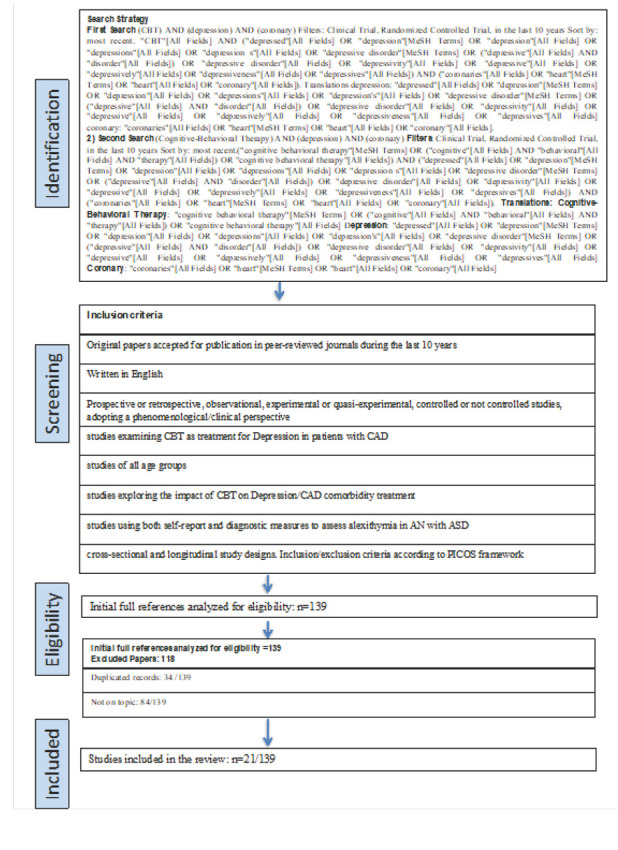
Method: A systematic search was conducted on the PUBMED database for the last ten years, in accordance with the PRISMA guidelines, following PICOS criteria, and applying specific queries in the 'PubMed Advanced Search Builder'.
Results: Twenty-one studies were selected and included in the systematic review, with a total number of 2498 patients enrolled, excluding patient samples analysed multiple times, with results published in different papers. The mean/SD age of the enrolled patients was 56.9±7.7 years (range: 30.3-63.0). The mean/SD number of scales used was 4.2±2.0 (range: 2-9). The psychological intervention included CBT in 8/21 (38.1%) studies, Internet-Delivered CBT (I-CBT) in 8/21 (38.1%), and CBT + Activity in 1/21 (4.8%) Monitor (AM), 1/21 (4.8%) Stress Management CBT-based, 1/21 (4.8%) CBT-WBT Sequential Approach, 1/21 (4.8%) e-IMPACT CBT (CBT delivered via internet o' by phone'), 1/21 (4.8%) Group-CBT. The control groups underwent 'treatment as usual' (TAU) in 5/21 (23.8%) studies, 'online discussion forum' (ODF) in 5/21 (23.8%) studies, 'clinical management' (CM) in 4/21 (19.0%) studies, pharmacological treatment with SSRIs (2/21; 9.5%), 'waiting list condition' (WLC), 'educational support' or 'simple monitoring' in the remaining 4/21 (19.0%) studies; in one study (4.8%), this information was not available.
Conclusions: Efficacy of CBT as a treatment for depressive syndromes in patients with CD is still under discussion, partly due to the heterogeneity of the outcome measures, partly due to methodological issues, such as therapist supervision and allegiance. CBT seems to be irrelevant to biological variables, such as inflammatory markers and heart rate variability and not ever superior to other interventions, in the treatment of depressive symptoms.




 京公网安备 11010802042870号
京ICP备2023020795号-1
京公网安备 11010802042870号
京ICP备2023020795号-1

 分享
分享
 求助内容:
求助内容: 应助结果提醒方式:
 扫码关注我们
