Juan Sun , Jiangtao Yang , Jiakun Guo , Lei Tao , Bin Xu , Guanglin Wang , Fenghua Meng , Zhiyuan Zhong
{"title":"Dual-targeted alpha therapy mitigates prostate cancer and boosts immune checkpoint blockade therapy","authors":"Juan Sun , Jiangtao Yang , Jiakun Guo , Lei Tao , Bin Xu , Guanglin Wang , Fenghua Meng , Zhiyuan Zhong","doi":"10.1016/j.jconrel.2025.113686","DOIUrl":null,"url":null,"abstract":"<div><div>Alpha radionuclide with a high emitting energy and short emitting range has emerged as a new tool for the treatment of advanced tumors; however, its clinical usage stringently depends on delivery vehicle. Here, we report on Sigma-1 receptor and PSMA dual-specific peptide with efficient 225‑actinium labeling (<sup>225</sup>Ac-S1R/PSMA-P) for targeted alpha therapy and alpha-immunotherapy of murine prostate tumor. <sup>225</sup>Ac-S1R/PSMA-P with a high specific activity and radiostability exhibited upgraded cell binding and uptake while diminished efflux in RM1-PSMA<sup>+</sup> cancer cells. Intriguingly, <sup>225</sup>Ac-S1R/PSMA-P afforded a peak uptake of 34.7 ± 3.2 %ID/g and elevated the radioactivity in the tumor over 7 days, with a tumor/kidney ratio of 12.2 ± 1.2 and minimal deposition in blood and other normal tissues like liver and muscle. A single injection of <sup>225</sup>Ac-S1R/PSMA-P effectively shrank large LNCaP-FGC tumors at 1.85 or 5.5 kBq, and completely eradicated highly malignant murine RM1-PSMA<sup>+</sup>/RM1 tumors at 33.3 kBq. We further showed that <sup>225</sup>Ac-S1R/PSMA-P at a low dose of 3.7 kBq could boost immune checkpoint blockade therapy of murine RM1-PSMA<sup>+</sup>/RM1 tumor, leading to 5 out of 7 mice tumor-free that showed durable antitumor immune memory. <sup>225</sup>Ac-S1R/PSMA-P with excellent targeting and immune activation ability has a great clinical potential for treating advanced prostate cancer patients.</div></div>","PeriodicalId":15450,"journal":{"name":"Journal of Controlled Release","volume":"382 ","pages":"Article 113686"},"PeriodicalIF":11.5000,"publicationDate":"2025-06-10","publicationTypes":"Journal Article","fieldsOfStudy":null,"isOpenAccess":false,"openAccessPdf":"","citationCount":"0","resultStr":null,"platform":"Semanticscholar","paperid":null,"PeriodicalName":"Journal of Controlled Release","FirstCategoryId":"3","ListUrlMain":"https://www.sciencedirect.com/science/article/pii/S0168365925003062","RegionNum":1,"RegionCategory":"医学","ArticlePicture":[],"TitleCN":null,"AbstractTextCN":null,"PMCID":null,"EPubDate":"2025/4/3 0:00:00","PubModel":"Epub","JCR":"Q1","JCRName":"CHEMISTRY, MULTIDISCIPLINARY","Score":null,"Total":0}
引用次数: 0
Abstract
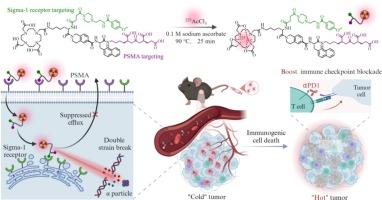
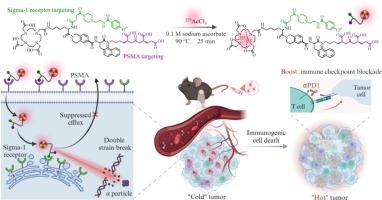
Alpha radionuclide with a high emitting energy and short emitting range has emerged as a new tool for the treatment of advanced tumors; however, its clinical usage stringently depends on delivery vehicle. Here, we report on Sigma-1 receptor and PSMA dual-specific peptide with efficient 225‑actinium labeling (225Ac-S1R/PSMA-P) for targeted alpha therapy and alpha-immunotherapy of murine prostate tumor. 225Ac-S1R/PSMA-P with a high specific activity and radiostability exhibited upgraded cell binding and uptake while diminished efflux in RM1-PSMA+ cancer cells. Intriguingly, 225Ac-S1R/PSMA-P afforded a peak uptake of 34.7 ± 3.2 %ID/g and elevated the radioactivity in the tumor over 7 days, with a tumor/kidney ratio of 12.2 ± 1.2 and minimal deposition in blood and other normal tissues like liver and muscle. A single injection of 225Ac-S1R/PSMA-P effectively shrank large LNCaP-FGC tumors at 1.85 or 5.5 kBq, and completely eradicated highly malignant murine RM1-PSMA+/RM1 tumors at 33.3 kBq. We further showed that 225Ac-S1R/PSMA-P at a low dose of 3.7 kBq could boost immune checkpoint blockade therapy of murine RM1-PSMA+/RM1 tumor, leading to 5 out of 7 mice tumor-free that showed durable antitumor immune memory. 225Ac-S1R/PSMA-P with excellent targeting and immune activation ability has a great clinical potential for treating advanced prostate cancer patients.
期刊介绍:
The Journal of Controlled Release (JCR) proudly serves as the Official Journal of the Controlled Release Society and the Japan Society of Drug Delivery System.
Dedicated to the broad field of delivery science and technology, JCR publishes high-quality research articles covering drug delivery systems and all facets of formulations. This includes the physicochemical and biological properties of drugs, design and characterization of dosage forms, release mechanisms, in vivo testing, and formulation research and development across pharmaceutical, diagnostic, agricultural, environmental, cosmetic, and food industries.
Priority is given to manuscripts that contribute to the fundamental understanding of principles or demonstrate the advantages of novel technologies in terms of safety and efficacy over current clinical standards. JCR strives to be a leading platform for advancements in delivery science and technology.



 京公网安备 11010802042870号
京ICP备2023020795号-1
京公网安备 11010802042870号
京ICP备2023020795号-1

 分享
分享
 求助内容:
求助内容: 应助结果提醒方式:
 扫码关注我们
