Xionghao Xu, Bo Zhao, Tao Jiang, Nan Yi, Chunhua Fan, Juyoung Yoon, Zhengliang Lu
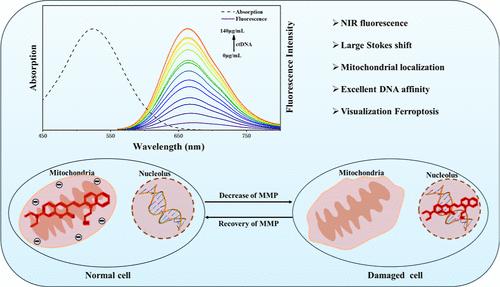
{"title":"Monitoring Ferroptosis with NIR Fluorescence Probe Capable of Reversible Mitochondria Nucleus Translocation","authors":"Xionghao Xu, Bo Zhao, Tao Jiang, Nan Yi, Chunhua Fan, Juyoung Yoon, Zhengliang Lu","doi":"10.1021/acs.analchem.4c07121","DOIUrl":null,"url":null,"abstract":"Ferroptosis, a recently proposed form of regulated cell death, is characterized by a surge in reactive oxygen species and a subsequent depletion of glutathione. The mitochondria and nucleoli play pivotal roles in the process of ferroptosis. Therefore, monitoring the interactions between mitochondria and the nucleoli during ferroptosis is crucial for clarifying its physiological and pathological processes. In this study, we designed and synthesized the near-infrared fluorescence probe <b>MINU</b>, which exhibits excellent stability against biological ions and physiological pH environments. Due to its cationic structure and good DNA affinity, <b>MINU</b> can target both mitochondria and the nucleoli. Cell imaging demonstrates that <b>MINU</b> can reversibly migrate between the mitochondria and the nucleoli in response to changes in mitochondrial membrane potential. By detecting the localization and intensity of fluorescence signals, we can effectively distinguish between normal cell, apoptotic cell, and ferroptotic cell. Monitoring the interactions between mitochondria and the nucleoli allows us to more accurately appreciate the biological processes of ferroptosis.","PeriodicalId":27,"journal":{"name":"Analytical Chemistry","volume":"3 1","pages":""},"PeriodicalIF":6.7000,"publicationDate":"2025-04-02","publicationTypes":"Journal Article","fieldsOfStudy":null,"isOpenAccess":false,"openAccessPdf":"","citationCount":"0","resultStr":null,"platform":"Semanticscholar","paperid":null,"PeriodicalName":"Analytical Chemistry","FirstCategoryId":"92","ListUrlMain":"https://doi.org/10.1021/acs.analchem.4c07121","RegionNum":1,"RegionCategory":"化学","ArticlePicture":[],"TitleCN":null,"AbstractTextCN":null,"PMCID":null,"EPubDate":"","PubModel":"","JCR":"Q1","JCRName":"CHEMISTRY, ANALYTICAL","Score":null,"Total":0}
引用次数: 0
Abstract
Ferroptosis, a recently proposed form of regulated cell death, is characterized by a surge in reactive oxygen species and a subsequent depletion of glutathione. The mitochondria and nucleoli play pivotal roles in the process of ferroptosis. Therefore, monitoring the interactions between mitochondria and the nucleoli during ferroptosis is crucial for clarifying its physiological and pathological processes. In this study, we designed and synthesized the near-infrared fluorescence probe MINU, which exhibits excellent stability against biological ions and physiological pH environments. Due to its cationic structure and good DNA affinity, MINU can target both mitochondria and the nucleoli. Cell imaging demonstrates that MINU can reversibly migrate between the mitochondria and the nucleoli in response to changes in mitochondrial membrane potential. By detecting the localization and intensity of fluorescence signals, we can effectively distinguish between normal cell, apoptotic cell, and ferroptotic cell. Monitoring the interactions between mitochondria and the nucleoli allows us to more accurately appreciate the biological processes of ferroptosis.
期刊介绍:
Analytical Chemistry, a peer-reviewed research journal, focuses on disseminating new and original knowledge across all branches of analytical chemistry. Fundamental articles may explore general principles of chemical measurement science and need not directly address existing or potential analytical methodology. They can be entirely theoretical or report experimental results. Contributions may cover various phases of analytical operations, including sampling, bioanalysis, electrochemistry, mass spectrometry, microscale and nanoscale systems, environmental analysis, separations, spectroscopy, chemical reactions and selectivity, instrumentation, imaging, surface analysis, and data processing. Papers discussing known analytical methods should present a significant, original application of the method, a notable improvement, or results on an important analyte.



 京公网安备 11010802042870号
京ICP备2023020795号-1
京公网安备 11010802042870号
京ICP备2023020795号-1

 分享
分享
 求助内容:
求助内容: 应助结果提醒方式:
 扫码关注我们
