Sanghyuk Lee, Seungwon Shim, Hyunwoo Jang, Jae Kyeong Jeong and Youngho Kang
{"title":"Carrier-generation mechanism in Zn-doped In2O3 transparent conductors†","authors":"Sanghyuk Lee, Seungwon Shim, Hyunwoo Jang, Jae Kyeong Jeong and Youngho Kang","doi":"10.1039/D5CP00408J","DOIUrl":null,"url":null,"abstract":"<p >Zn-doped In<small><sub>2</sub></small>O<small><sub>3</sub></small> (IZO) has been extensively studied as a transparent conducting oxide (TCO) due to its favorable optical and electrical characteristics. In this work, to uncover the origin of degenerate n-type doping in IZO, we investigated point defects using density functional theory (DFT) calculations. Among the two possible configurations of Zn dopants, namely interstitial (Zn<small><sub>i</sub></small>) and substitutional Zn(Zn<small><sub>In</sub></small>), Zn<small><sub>In</sub></small> is found to be energetically more favorable. While Zn<small><sub>In</sub></small> acts as an acceptor, potentially compensating for n-type doping, it readily forms a defect complex, Zn<small><sub>In</sub></small>–V<small><sub>O</sub></small>, by combining with oxygen vacancies (V<small><sub>O</sub></small>s), the dominant intrinsic defects in In<small><sub>2</sub></small>O<small><sub>3</sub></small>. This defect complex exhibits a substantial binding energy of approximately 1 eV and functions as a shallow donor. By evaluating carrier concentrations that can occur in IZO films, we demonstrate that the formation of Zn<small><sub>In</sub></small>–V<small><sub>O</sub></small> is critical to maintaining or even enhancing significant n-type conductivities of IZO. By elucidating the doping behavior of IZO, this work provides critical insights to optimize its properties, thereby helping the advancement of optoelectronic and energy devices where IZO serves as a vital TCO.</p>","PeriodicalId":99,"journal":{"name":"Physical Chemistry Chemical Physics","volume":" 17","pages":" 8764-8770"},"PeriodicalIF":2.9000,"publicationDate":"2025-04-02","publicationTypes":"Journal Article","fieldsOfStudy":null,"isOpenAccess":false,"openAccessPdf":"https://pubs.rsc.org/en/content/articlepdf/2025/cp/d5cp00408j?page=search","citationCount":"0","resultStr":null,"platform":"Semanticscholar","paperid":null,"PeriodicalName":"Physical Chemistry Chemical Physics","FirstCategoryId":"92","ListUrlMain":"https://pubs.rsc.org/en/content/articlelanding/2025/cp/d5cp00408j","RegionNum":3,"RegionCategory":"化学","ArticlePicture":[],"TitleCN":null,"AbstractTextCN":null,"PMCID":null,"EPubDate":"","PubModel":"","JCR":"Q3","JCRName":"CHEMISTRY, PHYSICAL","Score":null,"Total":0}
引用次数: 0
Abstract
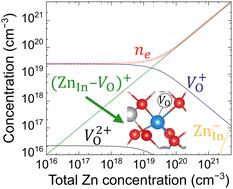
Zn-doped In2O3 (IZO) has been extensively studied as a transparent conducting oxide (TCO) due to its favorable optical and electrical characteristics. In this work, to uncover the origin of degenerate n-type doping in IZO, we investigated point defects using density functional theory (DFT) calculations. Among the two possible configurations of Zn dopants, namely interstitial (Zni) and substitutional Zn(ZnIn), ZnIn is found to be energetically more favorable. While ZnIn acts as an acceptor, potentially compensating for n-type doping, it readily forms a defect complex, ZnIn–VO, by combining with oxygen vacancies (VOs), the dominant intrinsic defects in In2O3. This defect complex exhibits a substantial binding energy of approximately 1 eV and functions as a shallow donor. By evaluating carrier concentrations that can occur in IZO films, we demonstrate that the formation of ZnIn–VO is critical to maintaining or even enhancing significant n-type conductivities of IZO. By elucidating the doping behavior of IZO, this work provides critical insights to optimize its properties, thereby helping the advancement of optoelectronic and energy devices where IZO serves as a vital TCO.
期刊介绍:
Physical Chemistry Chemical Physics (PCCP) is an international journal co-owned by 19 physical chemistry and physics societies from around the world. This journal publishes original, cutting-edge research in physical chemistry, chemical physics and biophysical chemistry. To be suitable for publication in PCCP, articles must include significant innovation and/or insight into physical chemistry; this is the most important criterion that reviewers and Editors will judge against when evaluating submissions.
The journal has a broad scope and welcomes contributions spanning experiment, theory, computation and data science. Topical coverage includes spectroscopy, dynamics, kinetics, statistical mechanics, thermodynamics, electrochemistry, catalysis, surface science, quantum mechanics, quantum computing and machine learning. Interdisciplinary research areas such as polymers and soft matter, materials, nanoscience, energy, surfaces/interfaces, and biophysical chemistry are welcomed if they demonstrate significant innovation and/or insight into physical chemistry. Joined experimental/theoretical studies are particularly appreciated when complementary and based on up-to-date approaches.





 京公网安备 11010802042870号
京ICP备2023020795号-1
京公网安备 11010802042870号
京ICP备2023020795号-1

 分享
分享
 求助内容:
求助内容: 应助结果提醒方式:
 扫码关注我们
