Alicia Llorente, Gurpreet K. Arora, Rabi Murad, Brooke M. Emerling
{"title":"Phosphoinositide kinases in cancer: from molecular mechanisms to therapeutic opportunities","authors":"Alicia Llorente, Gurpreet K. Arora, Rabi Murad, Brooke M. Emerling","doi":"10.1038/s41568-025-00810-1","DOIUrl":null,"url":null,"abstract":"Phosphoinositide kinases, extending beyond the well-known phosphoinositide 3-kinase (PI3K), are key players in the dynamic and site-specific phosphorylation of lipid phosphoinositides. Unlike PI3Ks, phosphatidylinositol 4-kinases (PI4Ks) and phosphatidylinositol phosphate kinases (PIPKs) do not usually exhibit mutational alterations, but mostly show altered expression in tumours, orchestrating a broad spectrum of signalling, metabolic and immune processes, all of which are crucial in the pathogenesis of cancer. Dysregulation of PI4Ks and PIPKs has been associated with various malignancies, which has sparked considerable interest towards their therapeutic targeting. In this Review we summarize the current understanding of the lesser-studied phosphoinositide kinase families, PI4K and PIPK, focusing on their functions and relevance in cancer. In addition, we provide an overview of ongoing efforts driving the preclinical and clinical development of phosphoinositide kinase-targeting molecules. In this Review, Emerling and colleagues summarize the roles of phosphatidylinositol 4-kinases (PI4Ks) and phosphatidylinositol phosphate kinases (PIPKs) in cancer. They highlight the altered expression of these kinases in tumours and discuss ongoing efforts in developing therapies targeting these lesser-studied phosphoinositide kinase families.","PeriodicalId":19055,"journal":{"name":"Nature Reviews Cancer","volume":"25 6","pages":"463-487"},"PeriodicalIF":66.8000,"publicationDate":"2025-04-03","publicationTypes":"Journal Article","fieldsOfStudy":null,"isOpenAccess":false,"openAccessPdf":"","citationCount":"0","resultStr":null,"platform":"Semanticscholar","paperid":null,"PeriodicalName":"Nature Reviews Cancer","FirstCategoryId":"3","ListUrlMain":"https://www.nature.com/articles/s41568-025-00810-1","RegionNum":1,"RegionCategory":"医学","ArticlePicture":[],"TitleCN":null,"AbstractTextCN":null,"PMCID":null,"EPubDate":"","PubModel":"","JCR":"Q1","JCRName":"ONCOLOGY","Score":null,"Total":0}
引用次数: 0
Abstract
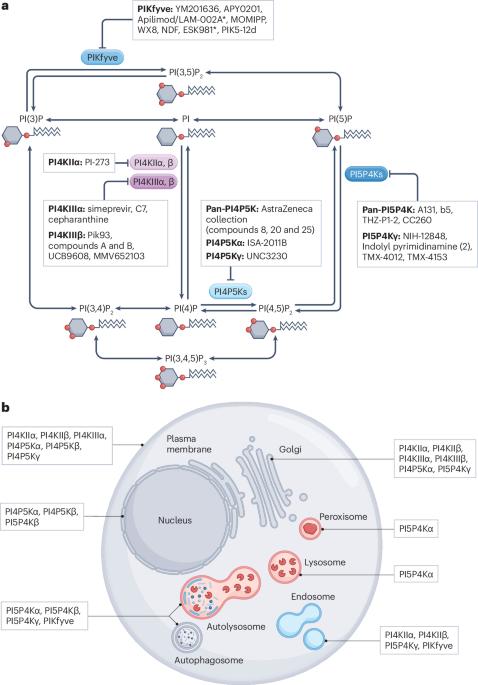
Phosphoinositide kinases, extending beyond the well-known phosphoinositide 3-kinase (PI3K), are key players in the dynamic and site-specific phosphorylation of lipid phosphoinositides. Unlike PI3Ks, phosphatidylinositol 4-kinases (PI4Ks) and phosphatidylinositol phosphate kinases (PIPKs) do not usually exhibit mutational alterations, but mostly show altered expression in tumours, orchestrating a broad spectrum of signalling, metabolic and immune processes, all of which are crucial in the pathogenesis of cancer. Dysregulation of PI4Ks and PIPKs has been associated with various malignancies, which has sparked considerable interest towards their therapeutic targeting. In this Review we summarize the current understanding of the lesser-studied phosphoinositide kinase families, PI4K and PIPK, focusing on their functions and relevance in cancer. In addition, we provide an overview of ongoing efforts driving the preclinical and clinical development of phosphoinositide kinase-targeting molecules. In this Review, Emerling and colleagues summarize the roles of phosphatidylinositol 4-kinases (PI4Ks) and phosphatidylinositol phosphate kinases (PIPKs) in cancer. They highlight the altered expression of these kinases in tumours and discuss ongoing efforts in developing therapies targeting these lesser-studied phosphoinositide kinase families.
期刊介绍:
Nature Reviews Cancer, a part of the Nature Reviews portfolio of journals, aims to be the premier source of reviews and commentaries for the scientific communities it serves. The correct abbreviation for abstracting and indexing purposes is Nat. Rev. Cancer. The international standard serial numbers (ISSN) for Nature Reviews Cancer are 1474-175X (print) and 1474-1768 (online). Unlike other journals, Nature Reviews Cancer does not have an external editorial board. Instead, all editorial decisions are made by a team of full-time professional editors who are PhD-level scientists. The journal publishes Research Highlights, Comments, Reviews, and Perspectives relevant to cancer researchers, ensuring that the articles reach the widest possible audience due to their broad scope.




 京公网安备 11010802042870号
京ICP备2023020795号-1
京公网安备 11010802042870号
京ICP备2023020795号-1

 分享
分享
 求助内容:
求助内容: 应助结果提醒方式:
 扫码关注我们
