{"title":"Low-valent tantalum/gold clusters: oxidation, protonation, and C–H activation†","authors":"Michela L. Maiola and Joshua A. Buss","doi":"10.1039/D5QI00334B","DOIUrl":null,"url":null,"abstract":"<p >Gold-based catalysts are topical heterogeneous and molecular species, the chemical diversity of which can be expanded through heterometal doping. Herein, we leverage a carbonyl-free metal–metal salt metathesis protocol to access rare examples of low-valent tantalum/gold multimetallics. The initial reaction between [Ta(naphthalene)<small><sub>3</sub></small>]<small><sup>−</sup></small> and gold(<small>I</small>) synthons affords a trimetallic monohydride cluster (<strong>2</strong>). Whereas dihydrogen addition to <strong>2</strong> results in deauration <em>en route</em> to a Ta–μH<small><sub>2</sub></small>–Au complex (<strong>1</strong>), oxidative transformations—either addition of chemical oxidants or cluster protonation—conserve the trimetallic core, even in the absence of a polynucleating ligand. The resultant series of compounds provides experimental anchors for computational interrogation of polarized metal–metal interactions as a function of metal identity, formal oxidation state, and ligand sphere. The electronic structure of these clusters showcases significant Ta–arene covalency, even at higher oxidation states, rationalizing a recalcitrance to undergo ligand substitution. Furthermore, the addition of <em>in situ</em> generated Au<small><sup>+</sup></small> to <strong>2</strong> results in an arene C–H activation process, highlighting that the naphthalene ligands in these complexes are simultaneously substitutionally inert and prone to functionalization.</p>","PeriodicalId":79,"journal":{"name":"Inorganic Chemistry Frontiers","volume":" 14","pages":" 4449-4458"},"PeriodicalIF":6.4000,"publicationDate":"2025-04-02","publicationTypes":"Journal Article","fieldsOfStudy":null,"isOpenAccess":false,"openAccessPdf":"https://pubs.rsc.org/en/content/articlepdf/2025/qi/d5qi00334b?page=search","citationCount":"0","resultStr":null,"platform":"Semanticscholar","paperid":null,"PeriodicalName":"Inorganic Chemistry Frontiers","FirstCategoryId":"92","ListUrlMain":"https://pubs.rsc.org/en/content/articlelanding/2025/qi/d5qi00334b","RegionNum":1,"RegionCategory":"化学","ArticlePicture":[],"TitleCN":null,"AbstractTextCN":null,"PMCID":null,"EPubDate":"","PubModel":"","JCR":"Q1","JCRName":"CHEMISTRY, INORGANIC & NUCLEAR","Score":null,"Total":0}
引用次数: 0
Abstract
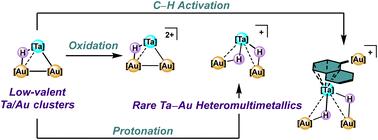
Gold-based catalysts are topical heterogeneous and molecular species, the chemical diversity of which can be expanded through heterometal doping. Herein, we leverage a carbonyl-free metal–metal salt metathesis protocol to access rare examples of low-valent tantalum/gold multimetallics. The initial reaction between [Ta(naphthalene)3]− and gold(I) synthons affords a trimetallic monohydride cluster (2). Whereas dihydrogen addition to 2 results in deauration en route to a Ta–μH2–Au complex (1), oxidative transformations—either addition of chemical oxidants or cluster protonation—conserve the trimetallic core, even in the absence of a polynucleating ligand. The resultant series of compounds provides experimental anchors for computational interrogation of polarized metal–metal interactions as a function of metal identity, formal oxidation state, and ligand sphere. The electronic structure of these clusters showcases significant Ta–arene covalency, even at higher oxidation states, rationalizing a recalcitrance to undergo ligand substitution. Furthermore, the addition of in situ generated Au+ to 2 results in an arene C–H activation process, highlighting that the naphthalene ligands in these complexes are simultaneously substitutionally inert and prone to functionalization.



 京公网安备 11010802042870号
京ICP备2023020795号-1
京公网安备 11010802042870号
京ICP备2023020795号-1

 分享
分享
 求助内容:
求助内容: 应助结果提醒方式:
 扫码关注我们
