Nano-bismuth vanadate supported on fibrous silica reduces the intrinsic charge impedance for superior photoelectrochemical water-splitting performance†
N. M. Izzudin, A. A. Jalil, Saravanan Rajendran, N. S. Hassan, M. H. Sawal, N. I. H. Hazril, Y. Nagao, K. Aoki and S. H. Zein
{"title":"Nano-bismuth vanadate supported on fibrous silica reduces the intrinsic charge impedance for superior photoelectrochemical water-splitting performance†","authors":"N. M. Izzudin, A. A. Jalil, Saravanan Rajendran, N. S. Hassan, M. H. Sawal, N. I. H. Hazril, Y. Nagao, K. Aoki and S. H. Zein","doi":"10.1039/D4NR05153J","DOIUrl":null,"url":null,"abstract":"<p >Bismuth vanadate (BiVO<small><sub>4</sub></small>) is one of the top-notch materials used in photoelectrochemical (PEC) water-splitting studies owing to its promising properties. However, its practical application is significantly hindered by its inherent limitations, which reduce its efficiency in water-splitting processes. In this study, a novel approach involving size transformation and improved dispersion of BiVO<small><sub>4</sub></small> was achieved <em>via</em> a microemulsion method, with fibrous silica serving as a support matrix. The fabricated catalyst, fibrous silica bismuth vanadate (FSBVO), was comprehensively characterized using XRD, FTIR, FESEM, TEM, UV-Vis/DRS, Mott–Schottky analysis, EIS, and PL spectroscopy and compared with commercial BiVO<small><sub>4</sub></small>. The PEC analysis demonstrated that the FSBVO photoanode delivered a remarkable performance, attaining a photocurrent density of 19.8 mA cm<small><sup>−2</sup></small> at 1.23 V<small><sub>RHE</sub></small> and a solar-to-hydrogen conversion efficiency of 24.35%, which correspond to enhancements of approximately 27.5 and 27.4 times, respectively, compared with those obtained using the pristine BiVO<small><sub>4</sub></small> photoanode. Further in-depth studies revealed that the improvement in the PEC water-splitting performance was mainly attributed to the transformation of BiVO<small><sub>4</sub></small> into nanoparticles and the distinctive Si–Bi interaction, which increased the carrier density and facilitated efficient electron transport, thereby accelerating the oxygen evolution kinetics. This study highlights the potential of FSBVO photoanodes and provides valuable insights for designing advanced materials to enhance the PEC water-splitting efficiency.</p>","PeriodicalId":92,"journal":{"name":"Nanoscale","volume":" 18","pages":" 11385-11400"},"PeriodicalIF":5.1000,"publicationDate":"2025-04-03","publicationTypes":"Journal Article","fieldsOfStudy":null,"isOpenAccess":false,"openAccessPdf":"","citationCount":"0","resultStr":null,"platform":"Semanticscholar","paperid":null,"PeriodicalName":"Nanoscale","FirstCategoryId":"88","ListUrlMain":"https://pubs.rsc.org/en/content/articlelanding/2025/nr/d4nr05153j","RegionNum":3,"RegionCategory":"材料科学","ArticlePicture":[],"TitleCN":null,"AbstractTextCN":null,"PMCID":null,"EPubDate":"","PubModel":"","JCR":"Q1","JCRName":"CHEMISTRY, MULTIDISCIPLINARY","Score":null,"Total":0}
引用次数: 0
Abstract
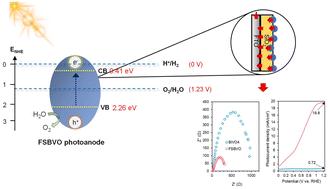
Bismuth vanadate (BiVO4) is one of the top-notch materials used in photoelectrochemical (PEC) water-splitting studies owing to its promising properties. However, its practical application is significantly hindered by its inherent limitations, which reduce its efficiency in water-splitting processes. In this study, a novel approach involving size transformation and improved dispersion of BiVO4 was achieved via a microemulsion method, with fibrous silica serving as a support matrix. The fabricated catalyst, fibrous silica bismuth vanadate (FSBVO), was comprehensively characterized using XRD, FTIR, FESEM, TEM, UV-Vis/DRS, Mott–Schottky analysis, EIS, and PL spectroscopy and compared with commercial BiVO4. The PEC analysis demonstrated that the FSBVO photoanode delivered a remarkable performance, attaining a photocurrent density of 19.8 mA cm−2 at 1.23 VRHE and a solar-to-hydrogen conversion efficiency of 24.35%, which correspond to enhancements of approximately 27.5 and 27.4 times, respectively, compared with those obtained using the pristine BiVO4 photoanode. Further in-depth studies revealed that the improvement in the PEC water-splitting performance was mainly attributed to the transformation of BiVO4 into nanoparticles and the distinctive Si–Bi interaction, which increased the carrier density and facilitated efficient electron transport, thereby accelerating the oxygen evolution kinetics. This study highlights the potential of FSBVO photoanodes and provides valuable insights for designing advanced materials to enhance the PEC water-splitting efficiency.
期刊介绍:
Nanoscale is a high-impact international journal, publishing high-quality research across nanoscience and nanotechnology. Nanoscale publishes a full mix of research articles on experimental and theoretical work, including reviews, communications, and full papers.Highly interdisciplinary, this journal appeals to scientists, researchers and professionals interested in nanoscience and nanotechnology, quantum materials and quantum technology, including the areas of physics, chemistry, biology, medicine, materials, energy/environment, information technology, detection science, healthcare and drug discovery, and electronics.



 京公网安备 11010802042870号
京ICP备2023020795号-1
京公网安备 11010802042870号
京ICP备2023020795号-1

 分享
分享
 求助内容:
求助内容: 应助结果提醒方式:
 扫码关注我们
