Donggyun Kim, Jinhyeon Park, Seonghyeon Jung, Jieun Jang, Minsu Han, Minjun Kim, Wenkai Zhu, Woo-Jin Song, Yusuke Yamauchi and Jeonghun Kim
{"title":"Study on the importance of uniformity and nanoparticle size in ZIF-8 carbon nanoarchitecture for enhancing electrochemical properties†","authors":"Donggyun Kim, Jinhyeon Park, Seonghyeon Jung, Jieun Jang, Minsu Han, Minjun Kim, Wenkai Zhu, Woo-Jin Song, Yusuke Yamauchi and Jeonghun Kim","doi":"10.1039/D5NR00556F","DOIUrl":null,"url":null,"abstract":"<p >Metal–organic framework (MOF)-derived carbons, known for their highly tunable structures, have attracted considerable attention for electrochemical applications. Efficient ion and electron transport, along with low electrode resistance, is critical for enhancing performance in these areas. To optimize MOF-derived carbons, we synthesize Zn-based zeolitic imidazolate framework (ZIF-8) nanocrystals with controlled sizes and a narrow size distribution, resulting in nanoporous polyhedral carbon structures. The sample is then subjected to carbonization to yield ZIF-8-derived carbon (ZIF-8-C) doped with heteroatoms, and subsequently, performance evaluations of supercapacitors are conducted to assess their ion and electron transport properties. Larger particles exhibit greater capacitance loss at high scan rates or current densities, likely due to underutilization of pores for ion diffusion. Uniform particle sizes facilitate ordered packing, improving electron pathways compared to electrodes with non-uniform particles and yielding higher electrochemical performance despite similar specific surface areas. Notably, the electrode prepared with the smallest and most uniformly sized ZIF-8-C-m1 exhibits a specific capacitance of 206.4 F g<small><sup>−1</sup></small> at 1 A g<small><sup>−1</sup></small>, along with excellent rate capability and stability, retaining 99.7% of its capacitance after 10 000 cycles at 10 A g<small><sup>−1</sup></small>. In a two-electrode system, it achieves an energy density of up to 19.4 W h kg<small><sup>−1</sup></small> at a specific power of 350 W kg<small><sup>−1</sup></small>. The results present here offer valuable insights into the utilization of nanoporous carbons across diverse electrochemical applications.</p>","PeriodicalId":92,"journal":{"name":"Nanoscale","volume":" 16","pages":" 10344-10355"},"PeriodicalIF":5.1000,"publicationDate":"2025-04-03","publicationTypes":"Journal Article","fieldsOfStudy":null,"isOpenAccess":false,"openAccessPdf":"https://pubs.rsc.org/en/content/articlepdf/2025/nr/d5nr00556f?page=search","citationCount":"0","resultStr":null,"platform":"Semanticscholar","paperid":null,"PeriodicalName":"Nanoscale","FirstCategoryId":"88","ListUrlMain":"https://pubs.rsc.org/en/content/articlelanding/2025/nr/d5nr00556f","RegionNum":3,"RegionCategory":"材料科学","ArticlePicture":[],"TitleCN":null,"AbstractTextCN":null,"PMCID":null,"EPubDate":"","PubModel":"","JCR":"Q1","JCRName":"CHEMISTRY, MULTIDISCIPLINARY","Score":null,"Total":0}
引用次数: 0
Abstract
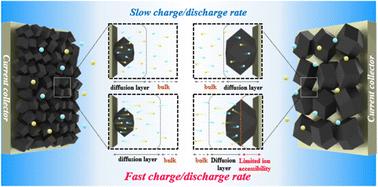
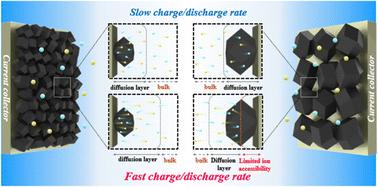
Metal–organic framework (MOF)-derived carbons, known for their highly tunable structures, have attracted considerable attention for electrochemical applications. Efficient ion and electron transport, along with low electrode resistance, is critical for enhancing performance in these areas. To optimize MOF-derived carbons, we synthesize Zn-based zeolitic imidazolate framework (ZIF-8) nanocrystals with controlled sizes and a narrow size distribution, resulting in nanoporous polyhedral carbon structures. The sample is then subjected to carbonization to yield ZIF-8-derived carbon (ZIF-8-C) doped with heteroatoms, and subsequently, performance evaluations of supercapacitors are conducted to assess their ion and electron transport properties. Larger particles exhibit greater capacitance loss at high scan rates or current densities, likely due to underutilization of pores for ion diffusion. Uniform particle sizes facilitate ordered packing, improving electron pathways compared to electrodes with non-uniform particles and yielding higher electrochemical performance despite similar specific surface areas. Notably, the electrode prepared with the smallest and most uniformly sized ZIF-8-C-m1 exhibits a specific capacitance of 206.4 F g−1 at 1 A g−1, along with excellent rate capability and stability, retaining 99.7% of its capacitance after 10 000 cycles at 10 A g−1. In a two-electrode system, it achieves an energy density of up to 19.4 W h kg−1 at a specific power of 350 W kg−1. The results present here offer valuable insights into the utilization of nanoporous carbons across diverse electrochemical applications.
金属有机骨架(MOF)衍生的碳以其高度可调的结构而闻名,在电化学应用中引起了广泛的关注。高效的离子和电子传输,以及低电极电阻,对于提高这些领域的性能至关重要。为了优化mof衍生碳,我们合成了具有控制尺寸和窄尺寸分布的锌基沸石咪唑盐框架(ZIF-8)纳米晶体,得到纳米多孔多面体碳结构。然后对样品进行碳化,得到掺杂杂原子的zif -8衍生碳(ZIF-8-C),随后对超级电容器进行性能评估,以评估其离子和电子传输特性。较大的颗粒在高扫描速率或电流密度下表现出更大的电容损失,可能是由于离子扩散的孔隙利用不足。均匀的颗粒尺寸有利于有序的包装,与不均匀颗粒的电极相比,改善了电子路径,尽管比表面积相似,但仍能产生更高的电化学性能。值得注意的是,用最小和尺寸最均匀的ZIF-8-C-m1制备的电极在1 a g−1下的比电容为206.4 F g−1,同时具有优异的倍率能力和稳定性,在10 a g−1下循环10,000次后仍保持99.7%的电容。在双电极系统中,当比功率为350w kg−1时,其能量密度可达19.4 W h kg−1。本文的研究结果为纳米多孔碳在不同电化学应用中的应用提供了有价值的见解。
期刊介绍:
Nanoscale is a high-impact international journal, publishing high-quality research across nanoscience and nanotechnology. Nanoscale publishes a full mix of research articles on experimental and theoretical work, including reviews, communications, and full papers.Highly interdisciplinary, this journal appeals to scientists, researchers and professionals interested in nanoscience and nanotechnology, quantum materials and quantum technology, including the areas of physics, chemistry, biology, medicine, materials, energy/environment, information technology, detection science, healthcare and drug discovery, and electronics.



 京公网安备 11010802042870号
京ICP备2023020795号-1
京公网安备 11010802042870号
京ICP备2023020795号-1

 分享
分享
 求助内容:
求助内容: 应助结果提醒方式:
 扫码关注我们
