{"title":"RVG engineered extracellular vesicles-transmitted miR-137 improves autism by modulating glucose metabolism and neuroinflammation","authors":"Qian Qin, Mengyue Li, Linlin Fan, Xin Zeng, Danyang Zheng, Han Wang, Yutong Jiang, Xinrui Ma, Lei Xing, Lijie Wu, Shuang Liang","doi":"10.1038/s41380-025-02988-0","DOIUrl":null,"url":null,"abstract":"Autism spectrum disorder (ASD) is a prevalent neurodevelopmental disorder. The microglia activation is a hallmark of ASD, which involves increased glycolysis. Elevated glycolysis regardless of oxygen availability, known as “Warburg effect”, is crucial to pathogenesis in neuropsychiatric disorders. Psychiatric risk gene MIR137 plays an important role in neurogenesis and neuronal maturation, but the impact on neuroinflammation and glucose metabolism remains obscure. Extracellular vesicles (EVs) can delivery miR-137 crossing the blood-brain barrier. Meanwhile, EVs can help miR-137 avoid being rapidly degraded by endogenous nucleases. Here, after first detecting miR-137 decreased both in the peripheral blood of individuals with ASD and the serum and cerebellum of BTBR mice, we demonstrated that microglia activation, the level of lactate and key enzymes (HK2, PKM2 and LDHA) involved in glycolysis were increased significantly in BTBR mice. Of particular note, EVs engineered by rabies virus glycoprotein (RVG) could promote the miR-137 (RVG-miR137-EVs) targeted to the brain accurately, and alleviated autism-like behaviors. Pro-inflammatory activation of BTBR mice was considerably inhibited by RVG-miR137-EVs via tail vein administration, accompanied by decreased lactate production. Mechanically, these effects were attributed to TLR4, the key target gene, which was regulated by miR-137. The TLR4/NF-κB pathway was inhibited, subsequently reducing HIF-1α and repressing the transcription of HK2, PKM2 and LDHA involved in glycolysis. Pharmacological inhibition of glycolysis and TLR4 attenuated microglial activation and lactate production, ultimately improved autism-like behaviors of BTBR mice. In conclusion, our results indicated that miR-137 could alleviate autism-like behaviors by HIF-1α-mediated adaptive metabolic changes in glycolysis and neuroinflammation.","PeriodicalId":19008,"journal":{"name":"Molecular Psychiatry","volume":"30 9","pages":"4072-4084"},"PeriodicalIF":10.1000,"publicationDate":"2025-04-02","publicationTypes":"Journal Article","fieldsOfStudy":null,"isOpenAccess":false,"openAccessPdf":"","citationCount":"0","resultStr":null,"platform":"Semanticscholar","paperid":null,"PeriodicalName":"Molecular Psychiatry","FirstCategoryId":"3","ListUrlMain":"https://www.nature.com/articles/s41380-025-02988-0","RegionNum":1,"RegionCategory":"医学","ArticlePicture":[],"TitleCN":null,"AbstractTextCN":null,"PMCID":null,"EPubDate":"","PubModel":"","JCR":"Q1","JCRName":"BIOCHEMISTRY & MOLECULAR BIOLOGY","Score":null,"Total":0}
引用次数: 0
Abstract
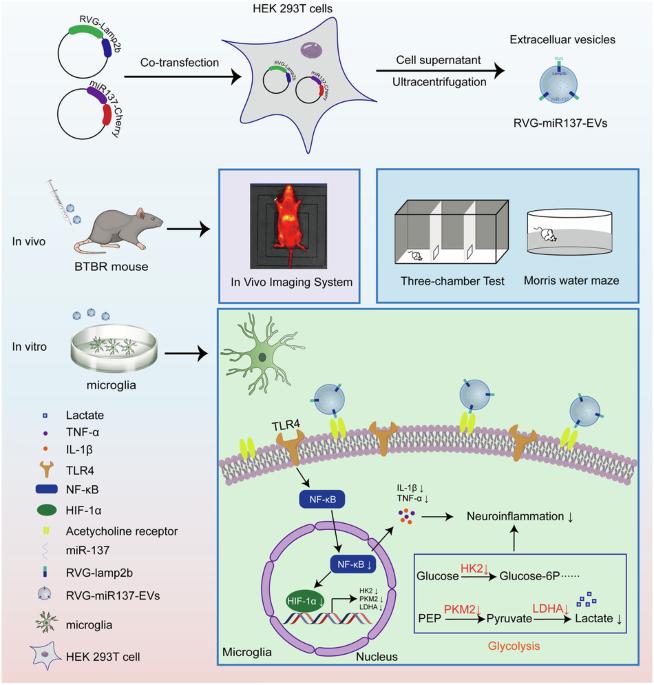
Autism spectrum disorder (ASD) is a prevalent neurodevelopmental disorder. The microglia activation is a hallmark of ASD, which involves increased glycolysis. Elevated glycolysis regardless of oxygen availability, known as “Warburg effect”, is crucial to pathogenesis in neuropsychiatric disorders. Psychiatric risk gene MIR137 plays an important role in neurogenesis and neuronal maturation, but the impact on neuroinflammation and glucose metabolism remains obscure. Extracellular vesicles (EVs) can delivery miR-137 crossing the blood-brain barrier. Meanwhile, EVs can help miR-137 avoid being rapidly degraded by endogenous nucleases. Here, after first detecting miR-137 decreased both in the peripheral blood of individuals with ASD and the serum and cerebellum of BTBR mice, we demonstrated that microglia activation, the level of lactate and key enzymes (HK2, PKM2 and LDHA) involved in glycolysis were increased significantly in BTBR mice. Of particular note, EVs engineered by rabies virus glycoprotein (RVG) could promote the miR-137 (RVG-miR137-EVs) targeted to the brain accurately, and alleviated autism-like behaviors. Pro-inflammatory activation of BTBR mice was considerably inhibited by RVG-miR137-EVs via tail vein administration, accompanied by decreased lactate production. Mechanically, these effects were attributed to TLR4, the key target gene, which was regulated by miR-137. The TLR4/NF-κB pathway was inhibited, subsequently reducing HIF-1α and repressing the transcription of HK2, PKM2 and LDHA involved in glycolysis. Pharmacological inhibition of glycolysis and TLR4 attenuated microglial activation and lactate production, ultimately improved autism-like behaviors of BTBR mice. In conclusion, our results indicated that miR-137 could alleviate autism-like behaviors by HIF-1α-mediated adaptive metabolic changes in glycolysis and neuroinflammation.
期刊介绍:
Molecular Psychiatry focuses on publishing research that aims to uncover the biological mechanisms behind psychiatric disorders and their treatment. The journal emphasizes studies that bridge pre-clinical and clinical research, covering cellular, molecular, integrative, clinical, imaging, and psychopharmacology levels.




 京公网安备 11010802042870号
京ICP备2023020795号-1
京公网安备 11010802042870号
京ICP备2023020795号-1

 分享
分享
 求助内容:
求助内容: 应助结果提醒方式:
 扫码关注我们
