Novel Laser-Assisted Electrospray Ionization Mass Spectrometry (Laser-Assisted ESI-MS): A Sensitive Method for Determining Tetrabromobisphenol A and Its Derivative
{"title":"Novel Laser-Assisted Electrospray Ionization Mass Spectrometry (Laser-Assisted ESI-MS): A Sensitive Method for Determining Tetrabromobisphenol A and Its Derivative","authors":"Haonan Liu, Xiaoxuan Han, Shuo Gao, Fada Shi, Yong Tian, Ligang Hu, Jianbo Shi, Guibin Jiang","doi":"10.1021/acs.analchem.5c00166","DOIUrl":null,"url":null,"abstract":"Efficient ionization is essential for sensitive mass spectrometry (MS) analysis. Herein, a novel laser-assisted electrospray ionization (laser-assisted ESI) source was developed to efficiently ionize low-polar and thermal unstable compounds. By irradiating the electrospray nozzle with a simple and low-cost laser probe (450 nm, 500 mW), the sample droplets were stimulated with a laser beam as well as the high voltage of the electrospray, which significantly enhanced the ionization efficiency. In positive ionization mode, by further utilizing the reaction of Ag<sup>+</sup> and tetrabromobisphenol A bis(allyl ether) (TBBPA-BAE), the established laser-assisted ESI strategy was able to efficiently ionize the low-polar and thermal unstable TBBPA-BAE. Specifically, a limit of detection (LOD) of 14 ng L<sup>–1</sup>, linear range of 0.1–10 μg L<sup>–1</sup> (R<sup>2</sup> > 0.99), and relative standard deviations (RSDs) of 2.5% (n = 7, intraday) and 6.2% (n = 3 per day for 5 days, interday) were achieved. In negative ionization mode, laser-assisted ESI also improved the detection sensitivity of tetrabromobisphenol A (TBBPA), achieving a LOD of 3.3 ng L<sup>–1</sup>, linear range of 0.01–10 μg L<sup>–1</sup> (R<sup>2</sup> > 0.99), and RSDs of 4.7% (n = 7, intraday) and 7.3% (n = 3 per day for 5 days, interday). Compared to extractive electrospray ionization mass spectrometry (EESI-MS) and ESI-MS, the LODs achieved with laser-assisted ESI-MS were 54 and 16 times lower for the detection of TBBPA-BAE and TBBPA, respectively. Notably, deep purification and preconcentration were not required to accurately detect TBBPA and TBBPA-BAE in river water and wastewater treatment plant effluent. The spiked recoveries were between 88.0% and 106.0%, demonstrating the high reliability and practicality of this method.","PeriodicalId":27,"journal":{"name":"Analytical Chemistry","volume":"58 1","pages":""},"PeriodicalIF":6.7000,"publicationDate":"2025-04-03","publicationTypes":"Journal Article","fieldsOfStudy":null,"isOpenAccess":false,"openAccessPdf":"","citationCount":"0","resultStr":null,"platform":"Semanticscholar","paperid":null,"PeriodicalName":"Analytical Chemistry","FirstCategoryId":"92","ListUrlMain":"https://doi.org/10.1021/acs.analchem.5c00166","RegionNum":1,"RegionCategory":"化学","ArticlePicture":[],"TitleCN":null,"AbstractTextCN":null,"PMCID":null,"EPubDate":"","PubModel":"","JCR":"Q1","JCRName":"CHEMISTRY, ANALYTICAL","Score":null,"Total":0}
引用次数: 0
Abstract
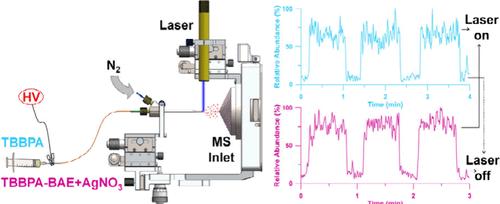
Efficient ionization is essential for sensitive mass spectrometry (MS) analysis. Herein, a novel laser-assisted electrospray ionization (laser-assisted ESI) source was developed to efficiently ionize low-polar and thermal unstable compounds. By irradiating the electrospray nozzle with a simple and low-cost laser probe (450 nm, 500 mW), the sample droplets were stimulated with a laser beam as well as the high voltage of the electrospray, which significantly enhanced the ionization efficiency. In positive ionization mode, by further utilizing the reaction of Ag+ and tetrabromobisphenol A bis(allyl ether) (TBBPA-BAE), the established laser-assisted ESI strategy was able to efficiently ionize the low-polar and thermal unstable TBBPA-BAE. Specifically, a limit of detection (LOD) of 14 ng L–1, linear range of 0.1–10 μg L–1 (R2 > 0.99), and relative standard deviations (RSDs) of 2.5% (n = 7, intraday) and 6.2% (n = 3 per day for 5 days, interday) were achieved. In negative ionization mode, laser-assisted ESI also improved the detection sensitivity of tetrabromobisphenol A (TBBPA), achieving a LOD of 3.3 ng L–1, linear range of 0.01–10 μg L–1 (R2 > 0.99), and RSDs of 4.7% (n = 7, intraday) and 7.3% (n = 3 per day for 5 days, interday). Compared to extractive electrospray ionization mass spectrometry (EESI-MS) and ESI-MS, the LODs achieved with laser-assisted ESI-MS were 54 and 16 times lower for the detection of TBBPA-BAE and TBBPA, respectively. Notably, deep purification and preconcentration were not required to accurately detect TBBPA and TBBPA-BAE in river water and wastewater treatment plant effluent. The spiked recoveries were between 88.0% and 106.0%, demonstrating the high reliability and practicality of this method.
期刊介绍:
Analytical Chemistry, a peer-reviewed research journal, focuses on disseminating new and original knowledge across all branches of analytical chemistry. Fundamental articles may explore general principles of chemical measurement science and need not directly address existing or potential analytical methodology. They can be entirely theoretical or report experimental results. Contributions may cover various phases of analytical operations, including sampling, bioanalysis, electrochemistry, mass spectrometry, microscale and nanoscale systems, environmental analysis, separations, spectroscopy, chemical reactions and selectivity, instrumentation, imaging, surface analysis, and data processing. Papers discussing known analytical methods should present a significant, original application of the method, a notable improvement, or results on an important analyte.



 京公网安备 11010802042870号
京ICP备2023020795号-1
京公网安备 11010802042870号
京ICP备2023020795号-1

 分享
分享
 求助内容:
求助内容: 应助结果提醒方式:
 扫码关注我们
