J. Carlos Sanchez, Ingrid H. Robertson, Victoria A. M. Shinkawa, Xiaojing Su, Wan-chen Tu, Timothy R. Robinson, Megan M. Chang, Andrea Blom, Elena Alfaro, Daniel B. Hatchett, Ayokunle O. Olanrewaju, Ellen R. Wald, Gregory P. DeMuri, Erwin Berthier, Sanitta Thongpang, Ashleigh B. Theberge
{"title":"Integration of Group A Streptococcus Rapid Tests with the Open Fluidic CandyCollect Device","authors":"J. Carlos Sanchez, Ingrid H. Robertson, Victoria A. M. Shinkawa, Xiaojing Su, Wan-chen Tu, Timothy R. Robinson, Megan M. Chang, Andrea Blom, Elena Alfaro, Daniel B. Hatchett, Ayokunle O. Olanrewaju, Ellen R. Wald, Gregory P. DeMuri, Erwin Berthier, Sanitta Thongpang, Ashleigh B. Theberge","doi":"10.1021/acs.analchem.4c05063","DOIUrl":null,"url":null,"abstract":"The CandyCollect is a lollipop-inspired open-fluidic oral sampling device designed to provide a comfortable user sampling experience. We demonstrate that the CandyCollect device can be coupled to a rapid antigen detection test (RADT) kit designed for Group A Streptococcus (GAS). Through <i>in vitro</i> experiments with pooled saliva spiked with <i>Streptococcus pyogenes</i>, we tested various reagents and elution volumes to optimize the RADT readout from CandyCollect device samples. The resulting optimized protocol uses the kit-provided reagents and lateral flow assay (LFA) while replacing the kit’s pharyngeal swab with the CandyCollect device, reducing the elution solution volume, and substituting the tube used for elution to accommodate the CandyCollect device. Positive test results were detected by eye with bacterial concentrations as low as the manufacturer’s “minimal detection limit” of 1.5 × 10<sup>5</sup> CFU/mL. LFA strips were also scanned and semiquantified with image analysis software to determine the signal-to-baseline ratio (SBR) and categorize positive test results without human bias. We tested our optimized protocol for integrating CandyCollect and RADT using CandyCollect clinical samples from pediatric patients (<i>n</i> = 6) who were previously diagnosed with GAS pharyngitis via pharyngeal swabs tested with RADT as part of their clinical care. The LFA results of these CandyCollect devices and interspersed negative controls were determined by independent observers with positive results obtained in four of the six participants on at least one LFA replicate. Taken together, our results show that CandyCollect devices from children with GAS pharyngitis can be tested by using LFA rapid tests.","PeriodicalId":27,"journal":{"name":"Analytical Chemistry","volume":"73 1","pages":""},"PeriodicalIF":6.7000,"publicationDate":"2025-04-02","publicationTypes":"Journal Article","fieldsOfStudy":null,"isOpenAccess":false,"openAccessPdf":"","citationCount":"0","resultStr":null,"platform":"Semanticscholar","paperid":null,"PeriodicalName":"Analytical Chemistry","FirstCategoryId":"92","ListUrlMain":"https://doi.org/10.1021/acs.analchem.4c05063","RegionNum":1,"RegionCategory":"化学","ArticlePicture":[],"TitleCN":null,"AbstractTextCN":null,"PMCID":null,"EPubDate":"","PubModel":"","JCR":"Q1","JCRName":"CHEMISTRY, ANALYTICAL","Score":null,"Total":0}
引用次数: 0
Abstract
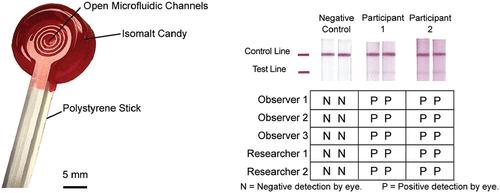
The CandyCollect is a lollipop-inspired open-fluidic oral sampling device designed to provide a comfortable user sampling experience. We demonstrate that the CandyCollect device can be coupled to a rapid antigen detection test (RADT) kit designed for Group A Streptococcus (GAS). Through in vitro experiments with pooled saliva spiked with Streptococcus pyogenes, we tested various reagents and elution volumes to optimize the RADT readout from CandyCollect device samples. The resulting optimized protocol uses the kit-provided reagents and lateral flow assay (LFA) while replacing the kit’s pharyngeal swab with the CandyCollect device, reducing the elution solution volume, and substituting the tube used for elution to accommodate the CandyCollect device. Positive test results were detected by eye with bacterial concentrations as low as the manufacturer’s “minimal detection limit” of 1.5 × 10⁵ CFU/mL. LFA strips were also scanned and semiquantified with image analysis software to determine the signal-to-baseline ratio (SBR) and categorize positive test results without human bias. We tested our optimized protocol for integrating CandyCollect and RADT using CandyCollect clinical samples from pediatric patients (n = 6) who were previously diagnosed with GAS pharyngitis via pharyngeal swabs tested with RADT as part of their clinical care. The LFA results of these CandyCollect devices and interspersed negative controls were determined by independent observers with positive results obtained in four of the six participants on at least one LFA replicate. Taken together, our results show that CandyCollect devices from children with GAS pharyngitis can be tested by using LFA rapid tests.
期刊介绍:
Analytical Chemistry, a peer-reviewed research journal, focuses on disseminating new and original knowledge across all branches of analytical chemistry. Fundamental articles may explore general principles of chemical measurement science and need not directly address existing or potential analytical methodology. They can be entirely theoretical or report experimental results. Contributions may cover various phases of analytical operations, including sampling, bioanalysis, electrochemistry, mass spectrometry, microscale and nanoscale systems, environmental analysis, separations, spectroscopy, chemical reactions and selectivity, instrumentation, imaging, surface analysis, and data processing. Papers discussing known analytical methods should present a significant, original application of the method, a notable improvement, or results on an important analyte.



 京公网安备 11010802042870号
京ICP备2023020795号-1
京公网安备 11010802042870号
京ICP备2023020795号-1

 分享
分享
 求助内容:
求助内容: 应助结果提醒方式:
 扫码关注我们
