Lingling Luo, Yuying Zhou, Yaqin Chai, Ruo Yuan, Hongyan Liu
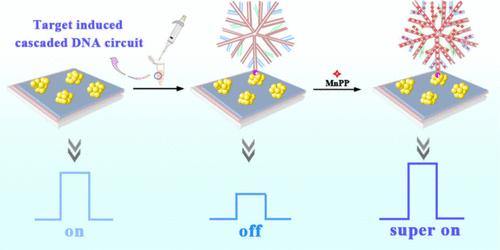
{"title":"Homogeneous Multicycle Cascaded DNA Circuit for Sensitive “Signal On-Off-Super On” PEC Biosensing","authors":"Lingling Luo, Yuying Zhou, Yaqin Chai, Ruo Yuan, Hongyan Liu","doi":"10.1021/acs.analchem.5c00373","DOIUrl":null,"url":null,"abstract":"The minor changes of miRNA levels due to various diseases and cancers bring great challenges for early diagnosis. Here we propose a “signal on-off-super on” PEC biosensor based on a homogeneous multicycle cascaded DNA circuit and a SnSe/CdS photoanode for sensitive detection of biomarker miRNA-222. Specifically, a Z-type SnSe/CdS heterojunction with greatly enhanced photoanodic performance was developed to provide the initial “on” signal. The target miRNA-222 was converted to a dendritic DNA structure through a cascade DNA circuit. The PEC signal can be switched off by the dendritic DNA structure and further switched super on by the loading of photosensitizer manganese porphyrin (MnPP). It is worth noting that the homogeneous multicycle cascaded DNA circuit not only improved the reaction kinetics but also avoided the leakage of signal. Compared with the traditional “signal-on” or “signal-off” readout, this “signal on-off-super on” strategy avoids the false response and background, thereby enhancing the sensitivity and accuracy of the PEC biosensor. The detection limit of the constructed PEC sensor is 0.3 fM in the linear range from 1 fM to 10 nM. The PEC biosensor with outstanding reproducibility, stability, and sensitivity provides a promising platform for biomarker detection and early disease diagnosis.","PeriodicalId":27,"journal":{"name":"Analytical Chemistry","volume":"128 1","pages":""},"PeriodicalIF":6.7000,"publicationDate":"2025-04-02","publicationTypes":"Journal Article","fieldsOfStudy":null,"isOpenAccess":false,"openAccessPdf":"","citationCount":"0","resultStr":null,"platform":"Semanticscholar","paperid":null,"PeriodicalName":"Analytical Chemistry","FirstCategoryId":"92","ListUrlMain":"https://doi.org/10.1021/acs.analchem.5c00373","RegionNum":1,"RegionCategory":"化学","ArticlePicture":[],"TitleCN":null,"AbstractTextCN":null,"PMCID":null,"EPubDate":"","PubModel":"","JCR":"Q1","JCRName":"CHEMISTRY, ANALYTICAL","Score":null,"Total":0}
引用次数: 0
Abstract
The minor changes of miRNA levels due to various diseases and cancers bring great challenges for early diagnosis. Here we propose a “signal on-off-super on” PEC biosensor based on a homogeneous multicycle cascaded DNA circuit and a SnSe/CdS photoanode for sensitive detection of biomarker miRNA-222. Specifically, a Z-type SnSe/CdS heterojunction with greatly enhanced photoanodic performance was developed to provide the initial “on” signal. The target miRNA-222 was converted to a dendritic DNA structure through a cascade DNA circuit. The PEC signal can be switched off by the dendritic DNA structure and further switched super on by the loading of photosensitizer manganese porphyrin (MnPP). It is worth noting that the homogeneous multicycle cascaded DNA circuit not only improved the reaction kinetics but also avoided the leakage of signal. Compared with the traditional “signal-on” or “signal-off” readout, this “signal on-off-super on” strategy avoids the false response and background, thereby enhancing the sensitivity and accuracy of the PEC biosensor. The detection limit of the constructed PEC sensor is 0.3 fM in the linear range from 1 fM to 10 nM. The PEC biosensor with outstanding reproducibility, stability, and sensitivity provides a promising platform for biomarker detection and early disease diagnosis.
期刊介绍:
Analytical Chemistry, a peer-reviewed research journal, focuses on disseminating new and original knowledge across all branches of analytical chemistry. Fundamental articles may explore general principles of chemical measurement science and need not directly address existing or potential analytical methodology. They can be entirely theoretical or report experimental results. Contributions may cover various phases of analytical operations, including sampling, bioanalysis, electrochemistry, mass spectrometry, microscale and nanoscale systems, environmental analysis, separations, spectroscopy, chemical reactions and selectivity, instrumentation, imaging, surface analysis, and data processing. Papers discussing known analytical methods should present a significant, original application of the method, a notable improvement, or results on an important analyte.



 京公网安备 11010802042870号
京ICP备2023020795号-1
京公网安备 11010802042870号
京ICP备2023020795号-1

 分享
分享
 求助内容:
求助内容: 应助结果提醒方式:
 扫码关注我们
