Jia Chen, Zhuozhuo Tang, Da Zhu, Li Sheng, Zonglong Li, Yang Yang, Jianlong Wang, Yaping Tang, Xiangming He, Hong Xu
{"title":"Three-Dimensional Covalent Organic Framework for Efficient Hydrogen Storage through Polarization-Wall Engineering","authors":"Jia Chen, Zhuozhuo Tang, Da Zhu, Li Sheng, Zonglong Li, Yang Yang, Jianlong Wang, Yaping Tang, Xiangming He, Hong Xu","doi":"10.1021/acs.nanolett.5c00934","DOIUrl":null,"url":null,"abstract":"Covalent organic frameworks (COFs), characterized by high surface areas and tunable pore structures/environments, are regarded as a promising alternative to physisorption H<sub>2</sub> storage materials. However, their interaction with hydrogen is often too weak, necessitating the exploration of strategies to enhance sorption heat. Herein, we strengthened the adsorption induction of COF on H<sub>2</sub> through a polarized wall engineering. The fluorine groups on the pore wall of three-dimensional COFs polarize their surrounding regions, resulting in high sorption heat sites. Due to the enhanced H<sub>2</sub> sorption heat, the total H<sub>2</sub> uptake of 3D-F-COF is up to to 5.96 wt % at 77 K and 90 bar. Moreover, the H<sub>2</sub> adsorption enhancement effect of the polar group does not involve chemisorption, and the material exhibits excellent cycling stability. These results reveal that modulating the H<sub>2</sub> sorption heat by incorporating polar groups is a promising strategy for achieving efficient H<sub>2</sub> storage in porous materials.","PeriodicalId":53,"journal":{"name":"Nano Letters","volume":"6 1","pages":""},"PeriodicalIF":9.1000,"publicationDate":"2025-04-03","publicationTypes":"Journal Article","fieldsOfStudy":null,"isOpenAccess":false,"openAccessPdf":"","citationCount":"0","resultStr":null,"platform":"Semanticscholar","paperid":null,"PeriodicalName":"Nano Letters","FirstCategoryId":"88","ListUrlMain":"https://doi.org/10.1021/acs.nanolett.5c00934","RegionNum":1,"RegionCategory":"材料科学","ArticlePicture":[],"TitleCN":null,"AbstractTextCN":null,"PMCID":null,"EPubDate":"","PubModel":"","JCR":"Q1","JCRName":"CHEMISTRY, MULTIDISCIPLINARY","Score":null,"Total":0}
引用次数: 0
Abstract
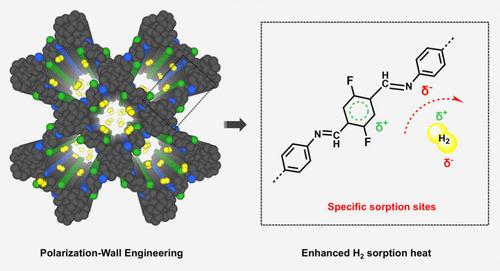
Covalent organic frameworks (COFs), characterized by high surface areas and tunable pore structures/environments, are regarded as a promising alternative to physisorption H2 storage materials. However, their interaction with hydrogen is often too weak, necessitating the exploration of strategies to enhance sorption heat. Herein, we strengthened the adsorption induction of COF on H2 through a polarized wall engineering. The fluorine groups on the pore wall of three-dimensional COFs polarize their surrounding regions, resulting in high sorption heat sites. Due to the enhanced H2 sorption heat, the total H2 uptake of 3D-F-COF is up to to 5.96 wt % at 77 K and 90 bar. Moreover, the H2 adsorption enhancement effect of the polar group does not involve chemisorption, and the material exhibits excellent cycling stability. These results reveal that modulating the H2 sorption heat by incorporating polar groups is a promising strategy for achieving efficient H2 storage in porous materials.
期刊介绍:
Nano Letters serves as a dynamic platform for promptly disseminating original results in fundamental, applied, and emerging research across all facets of nanoscience and nanotechnology. A pivotal criterion for inclusion within Nano Letters is the convergence of at least two different areas or disciplines, ensuring a rich interdisciplinary scope. The journal is dedicated to fostering exploration in diverse areas, including:
- Experimental and theoretical findings on physical, chemical, and biological phenomena at the nanoscale
- Synthesis, characterization, and processing of organic, inorganic, polymer, and hybrid nanomaterials through physical, chemical, and biological methodologies
- Modeling and simulation of synthetic, assembly, and interaction processes
- Realization of integrated nanostructures and nano-engineered devices exhibiting advanced performance
- Applications of nanoscale materials in living and environmental systems
Nano Letters is committed to advancing and showcasing groundbreaking research that intersects various domains, fostering innovation and collaboration in the ever-evolving field of nanoscience and nanotechnology.



 京公网安备 11010802042870号
京ICP备2023020795号-1
京公网安备 11010802042870号
京ICP备2023020795号-1

 分享
分享
 求助内容:
求助内容: 应助结果提醒方式:
 扫码关注我们
