Louise Kuehster, Michael Bingham, Jingyi Dai, Young Kuk Jhon, Yan Wang, Bin Qin, William C. Smith, Xiaoming Xu, Feng Zhang, Nathaniel A. Lynd
{"title":"Characterization of the Repeat Unit Sequence of Poly(lactide-co-glycolide)","authors":"Louise Kuehster, Michael Bingham, Jingyi Dai, Young Kuk Jhon, Yan Wang, Bin Qin, William C. Smith, Xiaoming Xu, Feng Zhang, Nathaniel A. Lynd","doi":"10.1021/acs.macromol.4c02895","DOIUrl":null,"url":null,"abstract":"Established methods of characterizing repeat unit sequence by measuring changes in comonomer concentration during copolymerization and inferring the resulting copolymer sequence are inapplicable to poly(lactide-<i>co</i>-glycolide) due to reverse and transesterification reactions. In this case, measurement of repeat unit sequences must be based on direct measurement on the copolymer. Here, the assignment of the <sup>13</sup>C NMR spectrum of the glycolyl methylene of poly(lactide-<i>co</i>-glycolide) to specific compositional ester tetrads is reported using insights provided by a stochastic model regression analysis of experimental reversible transesterification copolymerization data. The relative integrals of the deconvoluted compositional tetrad signals can be interpreted within the context of a model for repeat unit clustering that describes the cumulative population of homosequences with at least <i>n</i><sub>G</sub> adjacent glycolyl esters, including the resonant glycolyl ester. The decay of the relative population of homosequence length <i>n</i><sub>G</sub> is described by an exponential decay <i>f</i>(<i>n</i>) = <i>e</i><sup>(1–<i>n</i>)/σ<sub><i>b</i></sub></sup> with the parameter σ<sub>b</sub> describing the degree of clustering of glycolyl ester units. An empirical model describes the time-evolution of σ<sub>b</sub> as a function of reaction time, which evolves due to comonomer reversibility and copolymer transesterification.","PeriodicalId":51,"journal":{"name":"Macromolecules","volume":"133 1","pages":""},"PeriodicalIF":5.2000,"publicationDate":"2025-04-03","publicationTypes":"Journal Article","fieldsOfStudy":null,"isOpenAccess":false,"openAccessPdf":"","citationCount":"0","resultStr":null,"platform":"Semanticscholar","paperid":null,"PeriodicalName":"Macromolecules","FirstCategoryId":"92","ListUrlMain":"https://doi.org/10.1021/acs.macromol.4c02895","RegionNum":1,"RegionCategory":"化学","ArticlePicture":[],"TitleCN":null,"AbstractTextCN":null,"PMCID":null,"EPubDate":"","PubModel":"","JCR":"Q1","JCRName":"POLYMER SCIENCE","Score":null,"Total":0}
引用次数: 0
Abstract
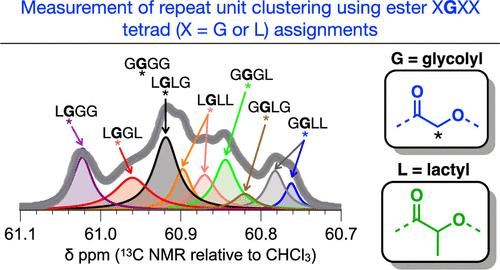
Established methods of characterizing repeat unit sequence by measuring changes in comonomer concentration during copolymerization and inferring the resulting copolymer sequence are inapplicable to poly(lactide-co-glycolide) due to reverse and transesterification reactions. In this case, measurement of repeat unit sequences must be based on direct measurement on the copolymer. Here, the assignment of the 13C NMR spectrum of the glycolyl methylene of poly(lactide-co-glycolide) to specific compositional ester tetrads is reported using insights provided by a stochastic model regression analysis of experimental reversible transesterification copolymerization data. The relative integrals of the deconvoluted compositional tetrad signals can be interpreted within the context of a model for repeat unit clustering that describes the cumulative population of homosequences with at least nG adjacent glycolyl esters, including the resonant glycolyl ester. The decay of the relative population of homosequence length nG is described by an exponential decay f(n) = e(1–n)/σb with the parameter σb describing the degree of clustering of glycolyl ester units. An empirical model describes the time-evolution of σb as a function of reaction time, which evolves due to comonomer reversibility and copolymer transesterification.
期刊介绍:
Macromolecules publishes original, fundamental, and impactful research on all aspects of polymer science. Topics of interest include synthesis (e.g., controlled polymerizations, polymerization catalysis, post polymerization modification, new monomer structures and polymer architectures, and polymerization mechanisms/kinetics analysis); phase behavior, thermodynamics, dynamic, and ordering/disordering phenomena (e.g., self-assembly, gelation, crystallization, solution/melt/solid-state characteristics); structure and properties (e.g., mechanical and rheological properties, surface/interfacial characteristics, electronic and transport properties); new state of the art characterization (e.g., spectroscopy, scattering, microscopy, rheology), simulation (e.g., Monte Carlo, molecular dynamics, multi-scale/coarse-grained modeling), and theoretical methods. Renewable/sustainable polymers, polymer networks, responsive polymers, electro-, magneto- and opto-active macromolecules, inorganic polymers, charge-transporting polymers (ion-containing, semiconducting, and conducting), nanostructured polymers, and polymer composites are also of interest. Typical papers published in Macromolecules showcase important and innovative concepts, experimental methods/observations, and theoretical/computational approaches that demonstrate a fundamental advance in the understanding of polymers.



 京公网安备 11010802042870号
京ICP备2023020795号-1
京公网安备 11010802042870号
京ICP备2023020795号-1

 分享
分享
 求助内容:
求助内容: 应助结果提醒方式:
 扫码关注我们
