Kairu Qu, Linhan Du, Shuqi Zhou, Lujie Huo, Anqi Gu, Diannan Lu, Chunlai Chen, Jia Di, Zhenzhong Yang
{"title":"Large-Scale Synthesis of Polymer Rings by Electrostatic-Mediated Closure of Single-Chain Nanoparticles","authors":"Kairu Qu, Linhan Du, Shuqi Zhou, Lujie Huo, Anqi Gu, Diannan Lu, Chunlai Chen, Jia Di, Zhenzhong Yang","doi":"10.1021/acs.macromol.5c00409","DOIUrl":null,"url":null,"abstract":"Polymer rings are unique over their linear counterparts in fundamental and engineering aspects. Although ring closure of polymers is a proven general method toward rings, the large-scale synthesis in concentrated solutions remains challenging due to the concurrent intermolecular reactions. Herein, we propose the electrostatic-mediated ring closure of polymers in the dynamic single-chain nanoparticle (SCNP) globular state, enabling large-scale synthesis of highly pure polymer rings at an unprecedentedly high concentration of 150 mg/mL. The dynamic SCNPs are also achieved by the electrostatic-mediated intramolecular cross-linking of polymers in concentrated solutions. Poly(2-(dimethylamino)ethyl methacrylate) (PDMAEMA)-based telechelic polymers are selected to demonstrate the concept. The charged dynamic SCNPs are constructed by simple amine-acid-specific interactions, and thiol–ene and Diels–Alder click reactions are employed for the ring closure to demonstrate the generality. The microstructure and composition of the rings can be tuned from the corresponding polymers with varied segmental sequences and compositions. The topology and function can be further tuned by the favorable growth of functional materials at the desired sites of the polymer rings.","PeriodicalId":51,"journal":{"name":"Macromolecules","volume":"73 1","pages":""},"PeriodicalIF":5.2000,"publicationDate":"2025-04-03","publicationTypes":"Journal Article","fieldsOfStudy":null,"isOpenAccess":false,"openAccessPdf":"","citationCount":"0","resultStr":null,"platform":"Semanticscholar","paperid":null,"PeriodicalName":"Macromolecules","FirstCategoryId":"92","ListUrlMain":"https://doi.org/10.1021/acs.macromol.5c00409","RegionNum":1,"RegionCategory":"化学","ArticlePicture":[],"TitleCN":null,"AbstractTextCN":null,"PMCID":null,"EPubDate":"","PubModel":"","JCR":"Q1","JCRName":"POLYMER SCIENCE","Score":null,"Total":0}
引用次数: 0
Abstract
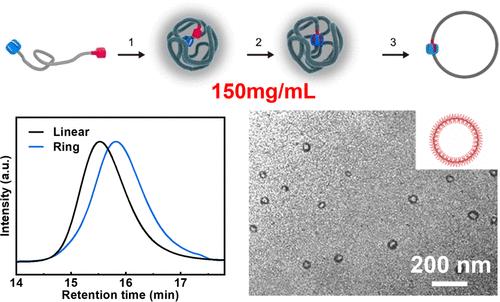
Polymer rings are unique over their linear counterparts in fundamental and engineering aspects. Although ring closure of polymers is a proven general method toward rings, the large-scale synthesis in concentrated solutions remains challenging due to the concurrent intermolecular reactions. Herein, we propose the electrostatic-mediated ring closure of polymers in the dynamic single-chain nanoparticle (SCNP) globular state, enabling large-scale synthesis of highly pure polymer rings at an unprecedentedly high concentration of 150 mg/mL. The dynamic SCNPs are also achieved by the electrostatic-mediated intramolecular cross-linking of polymers in concentrated solutions. Poly(2-(dimethylamino)ethyl methacrylate) (PDMAEMA)-based telechelic polymers are selected to demonstrate the concept. The charged dynamic SCNPs are constructed by simple amine-acid-specific interactions, and thiol–ene and Diels–Alder click reactions are employed for the ring closure to demonstrate the generality. The microstructure and composition of the rings can be tuned from the corresponding polymers with varied segmental sequences and compositions. The topology and function can be further tuned by the favorable growth of functional materials at the desired sites of the polymer rings.
期刊介绍:
Macromolecules publishes original, fundamental, and impactful research on all aspects of polymer science. Topics of interest include synthesis (e.g., controlled polymerizations, polymerization catalysis, post polymerization modification, new monomer structures and polymer architectures, and polymerization mechanisms/kinetics analysis); phase behavior, thermodynamics, dynamic, and ordering/disordering phenomena (e.g., self-assembly, gelation, crystallization, solution/melt/solid-state characteristics); structure and properties (e.g., mechanical and rheological properties, surface/interfacial characteristics, electronic and transport properties); new state of the art characterization (e.g., spectroscopy, scattering, microscopy, rheology), simulation (e.g., Monte Carlo, molecular dynamics, multi-scale/coarse-grained modeling), and theoretical methods. Renewable/sustainable polymers, polymer networks, responsive polymers, electro-, magneto- and opto-active macromolecules, inorganic polymers, charge-transporting polymers (ion-containing, semiconducting, and conducting), nanostructured polymers, and polymer composites are also of interest. Typical papers published in Macromolecules showcase important and innovative concepts, experimental methods/observations, and theoretical/computational approaches that demonstrate a fundamental advance in the understanding of polymers.



 京公网安备 11010802042870号
京ICP备2023020795号-1
京公网安备 11010802042870号
京ICP备2023020795号-1

 分享
分享
 求助内容:
求助内容: 应助结果提醒方式:
 扫码关注我们
