Timothy Harte, Bhagya Dharmasiri, Žan Simon, David J. Hayne, Daniel J. Eyckens and Luke C. Henderson
{"title":"Solvate ionic liquids: past, present and future†","authors":"Timothy Harte, Bhagya Dharmasiri, Žan Simon, David J. Hayne, Daniel J. Eyckens and Luke C. Henderson","doi":"10.1039/D5TA01406A","DOIUrl":null,"url":null,"abstract":"<p >Solvate ionic liquids (SILs) represent an expanding subclass of ionic liquids (ILs), formed through the chelation of the cationic species, typically by an oligoether, and an array of charge diffuse anions. Since their first report, SILs have garnered significant attention for their characteristic ionic liquid physicochemical properties, including high thermal stability, negligible vapour pressure, and tailored solvation dynamics, while being simple to synthesise and cost effective. These factors position SILs as promising candidates for next-generation energy storage applications, including lithium-ion (Li-ion), lithium–sulfur (Li–S), lithium–air (Li–air), lithium-redox, all-solid-state lithium batteries (ASLBs), as well as electric double layer transistors (EDLTs), thermoelectrochemical systems, piezoelectric generators and capacitor/supercapacitor devices. This review traces the evolution of SILs, from foundational studies on their structural and dynamic properties to contemporary advancements in their synthesis and application. SILs modular design potential, through ligand, cation, and anion modifications is evaluated. The multifaceted roles of SILs across various systems are explored, including their applications in electrodeposition and metal extraction, their function as reaction media in organic synthesis, their use as pharmaceutical delivery agents, and their role as constituents and curing catalysts in polymer composites. Furthermore, critical challenges such as optimising ion transport, understanding coordination dynamics, and mitigating environmental impacts are outlined. By integrating experimental insights with computational modeling, this review provides a comprehensive framework to guide future investigations, paving the way for the sustainable development of SILs across scientific and technological domains. SILs reported in the literature predominantly consist of oligoethers G3 (triglyme) or G4 (tetraglyme) chelating a lithium salt such as LiTFSI/LiTFSA/LiNTf<small><sub>2</sub></small>, lithium bis(trifluoromethanesulphonyl)imide.</p>","PeriodicalId":82,"journal":{"name":"Journal of Materials Chemistry A","volume":" 18","pages":" 12746-12784"},"PeriodicalIF":9.5000,"publicationDate":"2025-04-03","publicationTypes":"Journal Article","fieldsOfStudy":null,"isOpenAccess":false,"openAccessPdf":"","citationCount":"0","resultStr":null,"platform":"Semanticscholar","paperid":null,"PeriodicalName":"Journal of Materials Chemistry A","FirstCategoryId":"88","ListUrlMain":"https://pubs.rsc.org/en/content/articlelanding/2025/ta/d5ta01406a","RegionNum":2,"RegionCategory":"材料科学","ArticlePicture":[],"TitleCN":null,"AbstractTextCN":null,"PMCID":null,"EPubDate":"","PubModel":"","JCR":"Q1","JCRName":"CHEMISTRY, PHYSICAL","Score":null,"Total":0}
引用次数: 0
Abstract
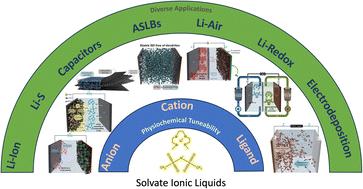
Solvate ionic liquids (SILs) represent an expanding subclass of ionic liquids (ILs), formed through the chelation of the cationic species, typically by an oligoether, and an array of charge diffuse anions. Since their first report, SILs have garnered significant attention for their characteristic ionic liquid physicochemical properties, including high thermal stability, negligible vapour pressure, and tailored solvation dynamics, while being simple to synthesise and cost effective. These factors position SILs as promising candidates for next-generation energy storage applications, including lithium-ion (Li-ion), lithium–sulfur (Li–S), lithium–air (Li–air), lithium-redox, all-solid-state lithium batteries (ASLBs), as well as electric double layer transistors (EDLTs), thermoelectrochemical systems, piezoelectric generators and capacitor/supercapacitor devices. This review traces the evolution of SILs, from foundational studies on their structural and dynamic properties to contemporary advancements in their synthesis and application. SILs modular design potential, through ligand, cation, and anion modifications is evaluated. The multifaceted roles of SILs across various systems are explored, including their applications in electrodeposition and metal extraction, their function as reaction media in organic synthesis, their use as pharmaceutical delivery agents, and their role as constituents and curing catalysts in polymer composites. Furthermore, critical challenges such as optimising ion transport, understanding coordination dynamics, and mitigating environmental impacts are outlined. By integrating experimental insights with computational modeling, this review provides a comprehensive framework to guide future investigations, paving the way for the sustainable development of SILs across scientific and technological domains. SILs reported in the literature predominantly consist of oligoethers G3 (triglyme) or G4 (tetraglyme) chelating a lithium salt such as LiTFSI/LiTFSA/LiNTf2, lithium bis(trifluoromethanesulphonyl)imide.
期刊介绍:
The Journal of Materials Chemistry A, B & C covers a wide range of high-quality studies in the field of materials chemistry, with each section focusing on specific applications of the materials studied. Journal of Materials Chemistry A emphasizes applications in energy and sustainability, including topics such as artificial photosynthesis, batteries, and fuel cells. Journal of Materials Chemistry B focuses on applications in biology and medicine, while Journal of Materials Chemistry C covers applications in optical, magnetic, and electronic devices. Example topic areas within the scope of Journal of Materials Chemistry A include catalysis, green/sustainable materials, sensors, and water treatment, among others.




 京公网安备 11010802042870号
京ICP备2023020795号-1
京公网安备 11010802042870号
京ICP备2023020795号-1

 分享
分享
 求助内容:
求助内容: 应助结果提醒方式:
 扫码关注我们
