Wenqi Li, Yingdong Chen, Tao Chen, Jing Zhao, Qianjin Zhang, Wei Chen, Mingchang Zhang, Haitao Gu and Jiajun Fu
{"title":"A mechanoresponsive elastomeric binder toughened using a supramolecular zwitterionic network for silicon microparticle anodes†","authors":"Wenqi Li, Yingdong Chen, Tao Chen, Jing Zhao, Qianjin Zhang, Wei Chen, Mingchang Zhang, Haitao Gu and Jiajun Fu","doi":"10.1039/D4TA08921A","DOIUrl":null,"url":null,"abstract":"<p >Silicon microparticle (SiMP) anodes are promising candidates for lithium-ion and post-lithium-ion batteries owing to their fewer interfacial reactions and higher tap density than nanostructured silicon anodes. However, the intractable volume expansion/contraction of micro-sized silicon upon cycling results in severe particle pulverization/disintegration and an unstable solid-electrolyte interphase. Binders play an essential role in dissipating huge mechanical stress and promoting the lithium-ion diffusion kinetics of silicon anodes. Herein, we design a mechanoresponsive dual cross-linking elastomeric network that incorporates a supramolecular zwitterionic reorganizable network into a hydrogen-bonded polyacrylic acid network to stabilize the interphase and improve cycling stability of silicon microparticle anodes. Such dual-network design enables effective stress dissipation and spontaneous crack repair <em>via</em> sequential dissociation of weak supramolecular zwitterionic interaction and strong dimeric H-bonds of zwitterions upon repeated lithiation/delithiation. Benefiting from these merits, the resultant SiMP anodes using the mechanoresponsive elastomeric binder exhibit a high reversible capacity of 1625.1 mA h g<small><sup>−1</sup></small> at 2.0 A g<small><sup>−1</sup></small> after 400 cycles. The assembled full cells with LiNi<small><sub>0.8</sub></small>Mn<small><sub>0.1</sub></small>Co<small><sub>0.1</sub></small>O<small><sub>2</sub></small> cathodes afford a reversible capacity of 105.2 mA h g<small><sup>−1</sup></small> after 100 cycles. This work demonstrates the great potential of mechanoresponsive elastomeric binders in developing state-of-the-art high-performance silicon microparticle anodes toward high-energy-density lithium-battery applications.</p>","PeriodicalId":82,"journal":{"name":"Journal of Materials Chemistry A","volume":" 19","pages":" 14324-14334"},"PeriodicalIF":9.5000,"publicationDate":"2025-04-03","publicationTypes":"Journal Article","fieldsOfStudy":null,"isOpenAccess":false,"openAccessPdf":"","citationCount":"0","resultStr":null,"platform":"Semanticscholar","paperid":null,"PeriodicalName":"Journal of Materials Chemistry A","FirstCategoryId":"88","ListUrlMain":"https://pubs.rsc.org/en/content/articlelanding/2025/ta/d4ta08921a","RegionNum":2,"RegionCategory":"材料科学","ArticlePicture":[],"TitleCN":null,"AbstractTextCN":null,"PMCID":null,"EPubDate":"","PubModel":"","JCR":"Q1","JCRName":"CHEMISTRY, PHYSICAL","Score":null,"Total":0}
引用次数: 0
Abstract
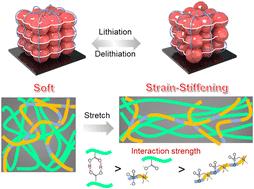
Silicon microparticle (SiMP) anodes are promising candidates for lithium-ion and post-lithium-ion batteries owing to their fewer interfacial reactions and higher tap density than nanostructured silicon anodes. However, the intractable volume expansion/contraction of micro-sized silicon upon cycling results in severe particle pulverization/disintegration and an unstable solid-electrolyte interphase. Binders play an essential role in dissipating huge mechanical stress and promoting the lithium-ion diffusion kinetics of silicon anodes. Herein, we design a mechanoresponsive dual cross-linking elastomeric network that incorporates a supramolecular zwitterionic reorganizable network into a hydrogen-bonded polyacrylic acid network to stabilize the interphase and improve cycling stability of silicon microparticle anodes. Such dual-network design enables effective stress dissipation and spontaneous crack repair via sequential dissociation of weak supramolecular zwitterionic interaction and strong dimeric H-bonds of zwitterions upon repeated lithiation/delithiation. Benefiting from these merits, the resultant SiMP anodes using the mechanoresponsive elastomeric binder exhibit a high reversible capacity of 1625.1 mA h g−1 at 2.0 A g−1 after 400 cycles. The assembled full cells with LiNi0.8Mn0.1Co0.1O2 cathodes afford a reversible capacity of 105.2 mA h g−1 after 100 cycles. This work demonstrates the great potential of mechanoresponsive elastomeric binders in developing state-of-the-art high-performance silicon microparticle anodes toward high-energy-density lithium-battery applications.
硅微粒(SiMP)阳极具有比纳米结构硅阳极更少的界面反应和更高的接枝密度,是锂离子和后锂离子电池的有前途的候选材料。然而,微尺寸硅在循环过程中难以控制的体积膨胀/收缩导致了严重的颗粒粉碎/解体和不稳定的固-电解质界面。粘结剂在消除硅阳极的巨大机械应力和促进锂离子扩散动力学方面起着至关重要的作用。在此,我们设计了一种机械响应的双交联弹性网络,将超分子两性离子可重组网络融入到氢键聚丙烯酸网络中,以稳定界面并提高硅微粒阳极的循环稳定性。这种双网络设计通过反复锂化/去锂化的弱超分子两性离子相互作用和两性离子强二聚氢键的顺序解离,实现了有效的应力耗散和自发裂纹修复。得益于这些优点,使用机械响应弹性粘合剂的SiMP阳极在2.0 a g−1下经过400次循环后显示出1625.1 mAh g−1的高可逆容量。以LiNi0.8Mn0.1Co0.1O2阴极组装的电池在100次循环后的可逆容量为105.2 mAh g−1。这项工作证明了机械响应弹性粘结剂在开发高性能硅微粒阳极用于高能量密度锂电池方面的巨大潜力。
期刊介绍:
The Journal of Materials Chemistry A, B & C covers a wide range of high-quality studies in the field of materials chemistry, with each section focusing on specific applications of the materials studied. Journal of Materials Chemistry A emphasizes applications in energy and sustainability, including topics such as artificial photosynthesis, batteries, and fuel cells. Journal of Materials Chemistry B focuses on applications in biology and medicine, while Journal of Materials Chemistry C covers applications in optical, magnetic, and electronic devices. Example topic areas within the scope of Journal of Materials Chemistry A include catalysis, green/sustainable materials, sensors, and water treatment, among others.



 京公网安备 11010802042870号
京ICP备2023020795号-1
京公网安备 11010802042870号
京ICP备2023020795号-1

 分享
分享
 求助内容:
求助内容: 应助结果提醒方式:
 扫码关注我们
