Amit Nagar, Akhtar Alam, Pradip Pachfule and C. M. Nagaraja
{"title":"Isomeric cyano-vinylene-linked covalent organic frameworks and their impact on photocatalytic hydrogen evolution†","authors":"Amit Nagar, Akhtar Alam, Pradip Pachfule and C. M. Nagaraja","doi":"10.1039/D5TA01539A","DOIUrl":null,"url":null,"abstract":"<p >Covalent organic frameworks (COFs) can be precisely designed through the choice of organic building blocks, bridging linkages and topologies with tailored photophysical properties, which consequently leads to their significantly different photocatalytic performances. Besides, the orientation of the bridge linkages in the COF backbone plays a critical role in facilitating photogenerated charge separation and migration and is one of the most important factors for photocatalysis. Herein, we demonstrate a pair of constitutionally isomeric cyano-vinylene-linked COFs (Py-PaCN and PyCN-Pa) with the same composition but different atomic arrangements of cyano-vinylene linkages to unveil their insightful structure–activity relationship for photocatalytic hydrogen generation <em>via</em> water splitting. The hydrogen evolution rate of Py-PaCN COF reaches up to 12.1 mmol g<small><sup>−1</sup></small> h<small><sup>−1</sup></small> (AQY = 7.15%), which is about three times higher than that of its isomer PyCN-Pa COF with 4.3 mmol g<small><sup>−1</sup></small> h<small><sup>−1</sup></small> (AQY = 2.54%), using ascorbic acid as a sacrificial agent. These minor structural changes in COFs result in remarkable variations in their light-harvesting, optoelectronic, and redox properties, resulting in divergent photocatalytic hydrogen evolution activity. This investigation of the constitutional isomerism of linkages in COFs will help in the selection of the right building blocks with distinct functionality in the design and precise tuning of the photophysical properties of COFs.</p>","PeriodicalId":82,"journal":{"name":"Journal of Materials Chemistry A","volume":" 19","pages":" 14304-14313"},"PeriodicalIF":9.5000,"publicationDate":"2025-04-03","publicationTypes":"Journal Article","fieldsOfStudy":null,"isOpenAccess":false,"openAccessPdf":"","citationCount":"0","resultStr":null,"platform":"Semanticscholar","paperid":null,"PeriodicalName":"Journal of Materials Chemistry A","FirstCategoryId":"88","ListUrlMain":"https://pubs.rsc.org/en/content/articlelanding/2025/ta/d5ta01539a","RegionNum":2,"RegionCategory":"材料科学","ArticlePicture":[],"TitleCN":null,"AbstractTextCN":null,"PMCID":null,"EPubDate":"","PubModel":"","JCR":"Q1","JCRName":"CHEMISTRY, PHYSICAL","Score":null,"Total":0}
引用次数: 0
Abstract
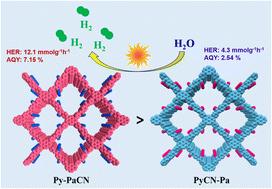
Covalent organic frameworks (COFs) can be precisely designed through the choice of organic building blocks, bridging linkages and topologies with tailored photophysical properties, which consequently leads to their significantly different photocatalytic performances. Besides, the orientation of the bridge linkages in the COF backbone plays a critical role in facilitating photogenerated charge separation and migration and is one of the most important factors for photocatalysis. Herein, we demonstrate a pair of constitutionally isomeric cyano-vinylene-linked COFs (Py-PaCN and PyCN-Pa) with the same composition but different atomic arrangements of cyano-vinylene linkages to unveil their insightful structure–activity relationship for photocatalytic hydrogen generation via water splitting. The hydrogen evolution rate of Py-PaCN COF reaches up to 12.1 mmol g−1 h−1 (AQY = 7.15%), which is about three times higher than that of its isomer PyCN-Pa COF with 4.3 mmol g−1 h−1 (AQY = 2.54%), using ascorbic acid as a sacrificial agent. These minor structural changes in COFs result in remarkable variations in their light-harvesting, optoelectronic, and redox properties, resulting in divergent photocatalytic hydrogen evolution activity. This investigation of the constitutional isomerism of linkages in COFs will help in the selection of the right building blocks with distinct functionality in the design and precise tuning of the photophysical properties of COFs.
期刊介绍:
The Journal of Materials Chemistry A, B & C covers a wide range of high-quality studies in the field of materials chemistry, with each section focusing on specific applications of the materials studied. Journal of Materials Chemistry A emphasizes applications in energy and sustainability, including topics such as artificial photosynthesis, batteries, and fuel cells. Journal of Materials Chemistry B focuses on applications in biology and medicine, while Journal of Materials Chemistry C covers applications in optical, magnetic, and electronic devices. Example topic areas within the scope of Journal of Materials Chemistry A include catalysis, green/sustainable materials, sensors, and water treatment, among others.



 京公网安备 11010802042870号
京ICP备2023020795号-1
京公网安备 11010802042870号
京ICP备2023020795号-1

 分享
分享
 求助内容:
求助内容: 应助结果提醒方式:
 扫码关注我们
