Wanqing Deng, Yangsen Xu, Xirui Zhang, Jiaojiao Xia, Kang Xu, Hui Gao, Bote Zhao and Yu Chen
{"title":"Achieving active and durable oxygen reduction/evolution reactions on protonic ceramic electrochemical cells with spinel-based air electrodes†","authors":"Wanqing Deng, Yangsen Xu, Xirui Zhang, Jiaojiao Xia, Kang Xu, Hui Gao, Bote Zhao and Yu Chen","doi":"10.1039/D4TA08703H","DOIUrl":null,"url":null,"abstract":"<p >Reversible protonic ceramic electrochemical cells (R-PCECs) have demonstrated great potential for efficient energy conversion and storage, and are expected to break through the limitations in traditional cell systems. However, the performance of R-PCECs is often constrained by the air electrode, where oxygen reduction/evolution reactions occur. Herein, we report a composite electrode of spinel oxide MnCo<small><sub>1.9</sub></small>Cu<small><sub>0.1</sub></small>O<small><sub>4</sub></small> (MCCO) and BaZr<small><sub>0.8</sub></small>Y<small><sub>0.2</sub></small>O<small><sub>3</sub></small> (BZY), at an optimized ratio of MCCO to BZY = 9 : 1, showing a low area-specific resistance of 0.107 Ω cm<small><sup>2</sup></small> at 700 °C. R-PCECs with this composite air electrode exhibit high performance: a maximum power density (<em>P</em><small><sub>max</sub></small>) of 1.81 W cm<small><sup>−2</sup></small> in fuel cell mode, and a current density of −3.57 A cm<small><sup>−2</sup></small> at 1.3 V in electrolysis mode at 700 °C. Moreover, the cells demonstrate remarkable stability in reversible operation for 70 hours and 15 cycles during cycling testing, at ±0.5 A cm<small><sup>−2</sup></small>. The enhanced activity and durability are likely attributed to the facilitated oxygen/proton transport and the increased concentration of oxygen vacancies after Cu doping, as indicated by the analyses of X-ray photoelectron spectroscopy and distribution of relaxation time.</p>","PeriodicalId":82,"journal":{"name":"Journal of Materials Chemistry A","volume":" 21","pages":" 15636-15644"},"PeriodicalIF":9.5000,"publicationDate":"2025-04-03","publicationTypes":"Journal Article","fieldsOfStudy":null,"isOpenAccess":false,"openAccessPdf":"","citationCount":"0","resultStr":null,"platform":"Semanticscholar","paperid":null,"PeriodicalName":"Journal of Materials Chemistry A","FirstCategoryId":"88","ListUrlMain":"https://pubs.rsc.org/en/content/articlelanding/2025/ta/d4ta08703h","RegionNum":2,"RegionCategory":"材料科学","ArticlePicture":[],"TitleCN":null,"AbstractTextCN":null,"PMCID":null,"EPubDate":"","PubModel":"","JCR":"Q1","JCRName":"CHEMISTRY, PHYSICAL","Score":null,"Total":0}
引用次数: 0
Abstract
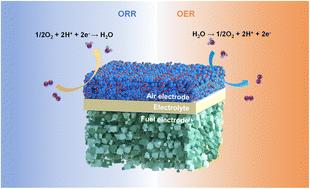
Reversible protonic ceramic electrochemical cells (R-PCECs) have demonstrated great potential for efficient energy conversion and storage, and are expected to break through the limitations in traditional cell systems. However, the performance of R-PCECs is often constrained by the air electrode, where oxygen reduction/evolution reactions occur. Herein, we report a composite electrode of spinel oxide MnCo1.9Cu0.1O4 (MCCO) and BaZr0.8Y0.2O3 (BZY), at an optimized ratio of MCCO to BZY = 9 : 1, showing a low area-specific resistance of 0.107 Ω cm2 at 700 °C. R-PCECs with this composite air electrode exhibit high performance: a maximum power density (Pmax) of 1.81 W cm−2 in fuel cell mode, and a current density of −3.57 A cm−2 at 1.3 V in electrolysis mode at 700 °C. Moreover, the cells demonstrate remarkable stability in reversible operation for 70 hours and 15 cycles during cycling testing, at ±0.5 A cm−2. The enhanced activity and durability are likely attributed to the facilitated oxygen/proton transport and the increased concentration of oxygen vacancies after Cu doping, as indicated by the analyses of X-ray photoelectron spectroscopy and distribution of relaxation time.
期刊介绍:
The Journal of Materials Chemistry A, B & C covers a wide range of high-quality studies in the field of materials chemistry, with each section focusing on specific applications of the materials studied. Journal of Materials Chemistry A emphasizes applications in energy and sustainability, including topics such as artificial photosynthesis, batteries, and fuel cells. Journal of Materials Chemistry B focuses on applications in biology and medicine, while Journal of Materials Chemistry C covers applications in optical, magnetic, and electronic devices. Example topic areas within the scope of Journal of Materials Chemistry A include catalysis, green/sustainable materials, sensors, and water treatment, among others.



 京公网安备 11010802042870号
京ICP备2023020795号-1
京公网安备 11010802042870号
京ICP备2023020795号-1

 分享
分享
 求助内容:
求助内容: 应助结果提醒方式:
 扫码关注我们
