Patrick Fernandes Rodrigues, Shitong Wu, Tihana Trsan, Santosh K. Panda, José Luís Fachi, Yizhou Liu, Siling Du, Sarah de Oliveira, Alina Ulezko Antonova, Darya Khantakova, Raki Sudan, Pritesh Desai, Michael S. Diamond, Susan Gilfillan, Stephen K. Anderson, Marina Cella, Marco Colonna
{"title":"Rorγt-positive dendritic cells are required for the induction of peripheral regulatory T cells in response to oral antigens","authors":"Patrick Fernandes Rodrigues, Shitong Wu, Tihana Trsan, Santosh K. Panda, José Luís Fachi, Yizhou Liu, Siling Du, Sarah de Oliveira, Alina Ulezko Antonova, Darya Khantakova, Raki Sudan, Pritesh Desai, Michael S. Diamond, Susan Gilfillan, Stephen K. Anderson, Marina Cella, Marco Colonna","doi":"10.1016/j.cell.2025.03.020","DOIUrl":null,"url":null,"abstract":"The intestinal immune system maintains tolerance to harmless food proteins and gut microbiota through peripherally derived RORγt<sup>+</sup> Tregs (pTregs), which prevent food intolerance and inflammatory bowel disease. Recent studies suggested that RORγt<sup>+</sup> antigen-presenting cells (APCs), which encompass rare dendritic cell (DC) subsets and type 3 innate lymphoid cells (ILC3s), are key to pTreg induction. Here, we developed a mouse with reduced RORγt<sup>+</sup> APCs by deleting a specific <em>cis</em>-regulatory element of <em>Rorc</em> encoding RORγt. Single-cell RNA sequencing and flow cytometry analyses confirmed the depletion of a RORγt<sup>+</sup> DC subset and ILC3s. These mice showed a secondary reduction in pTregs, impaired tolerance to oral antigens, and an increase in T helper (Th)2 cells. Conversely, ILC3-deficient mice showed no pTregs or Th2 cell abnormalities. Lineage tracing revealed that RORγt<sup>+</sup> DCs share a lymphoid origin with ILC3s, consistent with their similar phenotypic traits. These findings highlight the role of lymphoid RORγt<sup>+</sup> DCs in maintaining intestinal immune balance and preventing conditions like food allergies.","PeriodicalId":9656,"journal":{"name":"Cell","volume":"73 1","pages":""},"PeriodicalIF":42.5000,"publicationDate":"2025-04-03","publicationTypes":"Journal Article","fieldsOfStudy":null,"isOpenAccess":false,"openAccessPdf":"","citationCount":"0","resultStr":null,"platform":"Semanticscholar","paperid":null,"PeriodicalName":"Cell","FirstCategoryId":"99","ListUrlMain":"https://doi.org/10.1016/j.cell.2025.03.020","RegionNum":1,"RegionCategory":"生物学","ArticlePicture":[],"TitleCN":null,"AbstractTextCN":null,"PMCID":null,"EPubDate":"","PubModel":"","JCR":"Q1","JCRName":"BIOCHEMISTRY & MOLECULAR BIOLOGY","Score":null,"Total":0}
引用次数: 0
Abstract
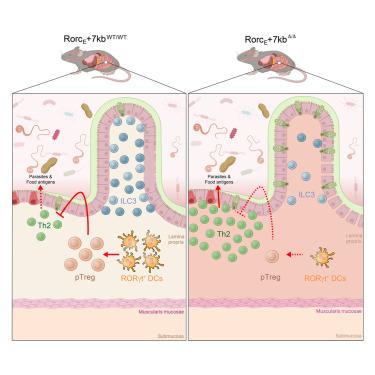
The intestinal immune system maintains tolerance to harmless food proteins and gut microbiota through peripherally derived RORγt+ Tregs (pTregs), which prevent food intolerance and inflammatory bowel disease. Recent studies suggested that RORγt+ antigen-presenting cells (APCs), which encompass rare dendritic cell (DC) subsets and type 3 innate lymphoid cells (ILC3s), are key to pTreg induction. Here, we developed a mouse with reduced RORγt+ APCs by deleting a specific cis-regulatory element of Rorc encoding RORγt. Single-cell RNA sequencing and flow cytometry analyses confirmed the depletion of a RORγt+ DC subset and ILC3s. These mice showed a secondary reduction in pTregs, impaired tolerance to oral antigens, and an increase in T helper (Th)2 cells. Conversely, ILC3-deficient mice showed no pTregs or Th2 cell abnormalities. Lineage tracing revealed that RORγt+ DCs share a lymphoid origin with ILC3s, consistent with their similar phenotypic traits. These findings highlight the role of lymphoid RORγt+ DCs in maintaining intestinal immune balance and preventing conditions like food allergies.
期刊介绍:
Cells is an international, peer-reviewed, open access journal that focuses on cell biology, molecular biology, and biophysics. It is affiliated with several societies, including the Spanish Society for Biochemistry and Molecular Biology (SEBBM), Nordic Autophagy Society (NAS), Spanish Society of Hematology and Hemotherapy (SEHH), and Society for Regenerative Medicine (Russian Federation) (RPO).
The journal publishes research findings of significant importance in various areas of experimental biology, such as cell biology, molecular biology, neuroscience, immunology, virology, microbiology, cancer, human genetics, systems biology, signaling, and disease mechanisms and therapeutics. The primary criterion for considering papers is whether the results contribute to significant conceptual advances or raise thought-provoking questions and hypotheses related to interesting and important biological inquiries.
In addition to primary research articles presented in four formats, Cells also features review and opinion articles in its "leading edge" section, discussing recent research advancements and topics of interest to its wide readership.



 京公网安备 11010802042870号
京ICP备2023020795号-1
京公网安备 11010802042870号
京ICP备2023020795号-1

 分享
分享
 求助内容:
求助内容: 应助结果提醒方式:
 扫码关注我们
