Jiaxin He, Yu Han, Xiao Xu, Miao Sun, Longtian Kang, Wenlie Lin and Jingjing Liu
{"title":"Controllable dispersion of nickel phthalocyanine molecules on graphene oxide for efficient electrocatalytic CO2 reduction†","authors":"Jiaxin He, Yu Han, Xiao Xu, Miao Sun, Longtian Kang, Wenlie Lin and Jingjing Liu","doi":"10.1039/D5TA01623A","DOIUrl":null,"url":null,"abstract":"<p >Single-atom electrocatalysts with Ni–N<small><sub><em>x</em></sub></small>–C sites usually possess excellent activity for the CO<small><sub>2</sub></small> reduction reaction (CO<small><sub>2</sub></small>RR). However, it still remains a challenge to synthesize them using unmodified nickel phthalocyanine (NiPc) with an intrinsic Ni–N<small><sub>4</sub></small>–C moiety at room temperature. Here, NiPc molecules are controllably dispersed on graphene oxide (GO) in the form of single molecules, dimers, or aggregates through a simple hydrolysis of protonated NiPc in a GO-containing aqueous phase. Systematic characterization shows the existence of π–π interaction, hydrogen bond and axial coordination between NiPc and GO in NiPc–GO composites. Electrochemical tests demonstrate that these NiPc–GO composites have high activity for electrocatalytic CO<small><sub>2</sub></small>RR to CO. After optimizing the GO content in NiPc–GO, a CO Faraday efficiency of >90% is achieved over a work potential range of −0.8 to −1.1 <em>V</em><small><sub>RHE</sub></small>, reaching up to 98.6% at −0.9 <em>V</em><small><sub>RHE</sub></small>. Further experiments confirm that GO in NiPc–GO benefits CO<small><sub>2</sub></small> adsorption and formation of the *COOH intermediate. The change in the Ni<small><sup>2+</sup></small>/Ni<small><sup>3+</sup></small> ratio with the GO amount in NiPc–GO composites reveals that the Ni(<small>II</small>)/Ni(<small>III</small>)/GO heterojunction structure is the most conductive to the CO<small><sub>2</sub></small>RR process. This work provides an insight into the design and synthesis of single-atom Ni–N<small><sub>4</sub></small>–C electrocatalysts for the CO<small><sub>2</sub></small>RR.</p>","PeriodicalId":82,"journal":{"name":"Journal of Materials Chemistry A","volume":" 21","pages":" 15762-15772"},"PeriodicalIF":9.5000,"publicationDate":"2025-04-02","publicationTypes":"Journal Article","fieldsOfStudy":null,"isOpenAccess":false,"openAccessPdf":"","citationCount":"0","resultStr":null,"platform":"Semanticscholar","paperid":null,"PeriodicalName":"Journal of Materials Chemistry A","FirstCategoryId":"88","ListUrlMain":"https://pubs.rsc.org/en/content/articlelanding/2025/ta/d5ta01623a","RegionNum":2,"RegionCategory":"材料科学","ArticlePicture":[],"TitleCN":null,"AbstractTextCN":null,"PMCID":null,"EPubDate":"","PubModel":"","JCR":"Q1","JCRName":"CHEMISTRY, PHYSICAL","Score":null,"Total":0}
引用次数: 0
Abstract
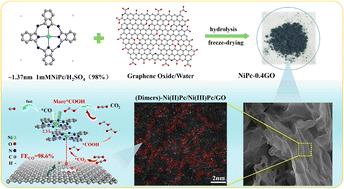
Single-atom electrocatalysts with Ni–Nx–C sites usually possess excellent activity for the CO2 reduction reaction (CO2RR). However, it still remains a challenge to synthesize them using unmodified nickel phthalocyanine (NiPc) with an intrinsic Ni–N4–C moiety at room temperature. Here, NiPc molecules are controllably dispersed on graphene oxide (GO) in the form of single molecules, dimers, or aggregates through a simple hydrolysis of protonated NiPc in a GO-containing aqueous phase. Systematic characterization shows the existence of π–π interaction, hydrogen bond and axial coordination between NiPc and GO in NiPc–GO composites. Electrochemical tests demonstrate that these NiPc–GO composites have high activity for electrocatalytic CO2RR to CO. After optimizing the GO content in NiPc–GO, a CO Faraday efficiency of >90% is achieved over a work potential range of −0.8 to −1.1 VRHE, reaching up to 98.6% at −0.9 VRHE. Further experiments confirm that GO in NiPc–GO benefits CO2 adsorption and formation of the *COOH intermediate. The change in the Ni2+/Ni3+ ratio with the GO amount in NiPc–GO composites reveals that the Ni(II)/Ni(III)/GO heterojunction structure is the most conductive to the CO2RR process. This work provides an insight into the design and synthesis of single-atom Ni–N4–C electrocatalysts for the CO2RR.
期刊介绍:
The Journal of Materials Chemistry A, B & C covers a wide range of high-quality studies in the field of materials chemistry, with each section focusing on specific applications of the materials studied. Journal of Materials Chemistry A emphasizes applications in energy and sustainability, including topics such as artificial photosynthesis, batteries, and fuel cells. Journal of Materials Chemistry B focuses on applications in biology and medicine, while Journal of Materials Chemistry C covers applications in optical, magnetic, and electronic devices. Example topic areas within the scope of Journal of Materials Chemistry A include catalysis, green/sustainable materials, sensors, and water treatment, among others.



 京公网安备 11010802042870号
京ICP备2023020795号-1
京公网安备 11010802042870号
京ICP备2023020795号-1

 分享
分享
 求助内容:
求助内容: 应助结果提醒方式:
 扫码关注我们
