{"title":"A non-isothermal water formation cell for electrochemical heat recovery†","authors":"Ritwik Mondal, Shyaam Srirangadhamu Yuvaraj, Bhojkumar Nayak, Hemanga Pradhan and Musthafa Ottakam Thotiyl","doi":"10.1039/D5SC00892A","DOIUrl":null,"url":null,"abstract":"<p >Low-grade heat harvesting has emerged as a promising strategy to recover waste heat into usable energy. However, most of the thermo-electrochemical approaches are limited to redox reactions involving metal ion complexes and halide species, which often exhibit low heat-to-electricity conversion efficiencies. We demonstrate a heat harvesting approach based on a non-redox reaction; water formation driven by a net-zero hydrogen redox process. Under standard conditions, its positive entropy change enables the interconversion of nearly 30% of surrounding heat into electrical energy, resulting in a thermodynamic efficiency greater than unity. This water formation-based galvanic–thermogalvanic device demonstrated a temperature-insensitive maximum power density as high as ∼33.55 mW m<small><sup>−2</sup></small> K<small><sup>−2</sup></small>. Notably, this figure of merit is ∼70 times higher than the state-of-the-art ferrocyanide–ferricyanide-based thermogalvanic devices, thereby extending the scope of electrochemical heat harvesting beyond conventional redox processes.</p>","PeriodicalId":9909,"journal":{"name":"Chemical Science","volume":" 18","pages":" 7751-7758"},"PeriodicalIF":7.4000,"publicationDate":"2025-04-03","publicationTypes":"Journal Article","fieldsOfStudy":null,"isOpenAccess":false,"openAccessPdf":"https://pubs.rsc.org/en/content/articlepdf/2025/sc/d5sc00892a?page=search","citationCount":"0","resultStr":null,"platform":"Semanticscholar","paperid":null,"PeriodicalName":"Chemical Science","FirstCategoryId":"92","ListUrlMain":"https://pubs.rsc.org/en/content/articlelanding/2025/sc/d5sc00892a","RegionNum":1,"RegionCategory":"化学","ArticlePicture":[],"TitleCN":null,"AbstractTextCN":null,"PMCID":null,"EPubDate":"","PubModel":"","JCR":"Q1","JCRName":"CHEMISTRY, MULTIDISCIPLINARY","Score":null,"Total":0}
引用次数: 0
Abstract
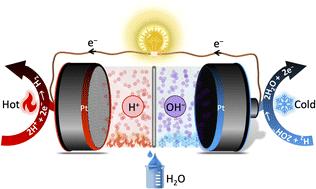
Low-grade heat harvesting has emerged as a promising strategy to recover waste heat into usable energy. However, most of the thermo-electrochemical approaches are limited to redox reactions involving metal ion complexes and halide species, which often exhibit low heat-to-electricity conversion efficiencies. We demonstrate a heat harvesting approach based on a non-redox reaction; water formation driven by a net-zero hydrogen redox process. Under standard conditions, its positive entropy change enables the interconversion of nearly 30% of surrounding heat into electrical energy, resulting in a thermodynamic efficiency greater than unity. This water formation-based galvanic–thermogalvanic device demonstrated a temperature-insensitive maximum power density as high as ∼33.55 mW m−2 K−2. Notably, this figure of merit is ∼70 times higher than the state-of-the-art ferrocyanide–ferricyanide-based thermogalvanic devices, thereby extending the scope of electrochemical heat harvesting beyond conventional redox processes.
期刊介绍:
Chemical Science is a journal that encompasses various disciplines within the chemical sciences. Its scope includes publishing ground-breaking research with significant implications for its respective field, as well as appealing to a wider audience in related areas. To be considered for publication, articles must showcase innovative and original advances in their field of study and be presented in a manner that is understandable to scientists from diverse backgrounds. However, the journal generally does not publish highly specialized research.




 京公网安备 11010802042870号
京ICP备2023020795号-1
京公网安备 11010802042870号
京ICP备2023020795号-1

 分享
分享
 求助内容:
求助内容: 应助结果提醒方式:
 扫码关注我们
