{"title":"Energy Transfer from a Perovskite Nanocrystal to Cyanine Dyes Depending on Spectral Overlap Revealed by a Single-Particle Spectroscopy","authors":"Kaho Matsunaga, Issei Inoue, Seiju Koyama, Tetsuo Yamaguchi, Mitsuaki Yamauchi, Sadahiro Masuo","doi":"10.1021/acs.nanolett.5c00337","DOIUrl":null,"url":null,"abstract":"Investigation of the energy transfer (ET) between perovskite nanocrystals (PNCs) and organic dyes is crucial because PNCs are suitable donor materials for creating photosensitizer systems. In this study, we investigated the relationship between a singlet ET mechanism and spectral overlap using CsPbBr<sub>3</sub> PNC–cyanine dyes─Cy3 and Cy5. We prepared PNC–dye linkage systems and investigated the ET at the single-PNC levels. The results of our study reveal that efficient ET occurs via fluorescence resonance ET (FRET) in the PNC–Cy3 system. Even in the PNC–Cy5 system, where the spectral overlap integral is 1 order of magnitude smaller than in the PNC–Cy3 system, efficient ET is observed, suggesting the occurrence of Dexter-type ET (DET). These results clearly demonstrate the change in the ET mechanism between FRET and DET depending on the spectral overlap. These findings are important for understanding exciton dynamics in PNC–organic molecule hybrid systems.","PeriodicalId":53,"journal":{"name":"Nano Letters","volume":"73 1","pages":""},"PeriodicalIF":9.1000,"publicationDate":"2025-04-03","publicationTypes":"Journal Article","fieldsOfStudy":null,"isOpenAccess":false,"openAccessPdf":"","citationCount":"0","resultStr":null,"platform":"Semanticscholar","paperid":null,"PeriodicalName":"Nano Letters","FirstCategoryId":"88","ListUrlMain":"https://doi.org/10.1021/acs.nanolett.5c00337","RegionNum":1,"RegionCategory":"材料科学","ArticlePicture":[],"TitleCN":null,"AbstractTextCN":null,"PMCID":null,"EPubDate":"","PubModel":"","JCR":"Q1","JCRName":"CHEMISTRY, MULTIDISCIPLINARY","Score":null,"Total":0}
引用次数: 0
Abstract
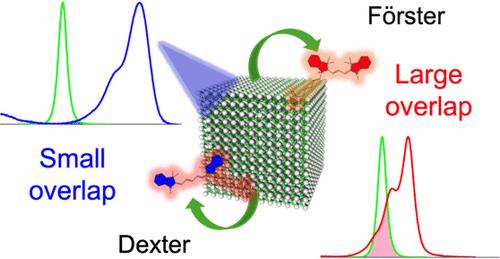
Investigation of the energy transfer (ET) between perovskite nanocrystals (PNCs) and organic dyes is crucial because PNCs are suitable donor materials for creating photosensitizer systems. In this study, we investigated the relationship between a singlet ET mechanism and spectral overlap using CsPbBr3 PNC–cyanine dyes─Cy3 and Cy5. We prepared PNC–dye linkage systems and investigated the ET at the single-PNC levels. The results of our study reveal that efficient ET occurs via fluorescence resonance ET (FRET) in the PNC–Cy3 system. Even in the PNC–Cy5 system, where the spectral overlap integral is 1 order of magnitude smaller than in the PNC–Cy3 system, efficient ET is observed, suggesting the occurrence of Dexter-type ET (DET). These results clearly demonstrate the change in the ET mechanism between FRET and DET depending on the spectral overlap. These findings are important for understanding exciton dynamics in PNC–organic molecule hybrid systems.
期刊介绍:
Nano Letters serves as a dynamic platform for promptly disseminating original results in fundamental, applied, and emerging research across all facets of nanoscience and nanotechnology. A pivotal criterion for inclusion within Nano Letters is the convergence of at least two different areas or disciplines, ensuring a rich interdisciplinary scope. The journal is dedicated to fostering exploration in diverse areas, including:
- Experimental and theoretical findings on physical, chemical, and biological phenomena at the nanoscale
- Synthesis, characterization, and processing of organic, inorganic, polymer, and hybrid nanomaterials through physical, chemical, and biological methodologies
- Modeling and simulation of synthetic, assembly, and interaction processes
- Realization of integrated nanostructures and nano-engineered devices exhibiting advanced performance
- Applications of nanoscale materials in living and environmental systems
Nano Letters is committed to advancing and showcasing groundbreaking research that intersects various domains, fostering innovation and collaboration in the ever-evolving field of nanoscience and nanotechnology.



 京公网安备 11010802042870号
京ICP备2023020795号-1
京公网安备 11010802042870号
京ICP备2023020795号-1

 分享
分享
 求助内容:
求助内容: 应助结果提醒方式:
 扫码关注我们
