Hanny Tika Draviana, Istikhori Fitriannisa, Achmad Jazidie, Dyah Ika Krisnawati, Muhamad Khafid and Tsung-Rong Kuo*,
{"title":"Antibacterial Mechanisms of Negatively and Positively Charged Ligands on Gold Nanoclusters","authors":"Hanny Tika Draviana, Istikhori Fitriannisa, Achmad Jazidie, Dyah Ika Krisnawati, Muhamad Khafid and Tsung-Rong Kuo*, ","doi":"10.1021/acsanm.4c07269","DOIUrl":null,"url":null,"abstract":"<p >Gold nanoclusters (AuNCs) with surface ligand modifications have been developed as antibacterial agents. While understanding the mechanisms and efficacy of bacterial killing is crucial for determining the clinical applications of AuNCs, the effects of different surface charges on their antibacterial mechanisms are still not well understood. Herein, the AuNCs were synthesized with a negatively charged ligand, 6-mercaptohexanoic acid (AuNCs-MHA), and with a positively charged ligand, 4,6-diamino-2-mercaptopyrimidine (AuNCs-DAMP), via a simple one-pot method. The successful preparations of both AuNCs were confirmed by their optical and structural characterizations. Antibacterial activities of the positive and negative surface charges of AuNCs against Gram-negative bacterium <i>Escherichia coli</i> and Gram-positive bacterium <i>Staphylococcus aureus</i> were observed by analyzing bacterial growth curves and reactive oxygen species (ROS) generation. The bacterial growth curves revealed that the antibacterial activity of AuNCs increased in direct proportion to their weight concentration, and the generation of ROS confirmed this finding. In agar plate assays, the antibacterial activity of positively charged AuNCs-DAMP was more potent than that of negatively charged AuNCs-MHA. Based on the Scanning Electron Microscopy (SEM) observation, the positively charged AuNCs-DAMP had a better antibacterial effect compared to the negative surface charge of AuNCs-MHA, showing that the clusters had electrostatic interactions and van der Waals forces between the negatively charged bacterial membrane and cationic AuNCs.</p>","PeriodicalId":6,"journal":{"name":"ACS Applied Nano Materials","volume":"8 13","pages":"6380–6390 6380–6390"},"PeriodicalIF":5.5000,"publicationDate":"2025-03-26","publicationTypes":"Journal Article","fieldsOfStudy":null,"isOpenAccess":false,"openAccessPdf":"https://pubs.acs.org/doi/epdf/10.1021/acsanm.4c07269","citationCount":"0","resultStr":null,"platform":"Semanticscholar","paperid":null,"PeriodicalName":"ACS Applied Nano Materials","FirstCategoryId":"88","ListUrlMain":"https://pubs.acs.org/doi/10.1021/acsanm.4c07269","RegionNum":2,"RegionCategory":"材料科学","ArticlePicture":[],"TitleCN":null,"AbstractTextCN":null,"PMCID":null,"EPubDate":"","PubModel":"","JCR":"Q2","JCRName":"MATERIALS SCIENCE, MULTIDISCIPLINARY","Score":null,"Total":0}
引用次数: 0
Abstract
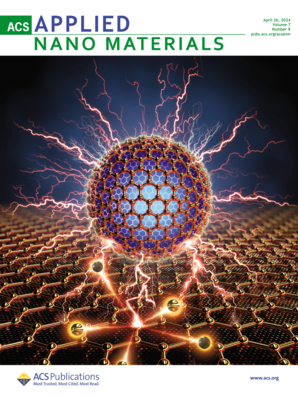
Gold nanoclusters (AuNCs) with surface ligand modifications have been developed as antibacterial agents. While understanding the mechanisms and efficacy of bacterial killing is crucial for determining the clinical applications of AuNCs, the effects of different surface charges on their antibacterial mechanisms are still not well understood. Herein, the AuNCs were synthesized with a negatively charged ligand, 6-mercaptohexanoic acid (AuNCs-MHA), and with a positively charged ligand, 4,6-diamino-2-mercaptopyrimidine (AuNCs-DAMP), via a simple one-pot method. The successful preparations of both AuNCs were confirmed by their optical and structural characterizations. Antibacterial activities of the positive and negative surface charges of AuNCs against Gram-negative bacterium Escherichia coli and Gram-positive bacterium Staphylococcus aureus were observed by analyzing bacterial growth curves and reactive oxygen species (ROS) generation. The bacterial growth curves revealed that the antibacterial activity of AuNCs increased in direct proportion to their weight concentration, and the generation of ROS confirmed this finding. In agar plate assays, the antibacterial activity of positively charged AuNCs-DAMP was more potent than that of negatively charged AuNCs-MHA. Based on the Scanning Electron Microscopy (SEM) observation, the positively charged AuNCs-DAMP had a better antibacterial effect compared to the negative surface charge of AuNCs-MHA, showing that the clusters had electrostatic interactions and van der Waals forces between the negatively charged bacterial membrane and cationic AuNCs.
期刊介绍:
ACS Applied Nano Materials is an interdisciplinary journal publishing original research covering all aspects of engineering, chemistry, physics and biology relevant to applications of nanomaterials. The journal is devoted to reports of new and original experimental and theoretical research of an applied nature that integrate knowledge in the areas of materials, engineering, physics, bioscience, and chemistry into important applications of nanomaterials.



 京公网安备 11010802042870号
京ICP备2023020795号-1
京公网安备 11010802042870号
京ICP备2023020795号-1

 分享
分享
 求助内容:
求助内容: 应助结果提醒方式:
 扫码关注我们
