Chunnian Xia , Xinyi Wu , Bingyang Wang , Han Zhang , Kailin Chen , Nuoqi Jin , Qiangsheng Sun , Wei Sun
{"title":"Efficient fixation of CO2 with epoxides catalyzed by Mg(II)-N4 complexes","authors":"Chunnian Xia , Xinyi Wu , Bingyang Wang , Han Zhang , Kailin Chen , Nuoqi Jin , Qiangsheng Sun , Wei Sun","doi":"10.1016/j.mcat.2025.115090","DOIUrl":null,"url":null,"abstract":"<div><div>In this study, a series of Mg(II) complexes supported by aminopyridine-N4 (MEP, DAP, TPA) and TMC (14-TMC) ligands were synthesized and characterized using various spectroscopic techniques. These Mg(II) complexes were investigated the catalytic activity for the cycloaddition of carbon dioxide with epoxides to obtain cyclic carbonates under cocatalyst- and solvent-free conditions, providing moderate to excellent yields depending on the specific N4 ligands used. The study involved analyzing the spectroscopic characterizations and experimental results to discuss the possible ligand topological structures of Mg-N4 complexes and their impact on catalytic performance. Moreover, the addition of (triphenylphosphoranylidene)ammonium chloride (PPNCl) as a cocatalyst significantly enhanced the turnover frequency (TOF) to 2100 h<sup>-1</sup> for the <strong>Mg-1</strong> [MEP-Mg(II), 0.01 mol % catalyst loading]. Also, the <strong>Mg-1</strong> catalyst demonstrates excellent stability under the reaction conditions, allowing for multiple reuses.</div></div>","PeriodicalId":393,"journal":{"name":"Molecular Catalysis","volume":"579 ","pages":"Article 115090"},"PeriodicalIF":4.9000,"publicationDate":"2025-05-15","publicationTypes":"Journal Article","fieldsOfStudy":null,"isOpenAccess":false,"openAccessPdf":"","citationCount":"0","resultStr":null,"platform":"Semanticscholar","paperid":null,"PeriodicalName":"Molecular Catalysis","FirstCategoryId":"92","ListUrlMain":"https://www.sciencedirect.com/science/article/pii/S2468823125002767","RegionNum":2,"RegionCategory":"化学","ArticlePicture":[],"TitleCN":null,"AbstractTextCN":null,"PMCID":null,"EPubDate":"2025/4/4 0:00:00","PubModel":"Epub","JCR":"Q2","JCRName":"CHEMISTRY, PHYSICAL","Score":null,"Total":0}
引用次数: 0
Abstract
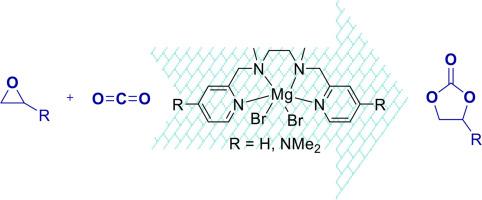
In this study, a series of Mg(II) complexes supported by aminopyridine-N4 (MEP, DAP, TPA) and TMC (14-TMC) ligands were synthesized and characterized using various spectroscopic techniques. These Mg(II) complexes were investigated the catalytic activity for the cycloaddition of carbon dioxide with epoxides to obtain cyclic carbonates under cocatalyst- and solvent-free conditions, providing moderate to excellent yields depending on the specific N4 ligands used. The study involved analyzing the spectroscopic characterizations and experimental results to discuss the possible ligand topological structures of Mg-N4 complexes and their impact on catalytic performance. Moreover, the addition of (triphenylphosphoranylidene)ammonium chloride (PPNCl) as a cocatalyst significantly enhanced the turnover frequency (TOF) to 2100 h-1 for the Mg-1 [MEP-Mg(II), 0.01 mol % catalyst loading]. Also, the Mg-1 catalyst demonstrates excellent stability under the reaction conditions, allowing for multiple reuses.
期刊介绍:
Molecular Catalysis publishes full papers that are original, rigorous, and scholarly contributions examining the molecular and atomic aspects of catalytic activation and reaction mechanisms. The fields covered are:
Heterogeneous catalysis including immobilized molecular catalysts
Homogeneous catalysis including organocatalysis, organometallic catalysis and biocatalysis
Photo- and electrochemistry
Theoretical aspects of catalysis analyzed by computational methods



 京公网安备 11010802042870号
京ICP备2023020795号-1
京公网安备 11010802042870号
京ICP备2023020795号-1

 分享
分享
 求助内容:
求助内容: 应助结果提醒方式:
 扫码关注我们
