Synthesis, properties and photocatalytic activities of iridium(Ⅲ) complexes based on the derivatives of imidazo[1,5-a]pyridine with electron-withdrawing groups
{"title":"Synthesis, properties and photocatalytic activities of iridium(Ⅲ) complexes based on the derivatives of imidazo[1,5-a]pyridine with electron-withdrawing groups","authors":"Biqin Wang, Xiaohan Yang, Yahong Li","doi":"10.1016/j.mcat.2025.115083","DOIUrl":null,"url":null,"abstract":"<div><div>Twelve cationic cyclometalated iridium(III) complexes with the general formula [Ir(C^N)<sub>2</sub>(N^N)]PF<sub>6</sub> (<strong>Ir1</strong>-<strong>Ir12</strong>), where C^N are cyclometalated ligands, including 2-(2,4-difluorophenyl)pyridine (dfppy), 2-(4-(trifluoromethyl)phenyl) pyridine (CF<sub>3</sub>ppy), and 1-(4-(trifluoromethyl)phenyl)isoquinoline (CF<sub>3</sub>piq) and where N^N represents 3-(pyridin-2-yl)imidazo[1,5-a]pyridine-based ancillary ligands, were successfully synthesized and structurally characterized via NMR and X-ray diffraction. The targets of this work were to investigate the effects of changes in the C^N and N^N ligands of the iridium(III) complexes on their photophysical, electrochemical, and catalytic properties. DFT and TD-DFT calculations were also utilized to support the photophysical and electrochemical property studies. The intense green to orange-red emissions of <strong>Ir1</strong>-<strong>Ir12</strong> arose from the <sup>3</sup>ILCT/<sup>3</sup>LLCT/<sup>3</sup>MLCT transition in the spectral range between 498 and 603 nm, with excited-state lifetimes between 4.61 and 7.45 <em>μ</em>s. These complexes were used as photocatalysts for the [4 + 2] cycloaddition of maleimides and <em>N,N</em>-dimethylanilines. Complex <strong>Ir7</strong> showed excellent catalytic activity, affording products in moderate to high yields (42 %-92 %) from a wide range of substrates under mild conditions.</div></div>","PeriodicalId":393,"journal":{"name":"Molecular Catalysis","volume":"579 ","pages":"Article 115083"},"PeriodicalIF":4.9000,"publicationDate":"2025-05-15","publicationTypes":"Journal Article","fieldsOfStudy":null,"isOpenAccess":false,"openAccessPdf":"","citationCount":"0","resultStr":null,"platform":"Semanticscholar","paperid":null,"PeriodicalName":"Molecular Catalysis","FirstCategoryId":"92","ListUrlMain":"https://www.sciencedirect.com/science/article/pii/S246882312500269X","RegionNum":2,"RegionCategory":"化学","ArticlePicture":[],"TitleCN":null,"AbstractTextCN":null,"PMCID":null,"EPubDate":"2025/4/4 0:00:00","PubModel":"Epub","JCR":"Q2","JCRName":"CHEMISTRY, PHYSICAL","Score":null,"Total":0}
引用次数: 0
Abstract
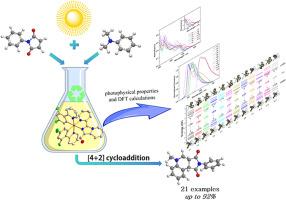
Twelve cationic cyclometalated iridium(III) complexes with the general formula [Ir(C^N)2(N^N)]PF6 (Ir1-Ir12), where C^N are cyclometalated ligands, including 2-(2,4-difluorophenyl)pyridine (dfppy), 2-(4-(trifluoromethyl)phenyl) pyridine (CF3ppy), and 1-(4-(trifluoromethyl)phenyl)isoquinoline (CF3piq) and where N^N represents 3-(pyridin-2-yl)imidazo[1,5-a]pyridine-based ancillary ligands, were successfully synthesized and structurally characterized via NMR and X-ray diffraction. The targets of this work were to investigate the effects of changes in the C^N and N^N ligands of the iridium(III) complexes on their photophysical, electrochemical, and catalytic properties. DFT and TD-DFT calculations were also utilized to support the photophysical and electrochemical property studies. The intense green to orange-red emissions of Ir1-Ir12 arose from the 3ILCT/3LLCT/3MLCT transition in the spectral range between 498 and 603 nm, with excited-state lifetimes between 4.61 and 7.45 μs. These complexes were used as photocatalysts for the [4 + 2] cycloaddition of maleimides and N,N-dimethylanilines. Complex Ir7 showed excellent catalytic activity, affording products in moderate to high yields (42 %-92 %) from a wide range of substrates under mild conditions.
期刊介绍:
Molecular Catalysis publishes full papers that are original, rigorous, and scholarly contributions examining the molecular and atomic aspects of catalytic activation and reaction mechanisms. The fields covered are:
Heterogeneous catalysis including immobilized molecular catalysts
Homogeneous catalysis including organocatalysis, organometallic catalysis and biocatalysis
Photo- and electrochemistry
Theoretical aspects of catalysis analyzed by computational methods



 京公网安备 11010802042870号
京ICP备2023020795号-1
京公网安备 11010802042870号
京ICP备2023020795号-1

 分享
分享
 求助内容:
求助内容: 应助结果提醒方式:
 扫码关注我们
