Youlin Wu , Chaoyue Zheng , Qingyang Pang , Yanke Yang , Jia-Min Lu , Yiming Xie
{"title":"Optimizing S-scheme heterojunctions of NiCo₂O₄ and graphdiyne-Cu₃P catalysts for enhanced photocatalytic hydrogen evolution","authors":"Youlin Wu , Chaoyue Zheng , Qingyang Pang , Yanke Yang , Jia-Min Lu , Yiming Xie","doi":"10.1016/j.mcat.2025.115087","DOIUrl":null,"url":null,"abstract":"<div><div>The development of integrated photocatalysts to enhance the charge carrier separation efficiency of bimetallic oxides is a crucial strategy for achieving photocatalytic hydrogen production. In this study, the crystalline structure and synthesis results of NiCo₂O₄ and graphdiyne-Cu₃P (G-CP) catalysts were systematically investigated using X-ray diffraction and Raman spectroscopy. The Raman spectroscopic results confirmed the presence of graphite-like carbon nitride in G-CP, further validating the successful synthesis of the catalyst. Photoelectrochemical performance tests demonstrated that the heterojunction formed between G-CP and NiCo₂O₄ effectively reduced the recombination rates of charge carriers, with NCOGCP-80 exhibiting the highest photocurrent response intensity and the lowest resistance, indicating exceptional hydrogen evolution performance. In photocatalytic hydrogen evolution experiments, NCOGCP-80 achieved a hydrogen evolution amount of 312.22 µmol (6244.4 µmol·g⁻¹·h⁻¹), representing increases of 9.83 and 4.66 times compared to the individual catalysts. Finally, the formation of the S-scheme heterojunction between G-CP and NiCo₂O₄ is verified through theoretical calculations and in situ X-ray photoelectron spectroscopy.</div></div>","PeriodicalId":393,"journal":{"name":"Molecular Catalysis","volume":"579 ","pages":"Article 115087"},"PeriodicalIF":4.9000,"publicationDate":"2025-05-15","publicationTypes":"Journal Article","fieldsOfStudy":null,"isOpenAccess":false,"openAccessPdf":"","citationCount":"0","resultStr":null,"platform":"Semanticscholar","paperid":null,"PeriodicalName":"Molecular Catalysis","FirstCategoryId":"92","ListUrlMain":"https://www.sciencedirect.com/science/article/pii/S2468823125002731","RegionNum":2,"RegionCategory":"化学","ArticlePicture":[],"TitleCN":null,"AbstractTextCN":null,"PMCID":null,"EPubDate":"2025/4/4 0:00:00","PubModel":"Epub","JCR":"Q2","JCRName":"CHEMISTRY, PHYSICAL","Score":null,"Total":0}
引用次数: 0
Abstract
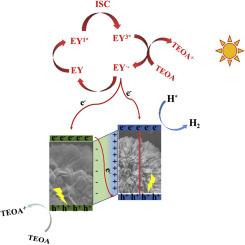
The development of integrated photocatalysts to enhance the charge carrier separation efficiency of bimetallic oxides is a crucial strategy for achieving photocatalytic hydrogen production. In this study, the crystalline structure and synthesis results of NiCo₂O₄ and graphdiyne-Cu₃P (G-CP) catalysts were systematically investigated using X-ray diffraction and Raman spectroscopy. The Raman spectroscopic results confirmed the presence of graphite-like carbon nitride in G-CP, further validating the successful synthesis of the catalyst. Photoelectrochemical performance tests demonstrated that the heterojunction formed between G-CP and NiCo₂O₄ effectively reduced the recombination rates of charge carriers, with NCOGCP-80 exhibiting the highest photocurrent response intensity and the lowest resistance, indicating exceptional hydrogen evolution performance. In photocatalytic hydrogen evolution experiments, NCOGCP-80 achieved a hydrogen evolution amount of 312.22 µmol (6244.4 µmol·g⁻¹·h⁻¹), representing increases of 9.83 and 4.66 times compared to the individual catalysts. Finally, the formation of the S-scheme heterojunction between G-CP and NiCo₂O₄ is verified through theoretical calculations and in situ X-ray photoelectron spectroscopy.
期刊介绍:
Molecular Catalysis publishes full papers that are original, rigorous, and scholarly contributions examining the molecular and atomic aspects of catalytic activation and reaction mechanisms. The fields covered are:
Heterogeneous catalysis including immobilized molecular catalysts
Homogeneous catalysis including organocatalysis, organometallic catalysis and biocatalysis
Photo- and electrochemistry
Theoretical aspects of catalysis analyzed by computational methods



 京公网安备 11010802042870号
京ICP备2023020795号-1
京公网安备 11010802042870号
京ICP备2023020795号-1

 分享
分享
 求助内容:
求助内容: 应助结果提醒方式:
 扫码关注我们
