Zeyu Yang , Qianqian Qi , Mingyu Fan , Yafei Wang , Li Tong
{"title":"Effects of the preparation methods of Co3O4 catalysts on catalytic oxidization performance toward o-xylene","authors":"Zeyu Yang , Qianqian Qi , Mingyu Fan , Yafei Wang , Li Tong","doi":"10.1016/j.mcat.2025.115095","DOIUrl":null,"url":null,"abstract":"<div><div>The Co<sub>3</sub>O<sub>4</sub> catalysts with different precursors (Na<sub>2</sub>CO<sub>3</sub>, CH<sub>4</sub>N<sub>2</sub>O) were synthesized and evaluated for its o-xylene catalytic oxidation performance. A series of techniques including BET, XRD, TEM, XPS, H<sub>2</sub>-TPR were employed to characterize the physical and chemical properties of catalysts under various preparation conditions. The results indicated that physisorption played an important role in the o-xylene removal and higher calcination temperature destructed the specific surface areas of the Co<sub>3</sub>O<sub>4</sub> samples. The enhanced catalytic performance of Co<sub>3</sub>O<sub>4</sub><sub><img></sub>N catalyst was mainly attributed to be abundance in active Co<sup>3+</sup> and lattice oxygen species, while that of Co<sub>3</sub>O<sub>4</sub><sub><img></sub>C catalyst was ascribed to the formation of superoxide anion, especially the lower calcination temperature facilitated the generation of active species. In addition, the reaction mechanisms toward o-xylene oxidation over Co<sub>3</sub>O<sub>4</sub> catalysts obtained by different preparation methods were explored in detail. The o-xylene molecule preferentially adsorbed onto the Co<sup>3+</sup> ion sites, and was further oxidized by the lattice oxygen or superoxide anion with the product being o-methyl benzyl alcohol. Soon the benzyl alcohol was transformed into the o-methyl benzaldehyde, and afterward to form benzoic acid. Later, the benzoic acid was converted into small-molecule carboxylate for Co<sub>3</sub>O<sub>4</sub><sub><img></sub>N catalyst, whereas for Co<sub>3</sub>O<sub>4</sub><sub><img></sub>C catalysts, the benzoic acid was further turned into maleic acid subsequently into acetone. Finally, both the small-molecule carboxylate and acetone species were oxidized to CO<sub>2</sub> and H<sub>2</sub>O. This finding offers some valuable insights for designing efficient o-xylene oxidation catalysts and mitigating industrial air pollution.</div></div>","PeriodicalId":393,"journal":{"name":"Molecular Catalysis","volume":"579 ","pages":"Article 115095"},"PeriodicalIF":4.9000,"publicationDate":"2025-05-15","publicationTypes":"Journal Article","fieldsOfStudy":null,"isOpenAccess":false,"openAccessPdf":"","citationCount":"0","resultStr":null,"platform":"Semanticscholar","paperid":null,"PeriodicalName":"Molecular Catalysis","FirstCategoryId":"92","ListUrlMain":"https://www.sciencedirect.com/science/article/pii/S2468823125002810","RegionNum":2,"RegionCategory":"化学","ArticlePicture":[],"TitleCN":null,"AbstractTextCN":null,"PMCID":null,"EPubDate":"2025/4/4 0:00:00","PubModel":"Epub","JCR":"Q2","JCRName":"CHEMISTRY, PHYSICAL","Score":null,"Total":0}
引用次数: 0
Abstract
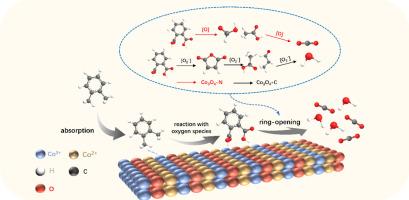
The Co3O4 catalysts with different precursors (Na2CO3, CH4N2O) were synthesized and evaluated for its o-xylene catalytic oxidation performance. A series of techniques including BET, XRD, TEM, XPS, H2-TPR were employed to characterize the physical and chemical properties of catalysts under various preparation conditions. The results indicated that physisorption played an important role in the o-xylene removal and higher calcination temperature destructed the specific surface areas of the Co3O4 samples. The enhanced catalytic performance of Co3O4N catalyst was mainly attributed to be abundance in active Co3+ and lattice oxygen species, while that of Co3O4C catalyst was ascribed to the formation of superoxide anion, especially the lower calcination temperature facilitated the generation of active species. In addition, the reaction mechanisms toward o-xylene oxidation over Co3O4 catalysts obtained by different preparation methods were explored in detail. The o-xylene molecule preferentially adsorbed onto the Co3+ ion sites, and was further oxidized by the lattice oxygen or superoxide anion with the product being o-methyl benzyl alcohol. Soon the benzyl alcohol was transformed into the o-methyl benzaldehyde, and afterward to form benzoic acid. Later, the benzoic acid was converted into small-molecule carboxylate for Co3O4N catalyst, whereas for Co3O4C catalysts, the benzoic acid was further turned into maleic acid subsequently into acetone. Finally, both the small-molecule carboxylate and acetone species were oxidized to CO2 and H2O. This finding offers some valuable insights for designing efficient o-xylene oxidation catalysts and mitigating industrial air pollution.
期刊介绍:
Molecular Catalysis publishes full papers that are original, rigorous, and scholarly contributions examining the molecular and atomic aspects of catalytic activation and reaction mechanisms. The fields covered are:
Heterogeneous catalysis including immobilized molecular catalysts
Homogeneous catalysis including organocatalysis, organometallic catalysis and biocatalysis
Photo- and electrochemistry
Theoretical aspects of catalysis analyzed by computational methods



 京公网安备 11010802042870号
京ICP备2023020795号-1
京公网安备 11010802042870号
京ICP备2023020795号-1

 分享
分享
 求助内容:
求助内容: 应助结果提醒方式:
 扫码关注我们
