Linjie Jian , Junfeng He , Guilin Wen , Zhen-Pei Wang , Jie Yang , Yi Min Xie , Jie Liu
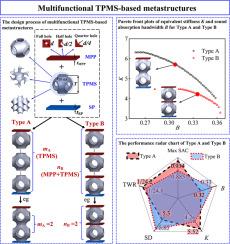
{"title":"Multifunctional TPMS-based metastructures","authors":"Linjie Jian , Junfeng He , Guilin Wen , Zhen-Pei Wang , Jie Yang , Yi Min Xie , Jie Liu","doi":"10.1016/j.ijmecsci.2025.110208","DOIUrl":null,"url":null,"abstract":"<div><div>Addressing the dual demands of concurrent low-frequency noise suppression and superior mechanical performance in lightweight structures remains a critical engineering challenge. This study proposes an innovative design and optimization strategy for novel multifunctional TPMS-based metastructures, enabling synergistic enhancement of both acoustic and mechanical functionalities. Two types of multifunctional TPMS-based metastructures, designated as Types A and B, are constructed with thickened triple periodic minimal surfaces (TPMS), micro-perforated panels (MPP), and solid panels (SP). The acoustics and mechanical performance of the proposed metastructures are quantified by the sound absorption coefficient and the equivalent bending stiffness, respectively. Subsequently, an optimization framework integrating a non-dominated sorting genetic algorithm II (NSGA-II) is developed to optimize low-frequency sound absorption bandwidth and equivalent bending stiffness. With the optimized configuration, Type A achieves effective sound absorption at 343–579 Hz (absorption coefficient <em>α</em> > 0.8) and an equivalent bending stiffness of 5.96. Additionally, we reveal the sound absorption mechanism by normalized acoustic resistance and normalized acoustic reactance as well as vibration velocity and acoustic energy dissipation density of the air particles inside the micro-perforations. A sound absorption theoretical model for the multifunctional TPMS-based metastructures is developed via the electro-acoustic analogy method and verified by finite element and experimental approaches. The equivalent bending stiffness is obtained through finite element and experimental. In addition, we have investigated the effect of geometrical parameters on the sound absorption coefficient and the equivalent bending stiffness. This study offers a novel approach to the multifunctional design of lightweight structures.</div></div>","PeriodicalId":56287,"journal":{"name":"International Journal of Mechanical Sciences","volume":"293 ","pages":"Article 110208"},"PeriodicalIF":11.4000,"publicationDate":"2025-05-01","publicationTypes":"Journal Article","fieldsOfStudy":null,"isOpenAccess":false,"openAccessPdf":"","citationCount":"0","resultStr":null,"platform":"Semanticscholar","paperid":null,"PeriodicalName":"International Journal of Mechanical Sciences","FirstCategoryId":"5","ListUrlMain":"https://www.sciencedirect.com/science/article/pii/S0020740325002942","RegionNum":1,"RegionCategory":"工程技术","ArticlePicture":[],"TitleCN":null,"AbstractTextCN":null,"PMCID":null,"EPubDate":"2025/3/31 0:00:00","PubModel":"Epub","JCR":"Q1","JCRName":"ENGINEERING, MECHANICAL","Score":null,"Total":0}
引用次数: 0
Abstract
Addressing the dual demands of concurrent low-frequency noise suppression and superior mechanical performance in lightweight structures remains a critical engineering challenge. This study proposes an innovative design and optimization strategy for novel multifunctional TPMS-based metastructures, enabling synergistic enhancement of both acoustic and mechanical functionalities. Two types of multifunctional TPMS-based metastructures, designated as Types A and B, are constructed with thickened triple periodic minimal surfaces (TPMS), micro-perforated panels (MPP), and solid panels (SP). The acoustics and mechanical performance of the proposed metastructures are quantified by the sound absorption coefficient and the equivalent bending stiffness, respectively. Subsequently, an optimization framework integrating a non-dominated sorting genetic algorithm II (NSGA-II) is developed to optimize low-frequency sound absorption bandwidth and equivalent bending stiffness. With the optimized configuration, Type A achieves effective sound absorption at 343–579 Hz (absorption coefficient α > 0.8) and an equivalent bending stiffness of 5.96. Additionally, we reveal the sound absorption mechanism by normalized acoustic resistance and normalized acoustic reactance as well as vibration velocity and acoustic energy dissipation density of the air particles inside the micro-perforations. A sound absorption theoretical model for the multifunctional TPMS-based metastructures is developed via the electro-acoustic analogy method and verified by finite element and experimental approaches. The equivalent bending stiffness is obtained through finite element and experimental. In addition, we have investigated the effect of geometrical parameters on the sound absorption coefficient and the equivalent bending stiffness. This study offers a novel approach to the multifunctional design of lightweight structures.
期刊介绍:
The International Journal of Mechanical Sciences (IJMS) serves as a global platform for the publication and dissemination of original research that contributes to a deeper scientific understanding of the fundamental disciplines within mechanical, civil, and material engineering.
The primary focus of IJMS is to showcase innovative and ground-breaking work that utilizes analytical and computational modeling techniques, such as Finite Element Method (FEM), Boundary Element Method (BEM), and mesh-free methods, among others. These modeling methods are applied to diverse fields including rigid-body mechanics (e.g., dynamics, vibration, stability), structural mechanics, metal forming, advanced materials (e.g., metals, composites, cellular, smart) behavior and applications, impact mechanics, strain localization, and other nonlinear effects (e.g., large deflections, plasticity, fracture).
Additionally, IJMS covers the realms of fluid mechanics (both external and internal flows), tribology, thermodynamics, and materials processing. These subjects collectively form the core of the journal's content.
In summary, IJMS provides a prestigious platform for researchers to present their original contributions, shedding light on analytical and computational modeling methods in various areas of mechanical engineering, as well as exploring the behavior and application of advanced materials, fluid mechanics, thermodynamics, and materials processing.




 京公网安备 11010802042870号
京ICP备2023020795号-1
京公网安备 11010802042870号
京ICP备2023020795号-1

 分享
分享
 求助内容:
求助内容: 应助结果提醒方式:
 扫码关注我们
