Mathematical modelling of a sustainable energy system for restaurant communities: Waste-to-H2 conversion, CO2 sequestration, clean fuel production, and power generation
Syed Muhammad Aun Rizvi, Khurram Kamal, Tahir Abdul Hussain Ratlamwala
{"title":"Mathematical modelling of a sustainable energy system for restaurant communities: Waste-to-H2 conversion, CO2 sequestration, clean fuel production, and power generation","authors":"Syed Muhammad Aun Rizvi, Khurram Kamal, Tahir Abdul Hussain Ratlamwala","doi":"10.1016/j.compchemeng.2025.109038","DOIUrl":null,"url":null,"abstract":"<div><div>This study presents a comprehensive mathematical simulation using Simulink software for a novel hybrid waste-to-energy sustainable system tailored for restaurant communities. The system integrates a microbial fuel cell with subsystems for biodiesel production, anaerobic biogas digestion, methane reforming, and methanol production. The hybrid system aims to convert 500 kg of waste cooking oil, 2000 kg of food waste, and wastewater produced daily by the community into valuable resources. Results revealed that the system can produce 319,376 kWh of electricity, 14.6 t of H<sub>2</sub> gas, 116.8 t of CO<sub>2</sub> and 525 m<sup>3</sup> of purified water annually. These outputs provide a net saving/profit of $245,530 with a return on investment of just 6 months. Additionally, the system demonstrates environmental benefits by reducing annual emissions by 200 tCO<sub>2</sub> and 27.450 tCH<sub>4.</sub> The findings highlight the hybrid system's effectiveness in mitigating environmental impact, generating clean energy and valuable fuels, and advancing sustainable waste management practices within restaurant communities.</div></div>","PeriodicalId":286,"journal":{"name":"Computers & Chemical Engineering","volume":"199 ","pages":"Article 109038"},"PeriodicalIF":3.9000,"publicationDate":"2025-08-01","publicationTypes":"Journal Article","fieldsOfStudy":null,"isOpenAccess":false,"openAccessPdf":"","citationCount":"0","resultStr":null,"platform":"Semanticscholar","paperid":null,"PeriodicalName":"Computers & Chemical Engineering","FirstCategoryId":"5","ListUrlMain":"https://www.sciencedirect.com/science/article/pii/S0098135425000420","RegionNum":2,"RegionCategory":"工程技术","ArticlePicture":[],"TitleCN":null,"AbstractTextCN":null,"PMCID":null,"EPubDate":"2025/2/9 0:00:00","PubModel":"Epub","JCR":"Q2","JCRName":"COMPUTER SCIENCE, INTERDISCIPLINARY APPLICATIONS","Score":null,"Total":0}
引用次数: 0
Abstract
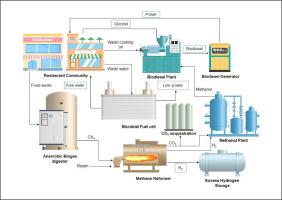
This study presents a comprehensive mathematical simulation using Simulink software for a novel hybrid waste-to-energy sustainable system tailored for restaurant communities. The system integrates a microbial fuel cell with subsystems for biodiesel production, anaerobic biogas digestion, methane reforming, and methanol production. The hybrid system aims to convert 500 kg of waste cooking oil, 2000 kg of food waste, and wastewater produced daily by the community into valuable resources. Results revealed that the system can produce 319,376 kWh of electricity, 14.6 t of H2 gas, 116.8 t of CO2 and 525 m3 of purified water annually. These outputs provide a net saving/profit of $245,530 with a return on investment of just 6 months. Additionally, the system demonstrates environmental benefits by reducing annual emissions by 200 tCO2 and 27.450 tCH4. The findings highlight the hybrid system's effectiveness in mitigating environmental impact, generating clean energy and valuable fuels, and advancing sustainable waste management practices within restaurant communities.
期刊介绍:
Computers & Chemical Engineering is primarily a journal of record for new developments in the application of computing and systems technology to chemical engineering problems.



 京公网安备 11010802042870号
京ICP备2023020795号-1
京公网安备 11010802042870号
京ICP备2023020795号-1

 分享
分享
 求助内容:
求助内容: 应助结果提醒方式:
 扫码关注我们
