Irfan Khan, Saad Ahmed, Zeeshan Haider, Kashan Memon and Azam Fareed
{"title":"Enhancing triboelectric nanogenerator performance using chitosan-modified multiwalled carbon nanotubes†","authors":"Irfan Khan, Saad Ahmed, Zeeshan Haider, Kashan Memon and Azam Fareed","doi":"10.1039/D4TC04321A","DOIUrl":null,"url":null,"abstract":"<p >The rising demand for a sustainable and immaculate energy source on a global scale is fascinating regarding the usage and potential effects of green energy. Triboelectric nanogenerators have emerged as some of the major green energy sources, converting mechanical energy into electrical energy by using different electropositive and tribonegative materials. We used surface-modified multiwalled carbon nanotubes incorporated with a chitosan membrane as a tribopositive material in triboelectric nanogenerators for improved efficiency. We demonstrate that the chitosan-modified multiwalled carbon nanotube-based tribopositive material with PDMS as the tribonegative layer with a constant device size of 2 × 2 cm<small><sup>2</sup></small> produced a short circuit current density (<em>J</em><small><sub>sc</sub></small>) of 42.004 mA m<small><sup>−2</sup></small>, an open circuit voltage (<em>V</em><small><sub>oc</sub></small>) of 244.90 volts, and a peak power density of 4.22 W m<small><sup>−2</sup></small>, which can light up more than hundreds of LED lights. The high electrical performance of chitosan-modified multiwalled carbon nanotubes as a tribopositive material is attributed to the increased surface roughness and charge separation without causing significant charge leakage, which is produced by carbon nanotubes. Henceforth, the present work successfully introduces the use of chitosan-modified multiwalled carbon nanotubes as a tribopositive material for enhancing the TENG's output performance.</p>","PeriodicalId":84,"journal":{"name":"Journal of Materials Chemistry C","volume":" 14","pages":" 7245-7256"},"PeriodicalIF":5.1000,"publicationDate":"2025-03-03","publicationTypes":"Journal Article","fieldsOfStudy":null,"isOpenAccess":false,"openAccessPdf":"","citationCount":"0","resultStr":null,"platform":"Semanticscholar","paperid":null,"PeriodicalName":"Journal of Materials Chemistry C","FirstCategoryId":"1","ListUrlMain":"https://pubs.rsc.org/en/content/articlelanding/2025/tc/d4tc04321a","RegionNum":2,"RegionCategory":"材料科学","ArticlePicture":[],"TitleCN":null,"AbstractTextCN":null,"PMCID":null,"EPubDate":"","PubModel":"","JCR":"Q2","JCRName":"MATERIALS SCIENCE, MULTIDISCIPLINARY","Score":null,"Total":0}
引用次数: 0
Abstract
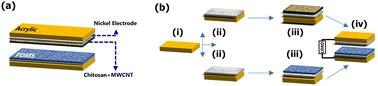
The rising demand for a sustainable and immaculate energy source on a global scale is fascinating regarding the usage and potential effects of green energy. Triboelectric nanogenerators have emerged as some of the major green energy sources, converting mechanical energy into electrical energy by using different electropositive and tribonegative materials. We used surface-modified multiwalled carbon nanotubes incorporated with a chitosan membrane as a tribopositive material in triboelectric nanogenerators for improved efficiency. We demonstrate that the chitosan-modified multiwalled carbon nanotube-based tribopositive material with PDMS as the tribonegative layer with a constant device size of 2 × 2 cm2 produced a short circuit current density (Jsc) of 42.004 mA m−2, an open circuit voltage (Voc) of 244.90 volts, and a peak power density of 4.22 W m−2, which can light up more than hundreds of LED lights. The high electrical performance of chitosan-modified multiwalled carbon nanotubes as a tribopositive material is attributed to the increased surface roughness and charge separation without causing significant charge leakage, which is produced by carbon nanotubes. Henceforth, the present work successfully introduces the use of chitosan-modified multiwalled carbon nanotubes as a tribopositive material for enhancing the TENG's output performance.
在全球范围内,对可持续和完美能源的需求不断增长,这对绿色能源的使用和潜在影响非常有吸引力。摩擦电纳米发电机已经成为一些主要的绿色能源,通过使用不同的正电和负电材料将机械能转化为电能。为了提高摩擦电纳米发电机的效率,我们将表面修饰的多壁碳纳米管与壳聚糖膜结合作为摩擦正极材料。我们证明了壳聚糖修饰的多壁碳纳米管基摩擦正材料,以PDMS为摩擦负层,恒定器件尺寸为2 × 2 cm2,产生的短路电流密度(Jsc)为42.004 mA m−2,开路电压(Voc)为244.90伏,峰值功率密度为4.22 W m−2,可以点亮数百个以上的LED灯。壳聚糖修饰的多壁碳纳米管作为摩擦正极材料的高电性能是由于碳纳米管增加了表面粗糙度和电荷分离,而不会引起明显的电荷泄漏。因此,本研究成功地介绍了壳聚糖修饰的多壁碳纳米管作为摩擦正材料的使用,以提高TENG的输出性能。
期刊介绍:
The Journal of Materials Chemistry is divided into three distinct sections, A, B, and C, each catering to specific applications of the materials under study:
Journal of Materials Chemistry A focuses primarily on materials intended for applications in energy and sustainability.
Journal of Materials Chemistry B specializes in materials designed for applications in biology and medicine.
Journal of Materials Chemistry C is dedicated to materials suitable for applications in optical, magnetic, and electronic devices.
Example topic areas within the scope of Journal of Materials Chemistry C are listed below. This list is neither exhaustive nor exclusive.
Bioelectronics
Conductors
Detectors
Dielectrics
Displays
Ferroelectrics
Lasers
LEDs
Lighting
Liquid crystals
Memory
Metamaterials
Multiferroics
Photonics
Photovoltaics
Semiconductors
Sensors
Single molecule conductors
Spintronics
Superconductors
Thermoelectrics
Topological insulators
Transistors



 京公网安备 11010802042870号
京ICP备2023020795号-1
京公网安备 11010802042870号
京ICP备2023020795号-1

 分享
分享
 求助内容:
求助内容: 应助结果提醒方式:
 扫码关注我们
