Muhammad Sohail, Zulfiqar Ali, M. Sohail, Areej S. Alqarni, Intikhab Alam, Nimra Razzaq, Fazl ullah and Qiuyun Ouyang
{"title":"Nonlinear optical properties of CsPbI3: synthesis, characterization, and application in passively Q-switched lasers†","authors":"Muhammad Sohail, Zulfiqar Ali, M. Sohail, Areej S. Alqarni, Intikhab Alam, Nimra Razzaq, Fazl ullah and Qiuyun Ouyang","doi":"10.1039/D4TC05393A","DOIUrl":null,"url":null,"abstract":"<p >Halide perovskites, particularly cesium lead iodide (CsPbI<small><sub>3</sub></small>), have garnered significant attention due to their remarkable properties, including strong absorbance across the visible to near-infrared spectrum and a unique electronic structure that enhances their nonlinear optical (NLO) and optoelectronic applications. In this study, CsPbI<small><sub>3</sub></small> was synthesized using a hot injection technique and incorporated into a methyl methacrylate (MMA) matrix through polymerization to form CsPbI<small><sub>3</sub></small>/PMMA organic glasses. The NLO properties of these glasses were characterized using the Z-scan technique with a nanosecond pulse laser at an excitation wavelength of 532 nm. Notably, the CsPbI<small><sub>3</sub></small>/PMMA organic glasses exhibited a transition from saturable absorption (SA) to reverse saturable absorption (RSA) upon adjusting the input energy. Furthermore, by integrating a fiber ferrule coating-based CsPbI<small><sub>3</sub></small> saturable absorber (SA) into the laser cavity, we successfully realized a passively Q-switching (PQS) laser with a minimum pulse duration of 4.7 μs and a signal-to-noise ratio (SNR) of 50 dB at 1.55 μm, respectively. Consequently, the experimental findings indicate that CsPbI<small><sub>3</sub></small>NP-based saturable absorbers (SAs) exhibit performance characteristics that are either comparable to or surpass those of conventional nanoparticle-based SAs. This observation underscores the significant potential of CsPbI<small><sub>3</sub></small>-based SAs for applications in pulsed laser sources, suggesting their viability as advanced materials for enhancing laser performance and stability.</p>","PeriodicalId":84,"journal":{"name":"Journal of Materials Chemistry C","volume":" 14","pages":" 7119-7129"},"PeriodicalIF":5.1000,"publicationDate":"2025-02-28","publicationTypes":"Journal Article","fieldsOfStudy":null,"isOpenAccess":false,"openAccessPdf":"","citationCount":"0","resultStr":null,"platform":"Semanticscholar","paperid":null,"PeriodicalName":"Journal of Materials Chemistry C","FirstCategoryId":"1","ListUrlMain":"https://pubs.rsc.org/en/content/articlelanding/2025/tc/d4tc05393a","RegionNum":2,"RegionCategory":"材料科学","ArticlePicture":[],"TitleCN":null,"AbstractTextCN":null,"PMCID":null,"EPubDate":"","PubModel":"","JCR":"Q2","JCRName":"MATERIALS SCIENCE, MULTIDISCIPLINARY","Score":null,"Total":0}
引用次数: 0
Abstract
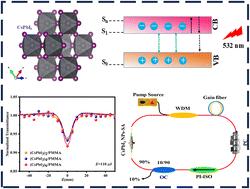
Halide perovskites, particularly cesium lead iodide (CsPbI3), have garnered significant attention due to their remarkable properties, including strong absorbance across the visible to near-infrared spectrum and a unique electronic structure that enhances their nonlinear optical (NLO) and optoelectronic applications. In this study, CsPbI3 was synthesized using a hot injection technique and incorporated into a methyl methacrylate (MMA) matrix through polymerization to form CsPbI3/PMMA organic glasses. The NLO properties of these glasses were characterized using the Z-scan technique with a nanosecond pulse laser at an excitation wavelength of 532 nm. Notably, the CsPbI3/PMMA organic glasses exhibited a transition from saturable absorption (SA) to reverse saturable absorption (RSA) upon adjusting the input energy. Furthermore, by integrating a fiber ferrule coating-based CsPbI3 saturable absorber (SA) into the laser cavity, we successfully realized a passively Q-switching (PQS) laser with a minimum pulse duration of 4.7 μs and a signal-to-noise ratio (SNR) of 50 dB at 1.55 μm, respectively. Consequently, the experimental findings indicate that CsPbI3NP-based saturable absorbers (SAs) exhibit performance characteristics that are either comparable to or surpass those of conventional nanoparticle-based SAs. This observation underscores the significant potential of CsPbI3-based SAs for applications in pulsed laser sources, suggesting their viability as advanced materials for enhancing laser performance and stability.
期刊介绍:
The Journal of Materials Chemistry is divided into three distinct sections, A, B, and C, each catering to specific applications of the materials under study:
Journal of Materials Chemistry A focuses primarily on materials intended for applications in energy and sustainability.
Journal of Materials Chemistry B specializes in materials designed for applications in biology and medicine.
Journal of Materials Chemistry C is dedicated to materials suitable for applications in optical, magnetic, and electronic devices.
Example topic areas within the scope of Journal of Materials Chemistry C are listed below. This list is neither exhaustive nor exclusive.
Bioelectronics
Conductors
Detectors
Dielectrics
Displays
Ferroelectrics
Lasers
LEDs
Lighting
Liquid crystals
Memory
Metamaterials
Multiferroics
Photonics
Photovoltaics
Semiconductors
Sensors
Single molecule conductors
Spintronics
Superconductors
Thermoelectrics
Topological insulators
Transistors



 京公网安备 11010802042870号
京ICP备2023020795号-1
京公网安备 11010802042870号
京ICP备2023020795号-1

 分享
分享
 求助内容:
求助内容: 应助结果提醒方式:
 扫码关注我们
