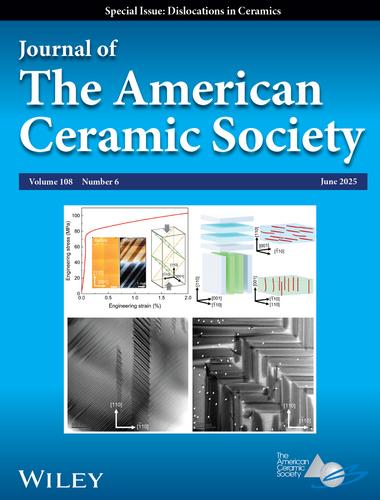
{"title":"Issue Information","authors":"","doi":"10.1111/jace.19885","DOIUrl":null,"url":null,"abstract":"<p><b>Cover Photograph</b>: <i>BaTiO<sub>3</sub> exhibits plastic deformation due to formation of dislocations. On the cover it can be seen that deformation reduces dislocation spacing from ∼20 µm to ∼1 µm. Properties such as charge state and strain state can influence the dislocation core's interaction with domain walls and charge transfer characteristic, adding complexity to this topic. See the Editor's Choice paper</i> https://doi.org/10.1111/jace.20147 for more information.\n\n <figure>\n <div><picture>\n <source></source></picture><p></p>\n </div>\n </figure></p>","PeriodicalId":200,"journal":{"name":"Journal of the American Ceramic Society","volume":"108 6","pages":""},"PeriodicalIF":3.8000,"publicationDate":"2025-04-04","publicationTypes":"Journal Article","fieldsOfStudy":null,"isOpenAccess":false,"openAccessPdf":"https://onlinelibrary.wiley.com/doi/epdf/10.1111/jace.19885","citationCount":"0","resultStr":null,"platform":"Semanticscholar","paperid":null,"PeriodicalName":"Journal of the American Ceramic Society","FirstCategoryId":"88","ListUrlMain":"https://ceramics.onlinelibrary.wiley.com/doi/10.1111/jace.19885","RegionNum":3,"RegionCategory":"材料科学","ArticlePicture":[],"TitleCN":null,"AbstractTextCN":null,"PMCID":null,"EPubDate":"","PubModel":"","JCR":"Q1","JCRName":"MATERIALS SCIENCE, CERAMICS","Score":null,"Total":0}
引用次数: 0
Abstract
Cover Photograph: BaTiO3 exhibits plastic deformation due to formation of dislocations. On the cover it can be seen that deformation reduces dislocation spacing from ∼20 µm to ∼1 µm. Properties such as charge state and strain state can influence the dislocation core's interaction with domain walls and charge transfer characteristic, adding complexity to this topic. See the Editor's Choice paper https://doi.org/10.1111/jace.20147 for more information.
期刊介绍:
The Journal of the American Ceramic Society contains records of original research that provide insight into or describe the science of ceramic and glass materials and composites based on ceramics and glasses. These papers include reports on discovery, characterization, and analysis of new inorganic, non-metallic materials; synthesis methods; phase relationships; processing approaches; microstructure-property relationships; and functionalities. Of great interest are works that support understanding founded on fundamental principles using experimental, theoretical, or computational methods or combinations of those approaches. All the published papers must be of enduring value and relevant to the science of ceramics and glasses or composites based on those materials.
Papers on fundamental ceramic and glass science are welcome including those in the following areas:
Enabling materials for grand challenges[...]
Materials design, selection, synthesis and processing methods[...]
Characterization of compositions, structures, defects, and properties along with new methods [...]
Mechanisms, Theory, Modeling, and Simulation[...]
JACerS accepts submissions of full-length Articles reporting original research, in-depth Feature Articles, Reviews of the state-of-the-art with compelling analysis, and Rapid Communications which are short papers with sufficient novelty or impact to justify swift publication.





 京公网安备 11010802042870号
京ICP备2023020795号-1
京公网安备 11010802042870号
京ICP备2023020795号-1

 分享
分享
 求助内容:
求助内容: 应助结果提醒方式:
 扫码关注我们
