Ana García-Sacristán , Elba Mauriz , Marta García-Hernández , Celia Pinto-Díez , Miguel Moreno , M. Elena Martín , Víctor M. González
{"title":"Adaptive SELEX Strategies Against HCV Core Protein Lead to the Same Aptamer","authors":"Ana García-Sacristán , Elba Mauriz , Marta García-Hernández , Celia Pinto-Díez , Miguel Moreno , M. Elena Martín , Víctor M. González","doi":"10.1016/j.jmb.2025.169117","DOIUrl":null,"url":null,"abstract":"<div><div>Herein, we demonstrate the accuracy of aptamer selection among different SELEX procedures, in different labs, using different variations of the same target and slightly different aptamer initial libraries. In our lab, we have selected DNA aptamers against HCV core protein by applying two consecutive selection approaches (in which two different variations of the target were used): using lysates of <em>E. coli</em> M15 bacteria expressing full-length HCV core protein (genotype 1a) as well as mature HCV core recombinant protein (genotype 1b). Three aptamers were finally identified: AptHCV14F, AptHCV4.2F and AptHCV7.2R, from which AptHCV14F resulted to be identical (within the variable region) to the previously reported (in this journal) aptamer AptD-1312. Functionality of these aptamers were deeply investigated by SPR and ELONA, resulting as high affinity binders of HCV core protein suitable for the development of new generation tools for hepatitis c virus detection and screening.</div></div>","PeriodicalId":369,"journal":{"name":"Journal of Molecular Biology","volume":"437 12","pages":"Article 169117"},"PeriodicalIF":4.5000,"publicationDate":"2025-06-15","publicationTypes":"Journal Article","fieldsOfStudy":null,"isOpenAccess":false,"openAccessPdf":"","citationCount":"0","resultStr":null,"platform":"Semanticscholar","paperid":null,"PeriodicalName":"Journal of Molecular Biology","FirstCategoryId":"99","ListUrlMain":"https://www.sciencedirect.com/science/article/pii/S0022283625001834","RegionNum":2,"RegionCategory":"生物学","ArticlePicture":[],"TitleCN":null,"AbstractTextCN":null,"PMCID":null,"EPubDate":"2025/3/31 0:00:00","PubModel":"Epub","JCR":"Q1","JCRName":"BIOCHEMISTRY & MOLECULAR BIOLOGY","Score":null,"Total":0}
引用次数: 0
Abstract
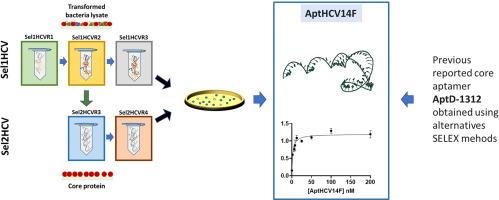
Herein, we demonstrate the accuracy of aptamer selection among different SELEX procedures, in different labs, using different variations of the same target and slightly different aptamer initial libraries. In our lab, we have selected DNA aptamers against HCV core protein by applying two consecutive selection approaches (in which two different variations of the target were used): using lysates of E. coli M15 bacteria expressing full-length HCV core protein (genotype 1a) as well as mature HCV core recombinant protein (genotype 1b). Three aptamers were finally identified: AptHCV14F, AptHCV4.2F and AptHCV7.2R, from which AptHCV14F resulted to be identical (within the variable region) to the previously reported (in this journal) aptamer AptD-1312. Functionality of these aptamers were deeply investigated by SPR and ELONA, resulting as high affinity binders of HCV core protein suitable for the development of new generation tools for hepatitis c virus detection and screening.
期刊介绍:
Journal of Molecular Biology (JMB) provides high quality, comprehensive and broad coverage in all areas of molecular biology. The journal publishes original scientific research papers that provide mechanistic and functional insights and report a significant advance to the field. The journal encourages the submission of multidisciplinary studies that use complementary experimental and computational approaches to address challenging biological questions.
Research areas include but are not limited to: Biomolecular interactions, signaling networks, systems biology; Cell cycle, cell growth, cell differentiation; Cell death, autophagy; Cell signaling and regulation; Chemical biology; Computational biology, in combination with experimental studies; DNA replication, repair, and recombination; Development, regenerative biology, mechanistic and functional studies of stem cells; Epigenetics, chromatin structure and function; Gene expression; Membrane processes, cell surface proteins and cell-cell interactions; Methodological advances, both experimental and theoretical, including databases; Microbiology, virology, and interactions with the host or environment; Microbiota mechanistic and functional studies; Nuclear organization; Post-translational modifications, proteomics; Processing and function of biologically important macromolecules and complexes; Molecular basis of disease; RNA processing, structure and functions of non-coding RNAs, transcription; Sorting, spatiotemporal organization, trafficking; Structural biology; Synthetic biology; Translation, protein folding, chaperones, protein degradation and quality control.



 京公网安备 11010802042870号
京ICP备2023020795号-1
京公网安备 11010802042870号
京ICP备2023020795号-1

 分享
分享
 求助内容:
求助内容: 应助结果提醒方式:
 扫码关注我们
