Developing a novel predictive model for identifying risk factors associated with being lost to follow-up among high-risk patients for recurrence following radical resection of hepatocellular carcinoma: the first report.
Zichen Yu, Wenli Cao, Chengfei Du, Jie Liu, Liping Peng, Fangqiang Wei
{"title":"Developing a novel predictive model for identifying risk factors associated with being lost to follow-up among high-risk patients for recurrence following radical resection of hepatocellular carcinoma: the first report.","authors":"Zichen Yu, Wenli Cao, Chengfei Du, Jie Liu, Liping Peng, Fangqiang Wei","doi":"10.1186/s12885-025-14030-1","DOIUrl":null,"url":null,"abstract":"<p><strong>Background: </strong>Follow-up is essential especially for patients who are at a high risk of recurrence after radical resection of hepatocellular carcinoma (HCC). The aim of this study was to develop a predictive model aimed at identifying the risk factors associated with being lost to follow-up (LTFU) in high-risk patients for recurrence following radical resection of HCC.</p><p><strong>Methods: </strong>The retrospective study was conducted at our institution between October 2018 to May 2023. The patients who underwent radical liver resection for HCC and had high-risk factors for recurrence were categorized into an LTFU group and a control group. Multivariate logistic regression analysis was utilized to determine risk factors and construct a nomogram predictive model.</p><p><strong>Results: </strong>A total of 352 patients were included and subsequently classified into two distinct groups: the LTFU group (n = 123, 34.94%) and the control group (n = 229, 65.06%). Logistic regression analysis was then conducted to explore the potential associations between various factors and the occurrence of LTFU. The findings identified several independent risk factors for LTFU, including smoking (odds ratio, OR = 1.823, 95% confidence interval, CI 1.086-3.060, p = 0.023); residing more than 200 km away from the hospital (OR = 1.857, 95% CI 1.105-3.121, p = 0.019); having an unstable profession (OR = 1.918, 95% CI 1.112-3.311, p = 0.019); and lacking medical insurance (OR = 5.921, 95% CI 1.747-20.071, p = 0.004); the presence of liver cirrhosis (OR = 2.161, 95% CI 1.153-4.048, p = 0.016); an operation time less than 240 min (OR = 2.138, 95% CI 1.240-3.688, p = 0.006); and the absence of postoperative adjuvant therapy (OR = 2.641, 95% CI 1.504-4.637, p = 0.001). Based on these seven significant factors, a main effects model was established, designated as the Wei-LTFU model, which achieved an area under the curve value of 0.744 (95% CI 0.691-0.798) in predicting the likelihood of LTFU.</p><p><strong>Conclusion: </strong>A main effects model, namely the Wei-LTFU model, incorporating the seven significant factors was formulated to predict the likelihood of LTFU occurrence, ultimately aiming to assist healthcare workers in developing effective strategies to improve follow-up outcomes for patients.</p>","PeriodicalId":9131,"journal":{"name":"BMC Cancer","volume":"25 1","pages":"597"},"PeriodicalIF":3.4000,"publicationDate":"2025-04-02","publicationTypes":"Journal Article","fieldsOfStudy":null,"isOpenAccess":false,"openAccessPdf":"https://www.ncbi.nlm.nih.gov/pmc/articles/PMC11967030/pdf/","citationCount":"0","resultStr":null,"platform":"Semanticscholar","paperid":null,"PeriodicalName":"BMC Cancer","FirstCategoryId":"3","ListUrlMain":"https://doi.org/10.1186/s12885-025-14030-1","RegionNum":2,"RegionCategory":"医学","ArticlePicture":[],"TitleCN":null,"AbstractTextCN":null,"PMCID":null,"EPubDate":"","PubModel":"","JCR":"Q2","JCRName":"ONCOLOGY","Score":null,"Total":0}
引用次数: 0
Abstract
Background: Follow-up is essential especially for patients who are at a high risk of recurrence after radical resection of hepatocellular carcinoma (HCC). The aim of this study was to develop a predictive model aimed at identifying the risk factors associated with being lost to follow-up (LTFU) in high-risk patients for recurrence following radical resection of HCC.
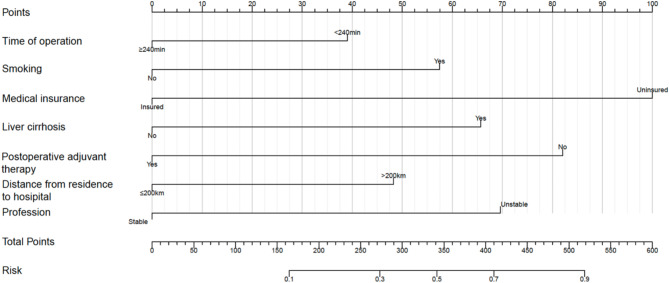
Methods: The retrospective study was conducted at our institution between October 2018 to May 2023. The patients who underwent radical liver resection for HCC and had high-risk factors for recurrence were categorized into an LTFU group and a control group. Multivariate logistic regression analysis was utilized to determine risk factors and construct a nomogram predictive model.
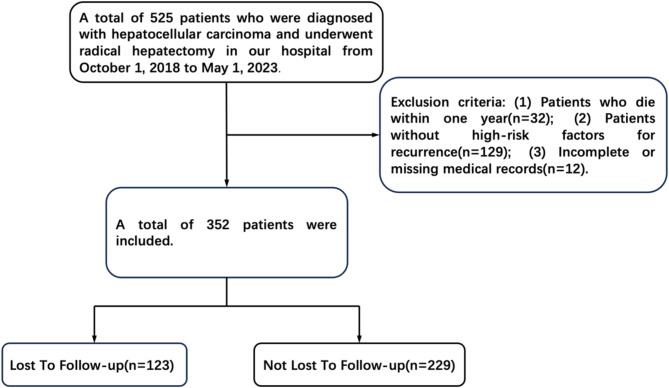
Results: A total of 352 patients were included and subsequently classified into two distinct groups: the LTFU group (n = 123, 34.94%) and the control group (n = 229, 65.06%). Logistic regression analysis was then conducted to explore the potential associations between various factors and the occurrence of LTFU. The findings identified several independent risk factors for LTFU, including smoking (odds ratio, OR = 1.823, 95% confidence interval, CI 1.086-3.060, p = 0.023); residing more than 200 km away from the hospital (OR = 1.857, 95% CI 1.105-3.121, p = 0.019); having an unstable profession (OR = 1.918, 95% CI 1.112-3.311, p = 0.019); and lacking medical insurance (OR = 5.921, 95% CI 1.747-20.071, p = 0.004); the presence of liver cirrhosis (OR = 2.161, 95% CI 1.153-4.048, p = 0.016); an operation time less than 240 min (OR = 2.138, 95% CI 1.240-3.688, p = 0.006); and the absence of postoperative adjuvant therapy (OR = 2.641, 95% CI 1.504-4.637, p = 0.001). Based on these seven significant factors, a main effects model was established, designated as the Wei-LTFU model, which achieved an area under the curve value of 0.744 (95% CI 0.691-0.798) in predicting the likelihood of LTFU.
Conclusion: A main effects model, namely the Wei-LTFU model, incorporating the seven significant factors was formulated to predict the likelihood of LTFU occurrence, ultimately aiming to assist healthcare workers in developing effective strategies to improve follow-up outcomes for patients.
背景:随访是必要的,特别是对于肝细胞癌根治术后复发风险高的患者。本研究的目的是建立一个预测模型,旨在确定HCC根治后复发的高危患者失访(LTFU)相关的危险因素。方法:回顾性研究于2018年10月至2023年5月在我院进行。将行肝根治性切除术且有复发高危因素的HCC患者分为LTFU组和对照组。采用多因素logistic回归分析确定危险因素,构建nomogram预测模型。结果:共纳入352例患者,并将其分为两组:LTFU组(n = 123, 34.94%)和对照组(n = 229, 65.06%)。然后进行Logistic回归分析,探讨各种因素与LTFU发生之间的潜在关联。研究结果确定了LTFU的几个独立危险因素,包括吸烟(优势比,OR = 1.823, 95%可信区间,CI 1.086-3.060, p = 0.023);居住在离医院超过200公里的地方(OR = 1.857, 95% CI 1.105-3.121, p = 0.019);职业不稳定(OR = 1.918, 95% CI 1.112-3.311, p = 0.019);缺乏医疗保险(OR = 5.921, 95% CI 1.747 ~ 20.071, p = 0.004);肝硬化的存在(OR = 2.161, 95% CI 1.153-4.048, p = 0.016);手术时间小于240 min (OR = 2.138, 95% CI 1.240 ~ 3.688, p = 0.006);术后无辅助治疗(OR = 2.641, 95% CI 1.504-4.637, p = 0.001)。基于这7个显著因素建立主效应模型,命名为Wei-LTFU模型,该模型预测LTFU发生可能性的曲线下面积为0.744 (95% CI 0.691-0.798)。结论:建立了包含七个显著因素的主效应模型,即Wei-LTFU模型,用于预测LTFU发生的可能性,最终目的是帮助医护人员制定有效的策略,改善患者的随访结果。
期刊介绍:
BMC Cancer is an open access, peer-reviewed journal that considers articles on all aspects of cancer research, including the pathophysiology, prevention, diagnosis and treatment of cancers. The journal welcomes submissions concerning molecular and cellular biology, genetics, epidemiology, and clinical trials.





 京公网安备 11010802042870号
京ICP备2023020795号-1
京公网安备 11010802042870号
京ICP备2023020795号-1

 分享
分享
 求助内容:
求助内容: 应助结果提醒方式:
 扫码关注我们
