{"title":"Derivation and validation of lifestyle-based and microbiota-based models for colorectal adenoma risk evaluation and self-prediction.","authors":"Yi-Lu Zhou, Jia-Wen Deng, Zhu-Hui Liu, Xin-Yue Ma, Chun-Qi Zhu, Yuan-Hong Xie, Cheng-Bei Zhou, Jing-Yuan Fang","doi":"10.1136/bmjgast-2024-001597","DOIUrl":null,"url":null,"abstract":"<p><strong>Objective: </strong>Early warning and screening of colorectal adenoma (CRA) is important for colorectal cancer (CRC) prevention. This study aimed to construct a non-invasive prediction model to improve CRA screening efficacy.</p><p><strong>Methods: </strong>This study incorporated three cohorts, comprising 9747 participants who underwent colonoscopy. In cohort 1, 683 participants were prospectively recruited with comprehensive lifestyle information and faecal samples. CRA-associated bacteria were identified through 16S rRNA sequencing and quantitative real-time PCR. CRA prediction models were established using lifestyle and gut microbiota information. Cohort 2 prospectively enrolled 1529 participants to validate the lifestyle-based model, while cohort 3 retrospectively analysed 7535 individuals to determine the recommended initial colonoscopy screening ages for different risk groups based on age-specific CRA incidence rates.</p><p><strong>Results: </strong>Multivariable logistic regression yielded a prediction model incorporating 14 variables, demonstrating robust discrimination (c-statistic=0.79, 95% CI 0.75, 0.82). Other machine learning approaches showed comparable performance (random forest: 0.78, 95% CI 0.73, 0.81; gradient boosting: 0.78, 95% CI 0.76, 0.83). The ages for starting colonoscopy screening were established at 42 years for the high-risk group vs 53 years for the low-risk group. The inclusion of <i>Fusobacterium nucleatum</i> and <i>pks<sup>+</sup> Escherichia</i> <i>coli</i> enhanced the model's performance (c-statistic=0.84-0.86).</p><p><strong>Conclusion: </strong>Integrated mathematical modelling incorporating lifestyle parameters and gut microbial signatures provides an effective non-invasive strategy for CRA risk stratification, while the accompanying machine learning-assisted prediction application enables cost-effective, population-level screening implementation to optimise CRC prevention protocols.</p>","PeriodicalId":9235,"journal":{"name":"BMJ Open Gastroenterology","volume":"12 1","pages":""},"PeriodicalIF":2.9000,"publicationDate":"2025-04-02","publicationTypes":"Journal Article","fieldsOfStudy":null,"isOpenAccess":false,"openAccessPdf":"https://www.ncbi.nlm.nih.gov/pmc/articles/PMC12001358/pdf/","citationCount":"0","resultStr":null,"platform":"Semanticscholar","paperid":null,"PeriodicalName":"BMJ Open Gastroenterology","FirstCategoryId":"1085","ListUrlMain":"https://doi.org/10.1136/bmjgast-2024-001597","RegionNum":0,"RegionCategory":null,"ArticlePicture":[],"TitleCN":null,"AbstractTextCN":null,"PMCID":null,"EPubDate":"","PubModel":"","JCR":"Q2","JCRName":"GASTROENTEROLOGY & HEPATOLOGY","Score":null,"Total":0}
引用次数: 0
Abstract
Objective: Early warning and screening of colorectal adenoma (CRA) is important for colorectal cancer (CRC) prevention. This study aimed to construct a non-invasive prediction model to improve CRA screening efficacy.
Methods: This study incorporated three cohorts, comprising 9747 participants who underwent colonoscopy. In cohort 1, 683 participants were prospectively recruited with comprehensive lifestyle information and faecal samples. CRA-associated bacteria were identified through 16S rRNA sequencing and quantitative real-time PCR. CRA prediction models were established using lifestyle and gut microbiota information. Cohort 2 prospectively enrolled 1529 participants to validate the lifestyle-based model, while cohort 3 retrospectively analysed 7535 individuals to determine the recommended initial colonoscopy screening ages for different risk groups based on age-specific CRA incidence rates.
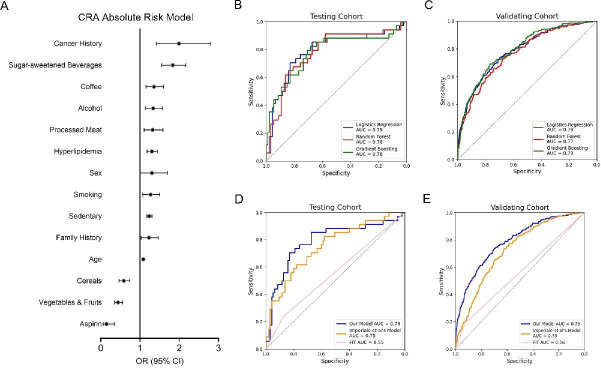
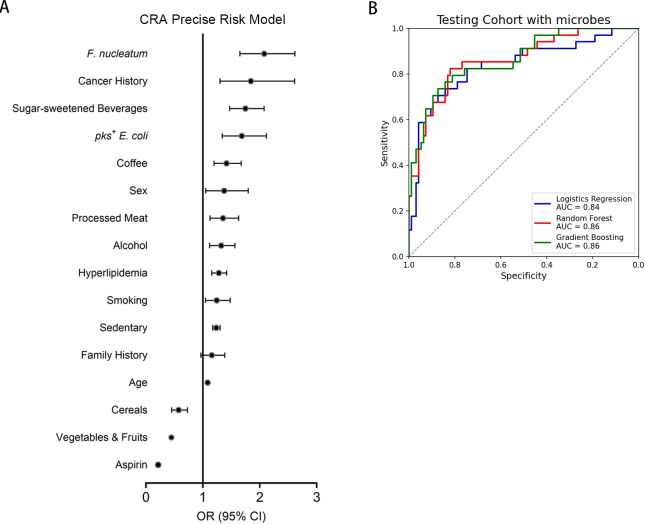
Results: Multivariable logistic regression yielded a prediction model incorporating 14 variables, demonstrating robust discrimination (c-statistic=0.79, 95% CI 0.75, 0.82). Other machine learning approaches showed comparable performance (random forest: 0.78, 95% CI 0.73, 0.81; gradient boosting: 0.78, 95% CI 0.76, 0.83). The ages for starting colonoscopy screening were established at 42 years for the high-risk group vs 53 years for the low-risk group. The inclusion of Fusobacterium nucleatum and pks+ Escherichiacoli enhanced the model's performance (c-statistic=0.84-0.86).
Conclusion: Integrated mathematical modelling incorporating lifestyle parameters and gut microbial signatures provides an effective non-invasive strategy for CRA risk stratification, while the accompanying machine learning-assisted prediction application enables cost-effective, population-level screening implementation to optimise CRC prevention protocols.
目的:早期预警和筛查结直肠腺瘤(CRA)对预防结直肠癌(CRC)具有重要意义。本研究旨在构建无创预测模型,提高CRA筛查效果。方法:本研究纳入三个队列,包括9747名接受结肠镜检查的参与者。在队列1中,683名参与者被前瞻性地招募,并提供了全面的生活方式信息和粪便样本。通过16S rRNA测序和实时荧光定量PCR鉴定cra相关细菌。利用生活方式和肠道菌群信息建立CRA预测模型。队列2前瞻性招募了1529名参与者,以验证基于生活方式的模型,而队列3回顾性分析了7535名个体,以确定基于年龄特异性CRA发病率的不同风险群体的推荐初始结肠镜筛查年龄。结果:多变量逻辑回归产生了包含14个变量的预测模型,显示出稳健的判别(c-statistic=0.79, 95% CI 0.75, 0.82)。其他机器学习方法表现出类似的性能(随机森林:0.78,95% CI 0.73, 0.81;梯度增强:0.78,95% CI 0.76, 0.83)。开始结肠镜检查的年龄为高危组42岁,低危组53岁。核梭杆菌和pks+大肠杆菌的加入提高了模型的性能(c-statistic=0.84-0.86)。结论:结合生活方式参数和肠道微生物特征的综合数学模型为CRA风险分层提供了有效的非侵入性策略,而伴随的机器学习辅助预测应用程序使成本效益高,人群水平的筛查实施能够优化CRC预防方案。
期刊介绍:
BMJ Open Gastroenterology is an online-only, peer-reviewed, open access gastroenterology journal, dedicated to publishing high-quality medical research from all disciplines and therapeutic areas of gastroenterology. It is the open access companion journal of Gut and is co-owned by the British Society of Gastroenterology. The journal publishes all research study types, from study protocols to phase I trials to meta-analyses, including small or specialist studies. Publishing procedures are built around continuous publication, publishing research online as soon as the article is ready.






 京公网安备 11010802042870号
京ICP备2023020795号-1
京公网安备 11010802042870号
京ICP备2023020795号-1

 分享
分享
 求助内容:
求助内容: 应助结果提醒方式:
 扫码关注我们
