Kazuomi Kario, David E. Kandzari, Felix Mahfoud, Michael A. Weber, Roland E. Schmieder, Konstantinos Tsioufis, Minglei Liu, Michael Böhm, Raymond R. Townsend
{"title":"Two-year nighttime blood pressure changes after radiofrequency renal denervation: pooled results from the SPYRAL HTN trials","authors":"Kazuomi Kario, David E. Kandzari, Felix Mahfoud, Michael A. Weber, Roland E. Schmieder, Konstantinos Tsioufis, Minglei Liu, Michael Böhm, Raymond R. Townsend","doi":"10.1038/s41440-025-02186-z","DOIUrl":null,"url":null,"abstract":"Elevated nighttime blood pressure (BP) and abnormal circadian dipping patterns are associated with advanced age and coexisting illnesses and are attributed to autonomic dysfunction. Radiofrequency renal denervation (RF RDN) effectively lowers BP throughout 24 h and thus may provide an effective antihypertensive therapeutic option. This analysis assesses the effects of RDN on nocturnal hypertension with different dipper patterns defined by nighttime/daytime BP ratio (i.e. dippers, non-dippers, risers) through 2 years in patients randomized to RDN from the SPYRAL HTN-OFF MED and -ON MED trials. Office and 24-h ambulatory BP, were also evaluated in patients stratified by age, obstructive sleep apnea (OSA), type 2 diabetes mellitus (T2DM) and chronic kidney disease (CKD). Among 388 patients, the baseline nighttime systolic BP (SBP) was 139.3 ± 11.3 mmHg. Patients with a riser pattern had the highest baseline nighttime SBP (152.7 ± 8.0 mmHg). At 2 years, patients experienced a significant reduction from baseline (p < 0.0001) in nighttime (−12.0 ± 17.1 mmHg), morning (−14.8 ± 20.0 mmHg), daytime (−13.8 ± 14.7 mmHg), and 24-h SBP (−13.4 ± 14.2 mmHg). The greatest reduction in SBP was in risers at nighttime (−23.7 ± 14.3 mmHg). RDN was equally effective in lowering nighttime BP in patients ≥65 years old or with OSA, CKD, or T2DM. In this pooled dataset of RF RDN patients, clinically meaningful reductions in BP over a 24-h period were observed through 2 years irrespective of dipping status. RF RDN may reduce the risk of cardiovascular outcomes in patients with uncontrolled hypertension, especially in those with elevated nighttime BP who may be the most challenging to treat.","PeriodicalId":13029,"journal":{"name":"Hypertension Research","volume":"48 6","pages":"1951-1962"},"PeriodicalIF":4.6000,"publicationDate":"2025-04-02","publicationTypes":"Journal Article","fieldsOfStudy":null,"isOpenAccess":false,"openAccessPdf":"https://www.ncbi.nlm.nih.gov/pmc/articles/PMC12137119/pdf/","citationCount":"0","resultStr":null,"platform":"Semanticscholar","paperid":null,"PeriodicalName":"Hypertension Research","FirstCategoryId":"3","ListUrlMain":"https://www.nature.com/articles/s41440-025-02186-z","RegionNum":2,"RegionCategory":"医学","ArticlePicture":[],"TitleCN":null,"AbstractTextCN":null,"PMCID":null,"EPubDate":"","PubModel":"","JCR":"Q1","JCRName":"PERIPHERAL VASCULAR DISEASE","Score":null,"Total":0}
引用次数: 0
Abstract
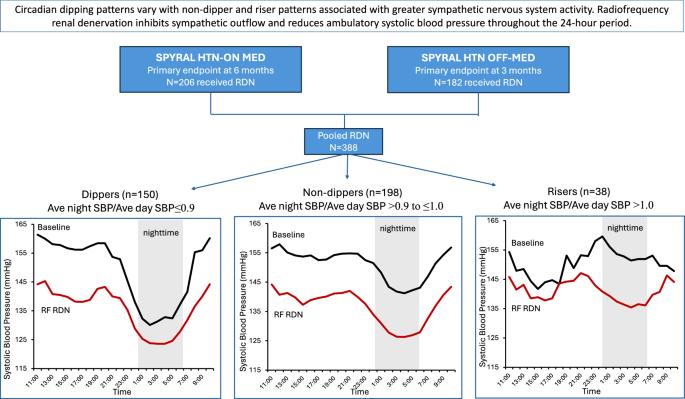
Elevated nighttime blood pressure (BP) and abnormal circadian dipping patterns are associated with advanced age and coexisting illnesses and are attributed to autonomic dysfunction. Radiofrequency renal denervation (RF RDN) effectively lowers BP throughout 24 h and thus may provide an effective antihypertensive therapeutic option. This analysis assesses the effects of RDN on nocturnal hypertension with different dipper patterns defined by nighttime/daytime BP ratio (i.e. dippers, non-dippers, risers) through 2 years in patients randomized to RDN from the SPYRAL HTN-OFF MED and -ON MED trials. Office and 24-h ambulatory BP, were also evaluated in patients stratified by age, obstructive sleep apnea (OSA), type 2 diabetes mellitus (T2DM) and chronic kidney disease (CKD). Among 388 patients, the baseline nighttime systolic BP (SBP) was 139.3 ± 11.3 mmHg. Patients with a riser pattern had the highest baseline nighttime SBP (152.7 ± 8.0 mmHg). At 2 years, patients experienced a significant reduction from baseline (p < 0.0001) in nighttime (−12.0 ± 17.1 mmHg), morning (−14.8 ± 20.0 mmHg), daytime (−13.8 ± 14.7 mmHg), and 24-h SBP (−13.4 ± 14.2 mmHg). The greatest reduction in SBP was in risers at nighttime (−23.7 ± 14.3 mmHg). RDN was equally effective in lowering nighttime BP in patients ≥65 years old or with OSA, CKD, or T2DM. In this pooled dataset of RF RDN patients, clinically meaningful reductions in BP over a 24-h period were observed through 2 years irrespective of dipping status. RF RDN may reduce the risk of cardiovascular outcomes in patients with uncontrolled hypertension, especially in those with elevated nighttime BP who may be the most challenging to treat.
期刊介绍:
Hypertension Research is the official publication of the Japanese Society of Hypertension. The journal publishes papers reporting original clinical and experimental research that contribute to the advancement of knowledge in the field of hypertension and related cardiovascular diseases. The journal publishes Review Articles, Articles, Correspondence and Comments.



 京公网安备 11010802042870号
京ICP备2023020795号-1
京公网安备 11010802042870号
京ICP备2023020795号-1

 分享
分享
 求助内容:
求助内容: 应助结果提醒方式:
 扫码关注我们
