Etiological Factors and Development of a Predictive Model for Urinary Tract Infections in Cervical Cancer Patients Undergoing Intensity-Modulated Radiotherapy.
{"title":"Etiological Factors and Development of a Predictive Model for Urinary Tract Infections in Cervical Cancer Patients Undergoing Intensity-Modulated Radiotherapy.","authors":"Ying Yao, Lijun Tao, Li Ma, Yuhan Fan, Dongju Zheng, Jian Wang, Wen Chen","doi":"10.2147/IDR.S508574","DOIUrl":null,"url":null,"abstract":"<p><strong>Objective: </strong>To investigate the distribution characteristics of pathogenic bacteria causing urinary tract infections in cervical cancer patients undergoing intensity-modulated radiotherapy (IMRT). Furthermore, to explore the risk factors and predictive factors associated with urinary tract infections, and to establish a personalized risk prediction model.</p><p><strong>Methods: </strong>A retrospective study analyzed 160 cervical cancer patients undergoing intensity-modulated radiotherapy at the People's Hospital of Ningxia Hui Autonomous Region from 2020 to 2023. The clinical characteristics of the participants were collected, and in combination with microbiological culture results, the distribution and drug resistance of pathogens causing urinary tract infections were analyzed. Using logistic regression and multivariable logistic analysis, we established a predictive model that includes clinical variables.</p><p><strong>Results: </strong>Urinary specimens were collected and analyzed from 52 patients with urinary tract infections. The incidence of urinary tract infections in cervical cancer patients after radiotherapy in this study was approximately 32.5%, with the predominant pathogens identified as <i>E. coli, E. faecalis, E. faecium</i>, and <i>P. mirabilis</i>. Invasive procedures (OR 4.202, 95% CI:1.003-17.608; <i>P</i>=0.050), history of ureteral stent insertion (OR 7.260, 95% CI:2.026-26.016; <i>P</i>=0.002), Concurrent chemotherapy (OR 2.587, 95% CI:1.010-6.623; <i>P</i>=0.048), and low serum albumin levels (OR 0.842, 95% CI:0.745-0.951; <i>P</i>=0.006) were identified as four key factors in the final predictive model. The calibration curve indicated a consistent alignment between the predicted probabilities from the nomogram model and the actual observed outcomes. With an AUC of 0.804 (95% CI: 0.727-0.881) for the ROC curve, the nomogram prediction model demonstrated strong predictive performance.</p><p><strong>Conclusion: </strong><i>E. coli</i> remains the most common pathogen causing urinary tract infections in cervical cancer patients with IMRT. The history of ureteral stent insertion, invasive procedures, concurrent chemotherapy, and serum albumin levels have been identified as independent risk factors of urinary tract infections in cervical cancer IMRT patients. The nomogram prediction model based on these factors can serve as a reference for clinicians to help prevent urinary tract infections.</p>","PeriodicalId":13577,"journal":{"name":"Infection and Drug Resistance","volume":"18 ","pages":"1637-1645"},"PeriodicalIF":2.9000,"publicationDate":"2025-03-29","publicationTypes":"Journal Article","fieldsOfStudy":null,"isOpenAccess":false,"openAccessPdf":"https://www.ncbi.nlm.nih.gov/pmc/articles/PMC11963793/pdf/","citationCount":"0","resultStr":null,"platform":"Semanticscholar","paperid":null,"PeriodicalName":"Infection and Drug Resistance","FirstCategoryId":"3","ListUrlMain":"https://doi.org/10.2147/IDR.S508574","RegionNum":3,"RegionCategory":"医学","ArticlePicture":[],"TitleCN":null,"AbstractTextCN":null,"PMCID":null,"EPubDate":"2025/1/1 0:00:00","PubModel":"eCollection","JCR":"Q2","JCRName":"INFECTIOUS DISEASES","Score":null,"Total":0}
引用次数: 0
Abstract
Objective: To investigate the distribution characteristics of pathogenic bacteria causing urinary tract infections in cervical cancer patients undergoing intensity-modulated radiotherapy (IMRT). Furthermore, to explore the risk factors and predictive factors associated with urinary tract infections, and to establish a personalized risk prediction model.
Methods: A retrospective study analyzed 160 cervical cancer patients undergoing intensity-modulated radiotherapy at the People's Hospital of Ningxia Hui Autonomous Region from 2020 to 2023. The clinical characteristics of the participants were collected, and in combination with microbiological culture results, the distribution and drug resistance of pathogens causing urinary tract infections were analyzed. Using logistic regression and multivariable logistic analysis, we established a predictive model that includes clinical variables.
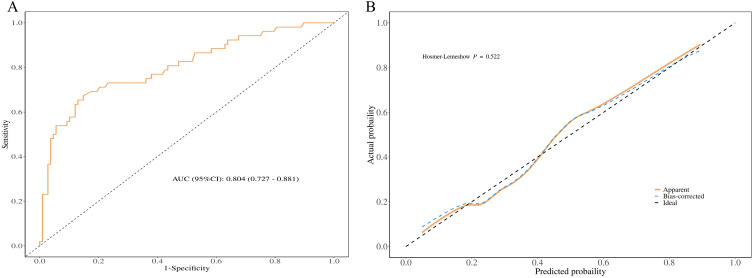
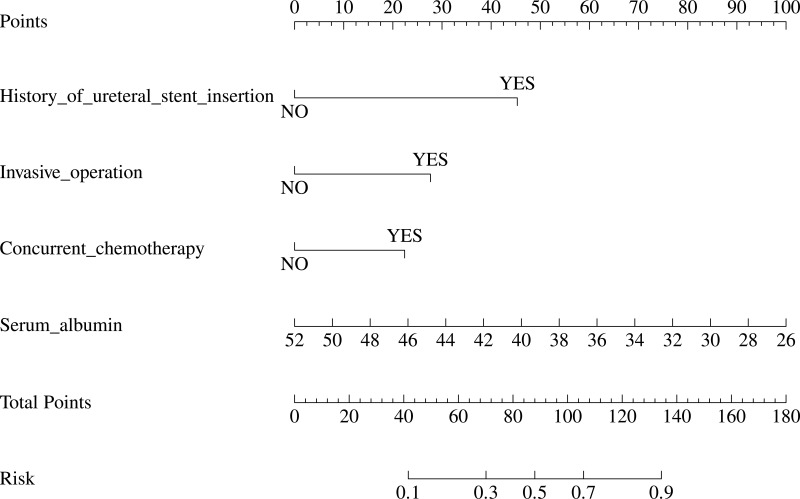
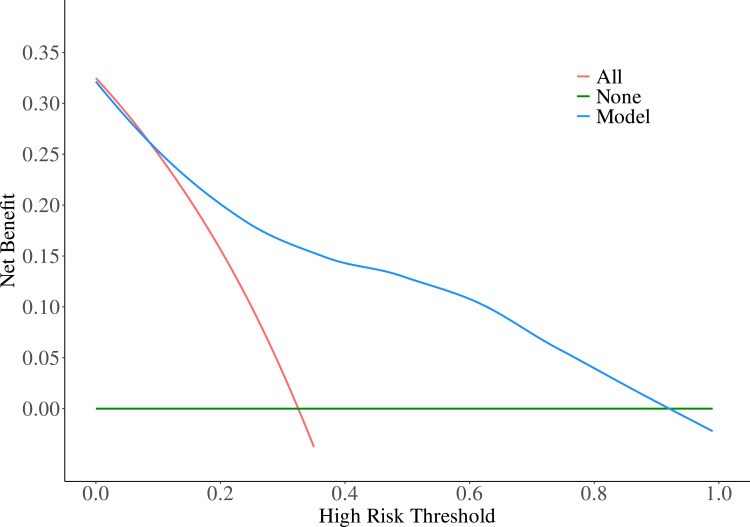
Results: Urinary specimens were collected and analyzed from 52 patients with urinary tract infections. The incidence of urinary tract infections in cervical cancer patients after radiotherapy in this study was approximately 32.5%, with the predominant pathogens identified as E. coli, E. faecalis, E. faecium, and P. mirabilis. Invasive procedures (OR 4.202, 95% CI:1.003-17.608; P=0.050), history of ureteral stent insertion (OR 7.260, 95% CI:2.026-26.016; P=0.002), Concurrent chemotherapy (OR 2.587, 95% CI:1.010-6.623; P=0.048), and low serum albumin levels (OR 0.842, 95% CI:0.745-0.951; P=0.006) were identified as four key factors in the final predictive model. The calibration curve indicated a consistent alignment between the predicted probabilities from the nomogram model and the actual observed outcomes. With an AUC of 0.804 (95% CI: 0.727-0.881) for the ROC curve, the nomogram prediction model demonstrated strong predictive performance.
Conclusion: E. coli remains the most common pathogen causing urinary tract infections in cervical cancer patients with IMRT. The history of ureteral stent insertion, invasive procedures, concurrent chemotherapy, and serum albumin levels have been identified as independent risk factors of urinary tract infections in cervical cancer IMRT patients. The nomogram prediction model based on these factors can serve as a reference for clinicians to help prevent urinary tract infections.
期刊介绍:
About Journal
Editors
Peer Reviewers
Articles
Article Publishing Charges
Aims and Scope
Call For Papers
ISSN: 1178-6973
Editor-in-Chief: Professor Suresh Antony
An international, peer-reviewed, open access journal that focuses on the optimal treatment of infection (bacterial, fungal and viral) and the development and institution of preventative strategies to minimize the development and spread of resistance.




 京公网安备 11010802042870号
京ICP备2023020795号-1
京公网安备 11010802042870号
京ICP备2023020795号-1

 分享
分享
 求助内容:
求助内容: 应助结果提醒方式:
 扫码关注我们
