{"title":"Plasma biomarkers in patients with familial cavernous malformation and their first-degree relatives: a cross-sectional study.","authors":"Chunwang Li, Shuna Huang, Qixuan Li, Lingyun Zhuo, Yaqing Kang, Penghui Liu, Weilin Huang, Ke Ma, Xinru Lin, Weiheng Zhuang, Darong Chen, Huimin Wang, Lingjun Yan, Dengliang Wang, Yuanxiang Lin, Dezhi Kang, Fuxin Lin","doi":"10.1038/s41598-025-91141-6","DOIUrl":null,"url":null,"abstract":"<p><p>Familial cerebral cavernous malformation (FCCM), especially severe cases, impose a heavy physical and psychological burden on patients and their families. To explore the differences in plasma biomarker levels between patients with FCCM and their healthy first-degree relatives (FDRs) and between FCCM patients with and without severe chronic disease aggressiveness (CDA). In a cross - sectional study, magnetic resonance imaging (MRI) scanning and genetic testing were performed in patients with multiple CCMs and their FDRs. Subsequently, sixty-seven plasma biomarkers were tested using a customised multiplex bead immunoassay kit. Univariate and multivariate unconditional logistic regression analyses were conducted to determine the associations between plasma factors and the risk of developing FCCM and severe CDA. Receiver operating characteristic (ROC) curves were generated for each independent risk factor. As a result, plasma factors of 37 patients with FCCM and 37 FDRs were examined. Low CD31 (P < 0.001) and BDNF levels (P = 0.013) were independent risk factors for FCCM. The best model was achieved by combining the results of CD31 and BDNF (AUC = 0.845, sensitivity 0.838, specificity 0.784, cutoff score - 4.295) to distinguish patients with FCCM from healthy FDRs. Low Serpin E1/PAI-1 (P = 0.011) and high ROBO4 levels (P = 0.013) were independent risk factors for severe CDA in patients with FCCM. The best model was achieved by combining the results of Serpin E1/PAI-1 and ROBO4 levels (AUC = 0.913, sensitivity 1.000, specificity 0.760, cutoff score - 0.525) to identify patients with FCCM and severe CDA. In summary, the plasma concentrations of CD31 and BDNF seem to be lower in patients with FCCM than in their healthy FDRs. Low Serpin E1/PAI-1 and high ROBO4 concentrations may be correlated with high lesion burden and risk of recurrent bleeding.Trial registration: ClinicalTrials.gov Identifier: NCT03467295.</p>","PeriodicalId":21811,"journal":{"name":"Scientific Reports","volume":"15 1","pages":"11284"},"PeriodicalIF":3.9000,"publicationDate":"2025-04-02","publicationTypes":"Journal Article","fieldsOfStudy":null,"isOpenAccess":false,"openAccessPdf":"https://www.ncbi.nlm.nih.gov/pmc/articles/PMC11965505/pdf/","citationCount":"0","resultStr":null,"platform":"Semanticscholar","paperid":null,"PeriodicalName":"Scientific Reports","FirstCategoryId":"103","ListUrlMain":"https://doi.org/10.1038/s41598-025-91141-6","RegionNum":2,"RegionCategory":"综合性期刊","ArticlePicture":[],"TitleCN":null,"AbstractTextCN":null,"PMCID":null,"EPubDate":"","PubModel":"","JCR":"Q1","JCRName":"MULTIDISCIPLINARY SCIENCES","Score":null,"Total":0}
引用次数: 0
Abstract
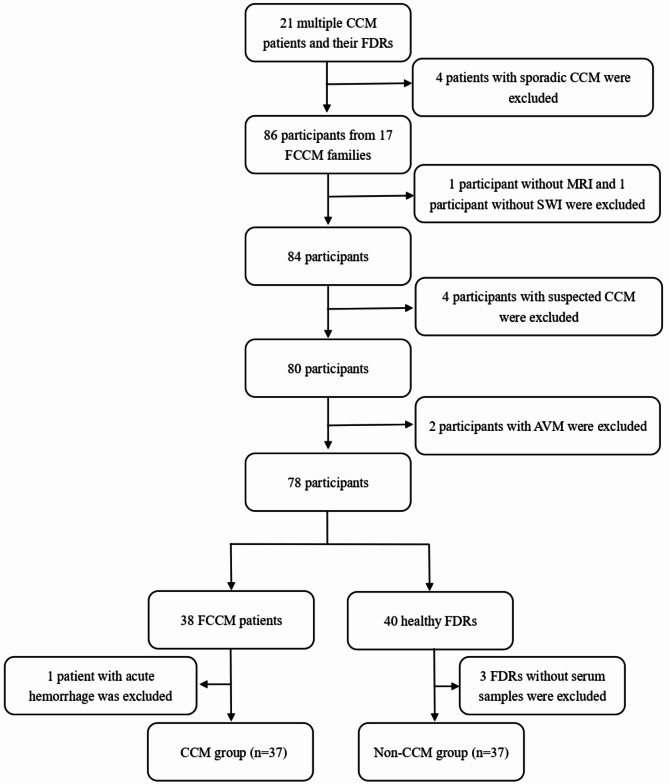
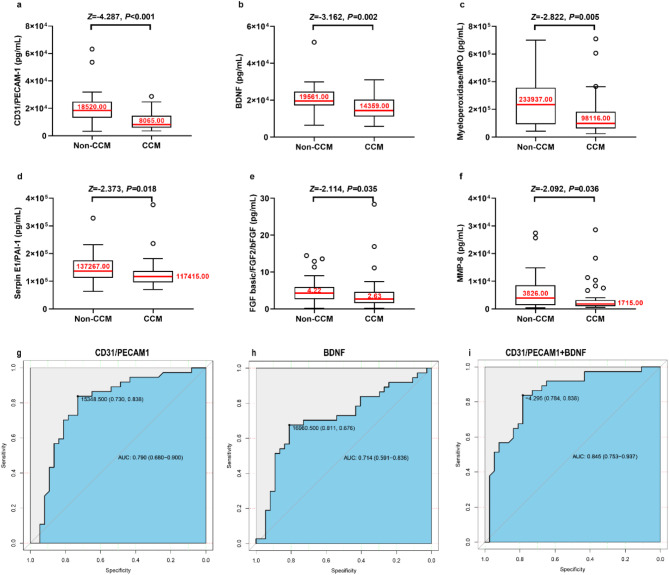
Familial cerebral cavernous malformation (FCCM), especially severe cases, impose a heavy physical and psychological burden on patients and their families. To explore the differences in plasma biomarker levels between patients with FCCM and their healthy first-degree relatives (FDRs) and between FCCM patients with and without severe chronic disease aggressiveness (CDA). In a cross - sectional study, magnetic resonance imaging (MRI) scanning and genetic testing were performed in patients with multiple CCMs and their FDRs. Subsequently, sixty-seven plasma biomarkers were tested using a customised multiplex bead immunoassay kit. Univariate and multivariate unconditional logistic regression analyses were conducted to determine the associations between plasma factors and the risk of developing FCCM and severe CDA. Receiver operating characteristic (ROC) curves were generated for each independent risk factor. As a result, plasma factors of 37 patients with FCCM and 37 FDRs were examined. Low CD31 (P < 0.001) and BDNF levels (P = 0.013) were independent risk factors for FCCM. The best model was achieved by combining the results of CD31 and BDNF (AUC = 0.845, sensitivity 0.838, specificity 0.784, cutoff score - 4.295) to distinguish patients with FCCM from healthy FDRs. Low Serpin E1/PAI-1 (P = 0.011) and high ROBO4 levels (P = 0.013) were independent risk factors for severe CDA in patients with FCCM. The best model was achieved by combining the results of Serpin E1/PAI-1 and ROBO4 levels (AUC = 0.913, sensitivity 1.000, specificity 0.760, cutoff score - 0.525) to identify patients with FCCM and severe CDA. In summary, the plasma concentrations of CD31 and BDNF seem to be lower in patients with FCCM than in their healthy FDRs. Low Serpin E1/PAI-1 and high ROBO4 concentrations may be correlated with high lesion burden and risk of recurrent bleeding.Trial registration: ClinicalTrials.gov Identifier: NCT03467295.
期刊介绍:
We publish original research from all areas of the natural sciences, psychology, medicine and engineering. You can learn more about what we publish by browsing our specific scientific subject areas below or explore Scientific Reports by browsing all articles and collections.
Scientific Reports has a 2-year impact factor: 4.380 (2021), and is the 6th most-cited journal in the world, with more than 540,000 citations in 2020 (Clarivate Analytics, 2021).
•Engineering
Engineering covers all aspects of engineering, technology, and applied science. It plays a crucial role in the development of technologies to address some of the world''s biggest challenges, helping to save lives and improve the way we live.
•Physical sciences
Physical sciences are those academic disciplines that aim to uncover the underlying laws of nature — often written in the language of mathematics. It is a collective term for areas of study including astronomy, chemistry, materials science and physics.
•Earth and environmental sciences
Earth and environmental sciences cover all aspects of Earth and planetary science and broadly encompass solid Earth processes, surface and atmospheric dynamics, Earth system history, climate and climate change, marine and freshwater systems, and ecology. It also considers the interactions between humans and these systems.
•Biological sciences
Biological sciences encompass all the divisions of natural sciences examining various aspects of vital processes. The concept includes anatomy, physiology, cell biology, biochemistry and biophysics, and covers all organisms from microorganisms, animals to plants.
•Health sciences
The health sciences study health, disease and healthcare. This field of study aims to develop knowledge, interventions and technology for use in healthcare to improve the treatment of patients.



 京公网安备 11010802042870号
京ICP备2023020795号-1
京公网安备 11010802042870号
京ICP备2023020795号-1

 分享
分享
 求助内容:
求助内容: 应助结果提醒方式:
 扫码关注我们
