{"title":"[Molecular pathology in non-small-cell lung cancer: current and emerging biomarkers].","authors":"Helen Pasternack, Jutta Kirfel","doi":"10.1007/s00292-025-01433-x","DOIUrl":null,"url":null,"abstract":"<p><p>In the classification of lung cancer, the basic division into small cell and non-small cell carcinomas continues to apply. Despite the same histological subtyping, it is known that there are defined genetic changes in the tumor cells that significantly determine tumor growth as \"drivers\", so that their blockade can significantly influence the clinical course. Thus, in the last 10 years, the treatment of lung cancer has been increasingly supplemented by the establishment of tumor-specific targeted drugs and immunomodulatory approaches. This development has led to increasingly differentiated and individualized approaches to treatment. Pathology and especially molecular pathological diagnostics play a central role here, as an increasing number of biomarkers must be examined.</p>","PeriodicalId":74402,"journal":{"name":"Pathologie (Heidelberg, Germany)","volume":" ","pages":"185-193"},"PeriodicalIF":0.6000,"publicationDate":"2025-05-01","publicationTypes":"Journal Article","fieldsOfStudy":null,"isOpenAccess":false,"openAccessPdf":"https://www.ncbi.nlm.nih.gov/pmc/articles/PMC12041048/pdf/","citationCount":"0","resultStr":null,"platform":"Semanticscholar","paperid":null,"PeriodicalName":"Pathologie (Heidelberg, Germany)","FirstCategoryId":"1085","ListUrlMain":"https://doi.org/10.1007/s00292-025-01433-x","RegionNum":0,"RegionCategory":null,"ArticlePicture":[],"TitleCN":null,"AbstractTextCN":null,"PMCID":null,"EPubDate":"2025/4/3 0:00:00","PubModel":"Epub","JCR":"","JCRName":"","Score":null,"Total":0}
引用次数: 0
Abstract
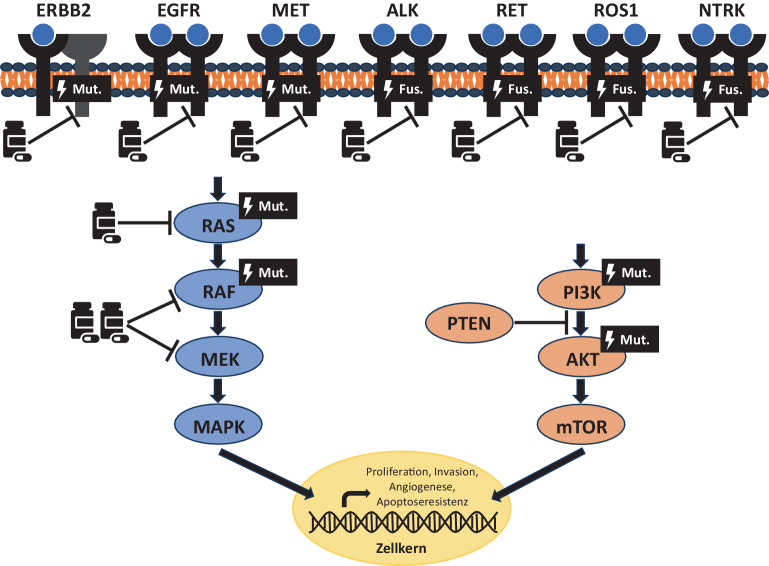
In the classification of lung cancer, the basic division into small cell and non-small cell carcinomas continues to apply. Despite the same histological subtyping, it is known that there are defined genetic changes in the tumor cells that significantly determine tumor growth as "drivers", so that their blockade can significantly influence the clinical course. Thus, in the last 10 years, the treatment of lung cancer has been increasingly supplemented by the establishment of tumor-specific targeted drugs and immunomodulatory approaches. This development has led to increasingly differentiated and individualized approaches to treatment. Pathology and especially molecular pathological diagnostics play a central role here, as an increasing number of biomarkers must be examined.




 京公网安备 11010802042870号
京ICP备2023020795号-1
京公网安备 11010802042870号
京ICP备2023020795号-1

 分享
分享

 求助内容:
求助内容: 应助结果提醒方式:
 扫码关注我们
