Le Xin, Wei Zheng, Kan Lin, Shulang Lin, Zhiwei Huang
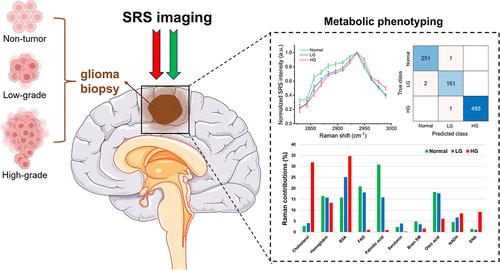
{"title":"Deciphering Metabolic Alterations Associated with Glioma Grading Using Hyperspectral Stimulated Raman Scattering Imaging","authors":"Le Xin, Wei Zheng, Kan Lin, Shulang Lin, Zhiwei Huang","doi":"10.1021/acs.analchem.4c07042","DOIUrl":null,"url":null,"abstract":"Metabolic dysregulation is a critical feature of various cancers, including brain tumors. Studying metabolic changes in tumor cells and tissues significantly improves our understanding of tumor development, progression, and treatment response. In this study, we utilize hyperspectral stimulated Raman scattering (SRS) imaging combined with biochemical spectral modeling to identify unique histological and molecular signatures linked to metabolic diversity across different glioma grades, without the need for labeling. By employing rapid label-free SRS histopathology and multivariate curve resolution analysis, we uncover changes in lipid profiles and varying levels of neuron demyelination from low-grade (LG) to high-grade (HG) gliomas. Quantitative analysis of key metabolites using non-negative least-squares regression spectral modeling reveals a significant increase in cellular proteins, DNA, and cholesterol levels, alongside a reduced redox ratio (flavin adenine dinucleotide (FAD)/NADH) in the glioblastoma (GBM, grade IV) tissue compared to pilocytic astrocytoma (PA, grade I) and healthy brain tissues, indicating a shift toward a pro-malignant metabolic state. A neural network diagnostic classifier, trained on 4547 SRS spectra (healthy: 1263; LG: 815; HG: 2469) from 45 patients with PA and GBM, achieves 99.6% accuracy in detecting and grading brain tumors. This study highlights the potential of hyperspectral SRS imaging for rapid, label-free, and spatially resolved analysis of metabolic heterogeneity in human gliomas, paving the way for metabolome-targeted therapeutic strategies in precision brain tumor treatment.","PeriodicalId":27,"journal":{"name":"Analytical Chemistry","volume":"108 1","pages":""},"PeriodicalIF":6.7000,"publicationDate":"2025-04-04","publicationTypes":"Journal Article","fieldsOfStudy":null,"isOpenAccess":false,"openAccessPdf":"","citationCount":"0","resultStr":null,"platform":"Semanticscholar","paperid":null,"PeriodicalName":"Analytical Chemistry","FirstCategoryId":"92","ListUrlMain":"https://doi.org/10.1021/acs.analchem.4c07042","RegionNum":1,"RegionCategory":"化学","ArticlePicture":[],"TitleCN":null,"AbstractTextCN":null,"PMCID":null,"EPubDate":"","PubModel":"","JCR":"Q1","JCRName":"CHEMISTRY, ANALYTICAL","Score":null,"Total":0}
引用次数: 0
Abstract
Metabolic dysregulation is a critical feature of various cancers, including brain tumors. Studying metabolic changes in tumor cells and tissues significantly improves our understanding of tumor development, progression, and treatment response. In this study, we utilize hyperspectral stimulated Raman scattering (SRS) imaging combined with biochemical spectral modeling to identify unique histological and molecular signatures linked to metabolic diversity across different glioma grades, without the need for labeling. By employing rapid label-free SRS histopathology and multivariate curve resolution analysis, we uncover changes in lipid profiles and varying levels of neuron demyelination from low-grade (LG) to high-grade (HG) gliomas. Quantitative analysis of key metabolites using non-negative least-squares regression spectral modeling reveals a significant increase in cellular proteins, DNA, and cholesterol levels, alongside a reduced redox ratio (flavin adenine dinucleotide (FAD)/NADH) in the glioblastoma (GBM, grade IV) tissue compared to pilocytic astrocytoma (PA, grade I) and healthy brain tissues, indicating a shift toward a pro-malignant metabolic state. A neural network diagnostic classifier, trained on 4547 SRS spectra (healthy: 1263; LG: 815; HG: 2469) from 45 patients with PA and GBM, achieves 99.6% accuracy in detecting and grading brain tumors. This study highlights the potential of hyperspectral SRS imaging for rapid, label-free, and spatially resolved analysis of metabolic heterogeneity in human gliomas, paving the way for metabolome-targeted therapeutic strategies in precision brain tumor treatment.
期刊介绍:
Analytical Chemistry, a peer-reviewed research journal, focuses on disseminating new and original knowledge across all branches of analytical chemistry. Fundamental articles may explore general principles of chemical measurement science and need not directly address existing or potential analytical methodology. They can be entirely theoretical or report experimental results. Contributions may cover various phases of analytical operations, including sampling, bioanalysis, electrochemistry, mass spectrometry, microscale and nanoscale systems, environmental analysis, separations, spectroscopy, chemical reactions and selectivity, instrumentation, imaging, surface analysis, and data processing. Papers discussing known analytical methods should present a significant, original application of the method, a notable improvement, or results on an important analyte.



 京公网安备 11010802042870号
京ICP备2023020795号-1
京公网安备 11010802042870号
京ICP备2023020795号-1

 分享
分享
 求助内容:
求助内容: 应助结果提醒方式:
 扫码关注我们
