Development of Proximity-Activated Programmable Multicomponent Nucleic Acid Enzymes for Simultaneous Visualization of Multiple mRNA Splicing Variants in Living Cells
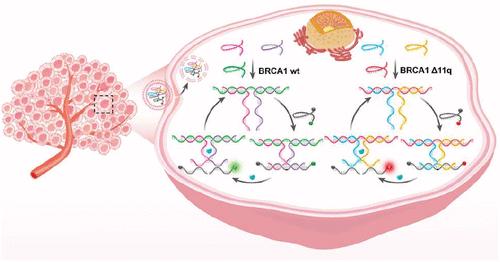
{"title":"Development of Proximity-Activated Programmable Multicomponent Nucleic Acid Enzymes for Simultaneous Visualization of Multiple mRNA Splicing Variants in Living Cells","authors":"Wen-jing Liu, Yun Han, Rui Song, Fei Ma, Chun-yang Zhang","doi":"10.1021/acs.analchem.5c01001","DOIUrl":null,"url":null,"abstract":"RNA splicing is a key regulatory process of gene expression that can increase the transcriptome complexity. Simultaneous monitoring of multiple splicing variants in living cells is critical for gaining new insight into cell development. Herein, we demonstrate the development of proximity-activated, programmable multicomponent nucleic acid enzymes (MNAzymes) for the simultaneous visualization of multiple RNA splicing variants (i.e., BRCA1 WT and BRCA1 Δ11q) in living cells. The presence of BRCA1 WT and BRCA1 Δ11q can specifically bring their corresponding partzymes into the proximity of each other to form two active MNAzyme motifs. Subsequently, the active sites of reporter probes 1 and 2 are cyclically cleaved by two activated MNAzyme motifs, respectively, to release abundant Cy3 and Cy5 fluorescent molecules, generating enhanced fluorescence signals for the simultaneous detection of BRCA1 WT and BRCA1 Δ11q <i>in vitro</i> and <i>in vivo</i>. Notably, this assay can be simply and isothermally conducted in a one-step format without the necessity for unstable protein enzymes, precise temperature control, and complex operation procedures. This method can sensitively detect 2.46 fM BRCA1 WT and 2.77 fM BRCA1 Δ11q and accurately distinguish breast cancer patients from healthy individuals by measuring target BRCA1 splicing variants from the tissue samples. Moreover, this method can real-time image BRCA1 splicing variants in living cells and can be extended to detect other cellular target RNAs (e.g., miRNAs, piRNAs, lncRNAs, and circRNAs) by simply changing the sequences of substrate arms, holding promising applications in clinical diagnosis and precise therapy.","PeriodicalId":27,"journal":{"name":"Analytical Chemistry","volume":"61 1","pages":""},"PeriodicalIF":6.7000,"publicationDate":"2025-04-03","publicationTypes":"Journal Article","fieldsOfStudy":null,"isOpenAccess":false,"openAccessPdf":"","citationCount":"0","resultStr":null,"platform":"Semanticscholar","paperid":null,"PeriodicalName":"Analytical Chemistry","FirstCategoryId":"92","ListUrlMain":"https://doi.org/10.1021/acs.analchem.5c01001","RegionNum":1,"RegionCategory":"化学","ArticlePicture":[],"TitleCN":null,"AbstractTextCN":null,"PMCID":null,"EPubDate":"","PubModel":"","JCR":"Q1","JCRName":"CHEMISTRY, ANALYTICAL","Score":null,"Total":0}
引用次数: 0
Abstract
RNA splicing is a key regulatory process of gene expression that can increase the transcriptome complexity. Simultaneous monitoring of multiple splicing variants in living cells is critical for gaining new insight into cell development. Herein, we demonstrate the development of proximity-activated, programmable multicomponent nucleic acid enzymes (MNAzymes) for the simultaneous visualization of multiple RNA splicing variants (i.e., BRCA1 WT and BRCA1 Δ11q) in living cells. The presence of BRCA1 WT and BRCA1 Δ11q can specifically bring their corresponding partzymes into the proximity of each other to form two active MNAzyme motifs. Subsequently, the active sites of reporter probes 1 and 2 are cyclically cleaved by two activated MNAzyme motifs, respectively, to release abundant Cy3 and Cy5 fluorescent molecules, generating enhanced fluorescence signals for the simultaneous detection of BRCA1 WT and BRCA1 Δ11q in vitro and in vivo. Notably, this assay can be simply and isothermally conducted in a one-step format without the necessity for unstable protein enzymes, precise temperature control, and complex operation procedures. This method can sensitively detect 2.46 fM BRCA1 WT and 2.77 fM BRCA1 Δ11q and accurately distinguish breast cancer patients from healthy individuals by measuring target BRCA1 splicing variants from the tissue samples. Moreover, this method can real-time image BRCA1 splicing variants in living cells and can be extended to detect other cellular target RNAs (e.g., miRNAs, piRNAs, lncRNAs, and circRNAs) by simply changing the sequences of substrate arms, holding promising applications in clinical diagnosis and precise therapy.
期刊介绍:
Analytical Chemistry, a peer-reviewed research journal, focuses on disseminating new and original knowledge across all branches of analytical chemistry. Fundamental articles may explore general principles of chemical measurement science and need not directly address existing or potential analytical methodology. They can be entirely theoretical or report experimental results. Contributions may cover various phases of analytical operations, including sampling, bioanalysis, electrochemistry, mass spectrometry, microscale and nanoscale systems, environmental analysis, separations, spectroscopy, chemical reactions and selectivity, instrumentation, imaging, surface analysis, and data processing. Papers discussing known analytical methods should present a significant, original application of the method, a notable improvement, or results on an important analyte.



 京公网安备 11010802042870号
京ICP备2023020795号-1
京公网安备 11010802042870号
京ICP备2023020795号-1

 分享
分享
 求助内容:
求助内容: 应助结果提醒方式:
 扫码关注我们
