{"title":"Theoretical Basis for the Highly Efficient Aptamer Selection Using Unique Molecular Identifiers","authors":"Zhenhao Long, Jingjing Yu, Tao Bing","doi":"10.1021/acs.analchem.5c00118","DOIUrl":null,"url":null,"abstract":"Rapid selection methods are crucial for promoting the discovery and application of aptamers across various fields. We previously reported a highly efficient aptamer selection strategy by using unique molecular identifiers (UMIs), enabling the efficient isolation of aptamers from a single cell by only one round. The strategy integrates an ultrasensitive DNA barcoding technology with high-throughput sequencing to accurately quantify aptamer candidates, thereby mitigating issues such as PCR bias and sequence overenrichment that are inherent in traditional multiround selection. Here, we conduct a systematically theoretical analysis of this strategy in the elucidation of the theoretical basis, advantages, and applicability. The feasibility and advantages of isolating aptamers from low-enriched DNA libraries was investigated at a theoretical level, showing that this strategy is effective in reducing nonspecific binding and thus increasing the success of selecting high-affinity aptamers. Our theoretical analysis supports the broad applicability of the strategy for the single-round aptamer selection, paving the way for its widespread adoption in high-efficiency aptamer discovery and aptamer-based cell atlas.","PeriodicalId":27,"journal":{"name":"Analytical Chemistry","volume":"73 1","pages":""},"PeriodicalIF":6.7000,"publicationDate":"2025-04-03","publicationTypes":"Journal Article","fieldsOfStudy":null,"isOpenAccess":false,"openAccessPdf":"","citationCount":"0","resultStr":null,"platform":"Semanticscholar","paperid":null,"PeriodicalName":"Analytical Chemistry","FirstCategoryId":"92","ListUrlMain":"https://doi.org/10.1021/acs.analchem.5c00118","RegionNum":1,"RegionCategory":"化学","ArticlePicture":[],"TitleCN":null,"AbstractTextCN":null,"PMCID":null,"EPubDate":"","PubModel":"","JCR":"Q1","JCRName":"CHEMISTRY, ANALYTICAL","Score":null,"Total":0}
引用次数: 0
Abstract
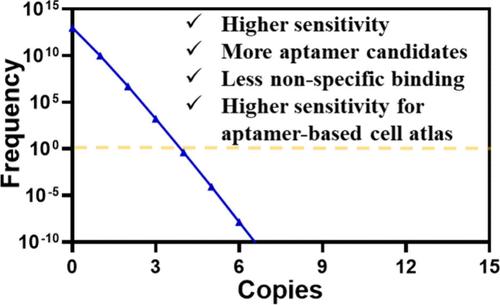
Rapid selection methods are crucial for promoting the discovery and application of aptamers across various fields. We previously reported a highly efficient aptamer selection strategy by using unique molecular identifiers (UMIs), enabling the efficient isolation of aptamers from a single cell by only one round. The strategy integrates an ultrasensitive DNA barcoding technology with high-throughput sequencing to accurately quantify aptamer candidates, thereby mitigating issues such as PCR bias and sequence overenrichment that are inherent in traditional multiround selection. Here, we conduct a systematically theoretical analysis of this strategy in the elucidation of the theoretical basis, advantages, and applicability. The feasibility and advantages of isolating aptamers from low-enriched DNA libraries was investigated at a theoretical level, showing that this strategy is effective in reducing nonspecific binding and thus increasing the success of selecting high-affinity aptamers. Our theoretical analysis supports the broad applicability of the strategy for the single-round aptamer selection, paving the way for its widespread adoption in high-efficiency aptamer discovery and aptamer-based cell atlas.
快速筛选方法对于促进各领域的适配体发现和应用至关重要。我们之前报道了一种利用独特分子标识符(UMI)的高效适配体筛选策略,只需一轮就能从单个细胞中高效分离出适配体。该策略将超灵敏 DNA 条形码技术与高通量测序技术相结合,准确量化了候选的适配体,从而缓解了传统多轮筛选中固有的 PCR 偏差和序列过度富集等问题。在此,我们对这一策略进行了系统的理论分析,以阐明其理论基础、优势和适用性。我们从理论层面研究了从低富集 DNA 文库中分离适配体的可行性和优势,结果表明这种策略能有效减少非特异性结合,从而提高选择高亲和性适配体的成功率。我们的理论分析支持该策略在单轮适配体筛选中的广泛适用性,为其在高效适配体发现和基于适配体的细胞图谱中的广泛应用铺平了道路。
期刊介绍:
Analytical Chemistry, a peer-reviewed research journal, focuses on disseminating new and original knowledge across all branches of analytical chemistry. Fundamental articles may explore general principles of chemical measurement science and need not directly address existing or potential analytical methodology. They can be entirely theoretical or report experimental results. Contributions may cover various phases of analytical operations, including sampling, bioanalysis, electrochemistry, mass spectrometry, microscale and nanoscale systems, environmental analysis, separations, spectroscopy, chemical reactions and selectivity, instrumentation, imaging, surface analysis, and data processing. Papers discussing known analytical methods should present a significant, original application of the method, a notable improvement, or results on an important analyte.



 京公网安备 11010802042870号
京ICP备2023020795号-1
京公网安备 11010802042870号
京ICP备2023020795号-1

 分享
分享
 求助内容:
求助内容: 应助结果提醒方式:
 扫码关注我们
