Heng Wang, Jingya Zhang, Chun Sun, Xinyu Zhao, Hongchao Qi, Ke Chen
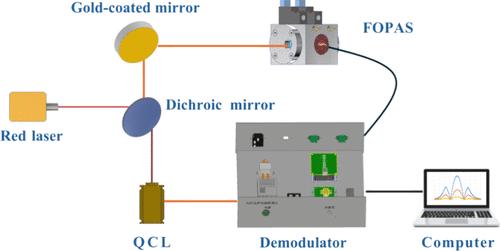
{"title":"Miniaturized Fiber-Optic Photoacoustic Gas Sensor for Sub-ppb-Level Detection of Carbon Monoxide Based on Quantum Cascade Laser and Multipass Cell","authors":"Heng Wang, Jingya Zhang, Chun Sun, Xinyu Zhao, Hongchao Qi, Ke Chen","doi":"10.1021/acs.analchem.5c01233","DOIUrl":null,"url":null,"abstract":"A high-sensitivity fiber-optic photoacoustic carbon monoxide (CO) sensor based on quantum cascade laser (QCL) and nonresonant multipass cell is proposed. By leveraging the mid-infrared fundamental band absorption, multipass absorption enhancement, and cantilever resonance frequency detection, a multimechanism synergy has been achieved to enable highly sensitive detection of CO. In the mid-infrared band, CO exhibits a strong absorption coefficient, thereby eliminating the need for a high-power optical amplifier. Furthermore, by integrating a miniaturized multipass cell, the photoacoustic signal is remarkably enhanced, enabling the miniaturization and ultrahigh sensitivity of the sensor. A pair of spherical reflectors are symmetrically installed at both ends of the photoacoustic cell to form a Herriott multipass cell. The light beam reflects 20 times within the multipass cell, creating 10 elliptically distributed light spots. The gas chamber volume of the sensor is only 1.28 mL, with an optical path length of 510 mm. The generated photoacoustic signals are measured by a fiber-optic Fabry–Perot (FP) cantilever microphone, which can detect weak signals with high sensitivity at the resonance frequency of the cantilever. The measured signal amplitude is 8.7 times that of a single reflection. When the averaging time is 100 s, the minimum detection limit of the system for CO is 0.8 ppb, corresponding to a normalized noise equivalent absorption (NNEA) coefficient of 4.94 × 10<sup>–9</sup> Wcm<sup>–1</sup>/Hz<sup>1/2</sup>.","PeriodicalId":27,"journal":{"name":"Analytical Chemistry","volume":"141 1","pages":""},"PeriodicalIF":6.7000,"publicationDate":"2025-04-03","publicationTypes":"Journal Article","fieldsOfStudy":null,"isOpenAccess":false,"openAccessPdf":"","citationCount":"0","resultStr":null,"platform":"Semanticscholar","paperid":null,"PeriodicalName":"Analytical Chemistry","FirstCategoryId":"92","ListUrlMain":"https://doi.org/10.1021/acs.analchem.5c01233","RegionNum":1,"RegionCategory":"化学","ArticlePicture":[],"TitleCN":null,"AbstractTextCN":null,"PMCID":null,"EPubDate":"","PubModel":"","JCR":"Q1","JCRName":"CHEMISTRY, ANALYTICAL","Score":null,"Total":0}
引用次数: 0
Abstract
A high-sensitivity fiber-optic photoacoustic carbon monoxide (CO) sensor based on quantum cascade laser (QCL) and nonresonant multipass cell is proposed. By leveraging the mid-infrared fundamental band absorption, multipass absorption enhancement, and cantilever resonance frequency detection, a multimechanism synergy has been achieved to enable highly sensitive detection of CO. In the mid-infrared band, CO exhibits a strong absorption coefficient, thereby eliminating the need for a high-power optical amplifier. Furthermore, by integrating a miniaturized multipass cell, the photoacoustic signal is remarkably enhanced, enabling the miniaturization and ultrahigh sensitivity of the sensor. A pair of spherical reflectors are symmetrically installed at both ends of the photoacoustic cell to form a Herriott multipass cell. The light beam reflects 20 times within the multipass cell, creating 10 elliptically distributed light spots. The gas chamber volume of the sensor is only 1.28 mL, with an optical path length of 510 mm. The generated photoacoustic signals are measured by a fiber-optic Fabry–Perot (FP) cantilever microphone, which can detect weak signals with high sensitivity at the resonance frequency of the cantilever. The measured signal amplitude is 8.7 times that of a single reflection. When the averaging time is 100 s, the minimum detection limit of the system for CO is 0.8 ppb, corresponding to a normalized noise equivalent absorption (NNEA) coefficient of 4.94 × 10⁻⁹ Wcm–1/Hz1/2.
期刊介绍:
Analytical Chemistry, a peer-reviewed research journal, focuses on disseminating new and original knowledge across all branches of analytical chemistry. Fundamental articles may explore general principles of chemical measurement science and need not directly address existing or potential analytical methodology. They can be entirely theoretical or report experimental results. Contributions may cover various phases of analytical operations, including sampling, bioanalysis, electrochemistry, mass spectrometry, microscale and nanoscale systems, environmental analysis, separations, spectroscopy, chemical reactions and selectivity, instrumentation, imaging, surface analysis, and data processing. Papers discussing known analytical methods should present a significant, original application of the method, a notable improvement, or results on an important analyte.



 京公网安备 11010802042870号
京ICP备2023020795号-1
京公网安备 11010802042870号
京ICP备2023020795号-1

 分享
分享
 求助内容:
求助内容: 应助结果提醒方式:
 扫码关注我们
