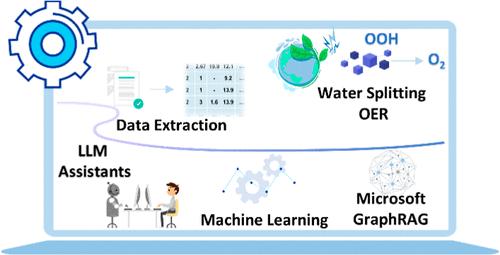
{"title":"Large Language Models Assisted Materials Development: Case of Predictive Analytics for Oxygen Evolution Reaction Catalysts of (Oxy)hydroxides","authors":"Chenyang Wei, Yutong Shi, Wenbo Mu, Hongyuan Zhang, Rui Qin, Yijun Yin, Gangqiang Yu, Tiancheng Mu","doi":"10.1021/acssuschemeng.5c00798","DOIUrl":null,"url":null,"abstract":"This study explores the transformative role of artificial intelligence (AI) and machine learning (ML) in materials science, leveraging large language models (LLMs) such as OpenAI’s ChatGPT. Focusing on (oxy)hydroxides as oxygen evolution reaction (OER) catalysts, we demonstrate how LLMs streamline data extraction, significantly reducing reliance on traditional, time-intensive methods. Using few-shot training and strategic prompting, ChatGPT achieved an extraction accuracy of approximately 0.9. The curated data set was then used to predict OER performance via the PyCaret library to evaluate various ML algorithms and a high-accuracy XGBoost regression model with accuracies above 0.9 is subsequently established. Further analysis using SHAP and Python Symbolic Regression (PySR) identified key descriptors-electrochemical double-layer capacitance, transition metal composition, support material, and d-electron count-as critical factors, consistent with established electrochemical principles. Additionally, SHAP’s extreme values for Cu and Zn suggest unconventional catalytic roles, potentially linked to Cu<sub>2</sub>O-facilitated NiOOH formation and Zn-induced electronic modulation, demonstrating the power of data-driven analysis in uncovering hidden mechanisms. To enhance literature-based insights, Microsoft’s GraphRAG technology was employed for in-depth chemical information retrieval. Overall, this study introduces an innovative, end-to-end ML framework powered by ChatGPT, promoting broader AI adoption in scientific research and bridging computational intelligence with experimental sciences.","PeriodicalId":25,"journal":{"name":"ACS Sustainable Chemistry & Engineering","volume":"80 1","pages":""},"PeriodicalIF":7.3000,"publicationDate":"2025-04-04","publicationTypes":"Journal Article","fieldsOfStudy":null,"isOpenAccess":false,"openAccessPdf":"","citationCount":"0","resultStr":null,"platform":"Semanticscholar","paperid":null,"PeriodicalName":"ACS Sustainable Chemistry & Engineering","FirstCategoryId":"92","ListUrlMain":"https://doi.org/10.1021/acssuschemeng.5c00798","RegionNum":1,"RegionCategory":"化学","ArticlePicture":[],"TitleCN":null,"AbstractTextCN":null,"PMCID":null,"EPubDate":"","PubModel":"","JCR":"Q1","JCRName":"CHEMISTRY, MULTIDISCIPLINARY","Score":null,"Total":0}
引用次数: 0
Abstract
This study explores the transformative role of artificial intelligence (AI) and machine learning (ML) in materials science, leveraging large language models (LLMs) such as OpenAI’s ChatGPT. Focusing on (oxy)hydroxides as oxygen evolution reaction (OER) catalysts, we demonstrate how LLMs streamline data extraction, significantly reducing reliance on traditional, time-intensive methods. Using few-shot training and strategic prompting, ChatGPT achieved an extraction accuracy of approximately 0.9. The curated data set was then used to predict OER performance via the PyCaret library to evaluate various ML algorithms and a high-accuracy XGBoost regression model with accuracies above 0.9 is subsequently established. Further analysis using SHAP and Python Symbolic Regression (PySR) identified key descriptors-electrochemical double-layer capacitance, transition metal composition, support material, and d-electron count-as critical factors, consistent with established electrochemical principles. Additionally, SHAP’s extreme values for Cu and Zn suggest unconventional catalytic roles, potentially linked to Cu2O-facilitated NiOOH formation and Zn-induced electronic modulation, demonstrating the power of data-driven analysis in uncovering hidden mechanisms. To enhance literature-based insights, Microsoft’s GraphRAG technology was employed for in-depth chemical information retrieval. Overall, this study introduces an innovative, end-to-end ML framework powered by ChatGPT, promoting broader AI adoption in scientific research and bridging computational intelligence with experimental sciences.
期刊介绍:
ACS Sustainable Chemistry & Engineering is a prestigious weekly peer-reviewed scientific journal published by the American Chemical Society. Dedicated to advancing the principles of green chemistry and green engineering, it covers a wide array of research topics including green chemistry, green engineering, biomass, alternative energy, and life cycle assessment.
The journal welcomes submissions in various formats, including Letters, Articles, Features, and Perspectives (Reviews), that address the challenges of sustainability in the chemical enterprise and contribute to the advancement of sustainable practices. Join us in shaping the future of sustainable chemistry and engineering.



 京公网安备 11010802042870号
京ICP备2023020795号-1
京公网安备 11010802042870号
京ICP备2023020795号-1

 分享
分享
 求助内容:
求助内容: 应助结果提醒方式:
 扫码关注我们
