{"title":"Enhanced Production of Five-Membered Ring Compounds Using a Biochar-Loaded Fe Catalyst: Catalytic Upgrading of Light Bio-Oil","authors":"Shihao Lv, Hao Xu, Weiwei Wu, Yun Yu, Jie Yang, Anjiang Gao, Yong Huang, Mudassir Hussain Tahir, Kuan Ding, Shu Zhang","doi":"10.1021/acssuschemeng.5c01547","DOIUrl":null,"url":null,"abstract":"The catalytic upgrading of light bio-oil (LB) is essential for enhancing the overall utilization of crude bio-oil. This study presents the synthesis of a biochar-loaded Fe catalyst (Fe<sub><i>n</i></sub>-STC) via a simple one-step pyrolysis method and evaluates its performance in the upgrading of LB. The Fe species were primarily loaded onto the biochar carrier in the form of iron oxides (Fe<sub>3</sub>O<sub>4</sub>/Fe<sub>2</sub>O<sub>3</sub>), which further etched the biochar carrier, resulting in a substantial alteration of its structure and aromaticity. The optimized Fe<sub>1.0</sub>-STC exhibited a substantial increase in the specific surface area and a uniform distribution of iron oxides. Notably, this catalyst significantly enhanced the selectivity for producing five-membered ring compounds, such as cyclic ketones and furans, achieving a relative abundance of 70.23%, an increase of 87.74% compared to the control group. Further examination of hydroxyacetone and 1-hydroxy-2-butanone as model compounds elucidated the mechanisms underpinning catalytic upgrading, revealing a synergistic effect that facilitated the transformation of linear short-chain ketones into high-value cyclic compounds through aldol condensation, dehydration, and cyclization reactions. These findings suggest that the Fe<sub><i>n</i></sub>-STC catalyst is a promising candidate for enhancing the quality of LB.","PeriodicalId":25,"journal":{"name":"ACS Sustainable Chemistry & Engineering","volume":"89 1","pages":""},"PeriodicalIF":7.3000,"publicationDate":"2025-04-04","publicationTypes":"Journal Article","fieldsOfStudy":null,"isOpenAccess":false,"openAccessPdf":"","citationCount":"0","resultStr":null,"platform":"Semanticscholar","paperid":null,"PeriodicalName":"ACS Sustainable Chemistry & Engineering","FirstCategoryId":"92","ListUrlMain":"https://doi.org/10.1021/acssuschemeng.5c01547","RegionNum":1,"RegionCategory":"化学","ArticlePicture":[],"TitleCN":null,"AbstractTextCN":null,"PMCID":null,"EPubDate":"","PubModel":"","JCR":"Q1","JCRName":"CHEMISTRY, MULTIDISCIPLINARY","Score":null,"Total":0}
引用次数: 0
Abstract
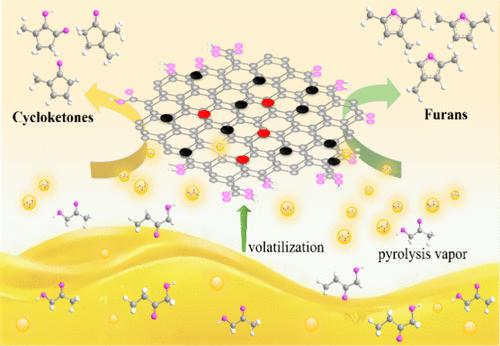
The catalytic upgrading of light bio-oil (LB) is essential for enhancing the overall utilization of crude bio-oil. This study presents the synthesis of a biochar-loaded Fe catalyst (Fen-STC) via a simple one-step pyrolysis method and evaluates its performance in the upgrading of LB. The Fe species were primarily loaded onto the biochar carrier in the form of iron oxides (Fe3O4/Fe2O3), which further etched the biochar carrier, resulting in a substantial alteration of its structure and aromaticity. The optimized Fe1.0-STC exhibited a substantial increase in the specific surface area and a uniform distribution of iron oxides. Notably, this catalyst significantly enhanced the selectivity for producing five-membered ring compounds, such as cyclic ketones and furans, achieving a relative abundance of 70.23%, an increase of 87.74% compared to the control group. Further examination of hydroxyacetone and 1-hydroxy-2-butanone as model compounds elucidated the mechanisms underpinning catalytic upgrading, revealing a synergistic effect that facilitated the transformation of linear short-chain ketones into high-value cyclic compounds through aldol condensation, dehydration, and cyclization reactions. These findings suggest that the Fen-STC catalyst is a promising candidate for enhancing the quality of LB.
期刊介绍:
ACS Sustainable Chemistry & Engineering is a prestigious weekly peer-reviewed scientific journal published by the American Chemical Society. Dedicated to advancing the principles of green chemistry and green engineering, it covers a wide array of research topics including green chemistry, green engineering, biomass, alternative energy, and life cycle assessment.
The journal welcomes submissions in various formats, including Letters, Articles, Features, and Perspectives (Reviews), that address the challenges of sustainability in the chemical enterprise and contribute to the advancement of sustainable practices. Join us in shaping the future of sustainable chemistry and engineering.



 京公网安备 11010802042870号
京ICP备2023020795号-1
京公网安备 11010802042870号
京ICP备2023020795号-1

 分享
分享
 求助内容:
求助内容: 应助结果提醒方式:
 扫码关注我们
