{"title":"Phase-Dependent Synthesis of Ru Grown on TiO2 for Solar Driven H2 Evolution","authors":"Xiangyang Cao, Xiaohu Sun, Ganghua Zhou, Yuqi Gao, Yubo Zhou, Xiaozhi Wang, Jianjian Yi","doi":"10.1021/acssuschemeng.5c00412","DOIUrl":null,"url":null,"abstract":"Crystal phase engineering provides a promising strategy for enhancing photocatalytic hydrogen evolution performance, yet the precise impact of phase structure on activity requires further exploration. In this study, hcp- and fcc-phase Ru nanoparticles were synthesized via precursor and solvent-controlled reduction processes and integrated with TiO<sub>2</sub>. Photocatalytic hydrogen evolution tests reveal that hcp-Ru/TiO<sub>2</sub> achieves the highest H<sub>2</sub> production rate of 23.52 μmol/h, surpassing fcc-Ru/TiO<sub>2</sub> (11.18 μmol/h) and bare TiO<sub>2</sub> (4.72 μmol/h). Electrochemical and photophysical analyses demonstrate that hcp-Ru/TiO<sub>2</sub> exhibits superior charge separation and transfer efficiency, as evidenced by the lowest charge transfer resistance, highest photocurrent response, and prolonged fluorescence lifetime. Theoretical calculations further confirm that hcp-Ru offers optimal hydrogen adsorption energy (Δ<i>G</i><sub>H*</sub> = −0.14 eV), contributing to reduced overpotential and enhanced catalytic activity. This work underscores the critical role of Ru crystal phases in driving photocatalytic performance and provides new insights into phase engineering for sustainable energy applications.","PeriodicalId":25,"journal":{"name":"ACS Sustainable Chemistry & Engineering","volume":"24 1","pages":""},"PeriodicalIF":7.3000,"publicationDate":"2025-04-03","publicationTypes":"Journal Article","fieldsOfStudy":null,"isOpenAccess":false,"openAccessPdf":"","citationCount":"0","resultStr":null,"platform":"Semanticscholar","paperid":null,"PeriodicalName":"ACS Sustainable Chemistry & Engineering","FirstCategoryId":"92","ListUrlMain":"https://doi.org/10.1021/acssuschemeng.5c00412","RegionNum":1,"RegionCategory":"化学","ArticlePicture":[],"TitleCN":null,"AbstractTextCN":null,"PMCID":null,"EPubDate":"","PubModel":"","JCR":"Q1","JCRName":"CHEMISTRY, MULTIDISCIPLINARY","Score":null,"Total":0}
引用次数: 0
Abstract
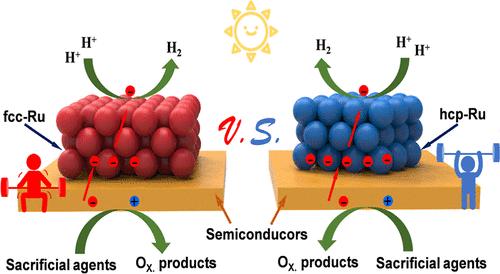
Crystal phase engineering provides a promising strategy for enhancing photocatalytic hydrogen evolution performance, yet the precise impact of phase structure on activity requires further exploration. In this study, hcp- and fcc-phase Ru nanoparticles were synthesized via precursor and solvent-controlled reduction processes and integrated with TiO2. Photocatalytic hydrogen evolution tests reveal that hcp-Ru/TiO2 achieves the highest H2 production rate of 23.52 μmol/h, surpassing fcc-Ru/TiO2 (11.18 μmol/h) and bare TiO2 (4.72 μmol/h). Electrochemical and photophysical analyses demonstrate that hcp-Ru/TiO2 exhibits superior charge separation and transfer efficiency, as evidenced by the lowest charge transfer resistance, highest photocurrent response, and prolonged fluorescence lifetime. Theoretical calculations further confirm that hcp-Ru offers optimal hydrogen adsorption energy (ΔGH* = −0.14 eV), contributing to reduced overpotential and enhanced catalytic activity. This work underscores the critical role of Ru crystal phases in driving photocatalytic performance and provides new insights into phase engineering for sustainable energy applications.
期刊介绍:
ACS Sustainable Chemistry & Engineering is a prestigious weekly peer-reviewed scientific journal published by the American Chemical Society. Dedicated to advancing the principles of green chemistry and green engineering, it covers a wide array of research topics including green chemistry, green engineering, biomass, alternative energy, and life cycle assessment.
The journal welcomes submissions in various formats, including Letters, Articles, Features, and Perspectives (Reviews), that address the challenges of sustainability in the chemical enterprise and contribute to the advancement of sustainable practices. Join us in shaping the future of sustainable chemistry and engineering.



 京公网安备 11010802042870号
京ICP备2023020795号-1
京公网安备 11010802042870号
京ICP备2023020795号-1

 分享
分享
 求助内容:
求助内容: 应助结果提醒方式:
 扫码关注我们
