{"title":"Theoretical Insights into the Impact of the Central Atom on the Photoluminescence Mechanisms of Ligand-Protected Cu Nanoclusters","authors":"Yuting Luo, Pu Wang, Yong Pei","doi":"10.1021/acs.jpclett.5c00395","DOIUrl":null,"url":null,"abstract":"Ligand-protected copper nanoclusters (CuNCs) have attracted considerable attention in both fundamental research and practical applications due to their easy availability, environmental friendliness, and exceptional optical properties. In this study, density functional theory (DFT) and time-dependent density functional theory (TD-DFT) calculations were employed to investigate the photoluminescence (PL) mechanism of two-electron (2<i>e</i>) cluster [Au@Cu<sub>14</sub>(SCH<sub>2</sub>CH<sub>3</sub>)<sub>12</sub>(P(CH<sub>2</sub>CH<sub>3</sub>)<sub>3</sub>)<sub>6</sub>]<sup>+</sup> (<b>Au@Cu</b><sub><b>14</b></sub>) and zero-electron (0<i>e</i>) cluster [Cl@Cu<sub>14</sub>(SCH<sub>2</sub>CH<sub>3</sub>)<sub>12</sub>(P(CH<sub>2</sub>CH<sub>3</sub>)<sub>3</sub>)<sub>6</sub>]<sup>+</sup> (<b>Cl@Cu</b><sub><b>14</b></sub>) to explore the impact of the central atom on the PL mechanisms of CuNCs. The accuracy of various exchange-correlation (XC) functionals used for fluorescence and phosphorescence energy calculations was evaluated. The BP86 and PBE0 functionals were used to calculate the radiative and nonradiative transition processes of the two clusters. Theoretical calculations showed that enhanced spin–orbit coupling, larger transition dipole moments, more significant orbital overlap, and smaller Huang–Rhys factors and reorganization energies were the main reasons for the higher PL quantum yield (PLQY) of <b>Au@Cu</b><sub><b>14</b></sub> than <b>Cl@Cu</b><sub><b>14</b></sub>. These findings provide important insights into the central atom effect of CuNCs and valuable guidance for their design and optimization in optical applications.","PeriodicalId":62,"journal":{"name":"The Journal of Physical Chemistry Letters","volume":"73 1","pages":""},"PeriodicalIF":4.6000,"publicationDate":"2025-04-04","publicationTypes":"Journal Article","fieldsOfStudy":null,"isOpenAccess":false,"openAccessPdf":"","citationCount":"0","resultStr":null,"platform":"Semanticscholar","paperid":null,"PeriodicalName":"The Journal of Physical Chemistry Letters","FirstCategoryId":"1","ListUrlMain":"https://doi.org/10.1021/acs.jpclett.5c00395","RegionNum":2,"RegionCategory":"化学","ArticlePicture":[],"TitleCN":null,"AbstractTextCN":null,"PMCID":null,"EPubDate":"","PubModel":"","JCR":"Q2","JCRName":"CHEMISTRY, PHYSICAL","Score":null,"Total":0}
引用次数: 0
Abstract
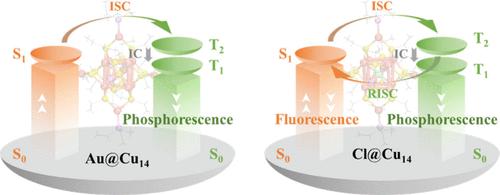
Ligand-protected copper nanoclusters (CuNCs) have attracted considerable attention in both fundamental research and practical applications due to their easy availability, environmental friendliness, and exceptional optical properties. In this study, density functional theory (DFT) and time-dependent density functional theory (TD-DFT) calculations were employed to investigate the photoluminescence (PL) mechanism of two-electron (2e) cluster [Au@Cu14(SCH2CH3)12(P(CH2CH3)3)6]+ (Au@Cu14) and zero-electron (0e) cluster [Cl@Cu14(SCH2CH3)12(P(CH2CH3)3)6]+ (Cl@Cu14) to explore the impact of the central atom on the PL mechanisms of CuNCs. The accuracy of various exchange-correlation (XC) functionals used for fluorescence and phosphorescence energy calculations was evaluated. The BP86 and PBE0 functionals were used to calculate the radiative and nonradiative transition processes of the two clusters. Theoretical calculations showed that enhanced spin–orbit coupling, larger transition dipole moments, more significant orbital overlap, and smaller Huang–Rhys factors and reorganization energies were the main reasons for the higher PL quantum yield (PLQY) of Au@Cu14 than Cl@Cu14. These findings provide important insights into the central atom effect of CuNCs and valuable guidance for their design and optimization in optical applications.
期刊介绍:
The Journal of Physical Chemistry (JPC) Letters is devoted to reporting new and original experimental and theoretical basic research of interest to physical chemists, biophysical chemists, chemical physicists, physicists, material scientists, and engineers. An important criterion for acceptance is that the paper reports a significant scientific advance and/or physical insight such that rapid publication is essential. Two issues of JPC Letters are published each month.



 京公网安备 11010802042870号
京ICP备2023020795号-1
京公网安备 11010802042870号
京ICP备2023020795号-1

 分享
分享
 求助内容:
求助内容: 应助结果提醒方式:
 扫码关注我们
