{"title":"Spiro-OMeTAD with a 1,4-Benzenedithiol Additive to Promote High-Performance Perovskite Solar Cells","authors":"Yang Hao, Jingkun Ren, Mengxue Sun, Yuan Li, Yanan Liu, Wenqiang Li, Yuying Hao","doi":"10.1021/acs.jpclett.5c00428","DOIUrl":null,"url":null,"abstract":"Small molecule material spiro-OMeTAD is widely employed as the hole transport layer (HTL) in efficient n-i-p perovskite solar cells (PSCs). However, the intrinsic poor conductivity and hole mobility of spiro-OMeTAD, coupled with its strong hygroscopic nature, severely limit the performance and lifetime of the devices. Herein, we employ a low-cost 1,4-benzenedithiol (BDT) additive to overcome the limits of pristine spiro-OMeTAD. BDT doping in spiro-OMeTAD can increase the carrier mobility and electrical conductivity. Meanwhile, because of the sulfhydryl group in BDT, the hygroscopic nature of spiro-OMeTAD is decreased. Furthermore, the trap-state density and defect-induced nonradiative recombination of the BDT-doped device are decreased. Additionally, the improved energy level alignment between the HTL and the perovskite layer facilitates more efficient hole transport. Consequently, the rigid PSC and flexible PSC doped with BDT achieve champion power conversion efficiencies (PCEs) of 22.34% and 21.04%, respectively, surpassing the PCEs of 20.83% and 19.64% obtained from the original rigid PSC and flexible PSC, respectively. Furthermore, the BDT-based devices exhibit better stability than control devices.","PeriodicalId":62,"journal":{"name":"The Journal of Physical Chemistry Letters","volume":"43 1","pages":""},"PeriodicalIF":4.6000,"publicationDate":"2025-04-04","publicationTypes":"Journal Article","fieldsOfStudy":null,"isOpenAccess":false,"openAccessPdf":"","citationCount":"0","resultStr":null,"platform":"Semanticscholar","paperid":null,"PeriodicalName":"The Journal of Physical Chemistry Letters","FirstCategoryId":"1","ListUrlMain":"https://doi.org/10.1021/acs.jpclett.5c00428","RegionNum":2,"RegionCategory":"化学","ArticlePicture":[],"TitleCN":null,"AbstractTextCN":null,"PMCID":null,"EPubDate":"","PubModel":"","JCR":"Q2","JCRName":"CHEMISTRY, PHYSICAL","Score":null,"Total":0}
引用次数: 0
Abstract
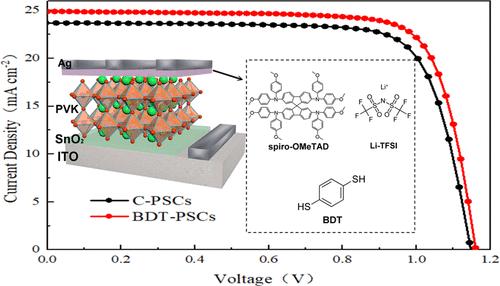
Small molecule material spiro-OMeTAD is widely employed as the hole transport layer (HTL) in efficient n-i-p perovskite solar cells (PSCs). However, the intrinsic poor conductivity and hole mobility of spiro-OMeTAD, coupled with its strong hygroscopic nature, severely limit the performance and lifetime of the devices. Herein, we employ a low-cost 1,4-benzenedithiol (BDT) additive to overcome the limits of pristine spiro-OMeTAD. BDT doping in spiro-OMeTAD can increase the carrier mobility and electrical conductivity. Meanwhile, because of the sulfhydryl group in BDT, the hygroscopic nature of spiro-OMeTAD is decreased. Furthermore, the trap-state density and defect-induced nonradiative recombination of the BDT-doped device are decreased. Additionally, the improved energy level alignment between the HTL and the perovskite layer facilitates more efficient hole transport. Consequently, the rigid PSC and flexible PSC doped with BDT achieve champion power conversion efficiencies (PCEs) of 22.34% and 21.04%, respectively, surpassing the PCEs of 20.83% and 19.64% obtained from the original rigid PSC and flexible PSC, respectively. Furthermore, the BDT-based devices exhibit better stability than control devices.
期刊介绍:
The Journal of Physical Chemistry (JPC) Letters is devoted to reporting new and original experimental and theoretical basic research of interest to physical chemists, biophysical chemists, chemical physicists, physicists, material scientists, and engineers. An important criterion for acceptance is that the paper reports a significant scientific advance and/or physical insight such that rapid publication is essential. Two issues of JPC Letters are published each month.



 京公网安备 11010802042870号
京ICP备2023020795号-1
京公网安备 11010802042870号
京ICP备2023020795号-1

 分享
分享
 求助内容:
求助内容: 应助结果提醒方式:
 扫码关注我们
