Stefanie M. Müller, Benjamin R. Nelson, Rita Höller, Christoph Waly, Alexander Jelinek, Bruce E. Kirkpatrick, Sean P. Keyser, Christoph Naderer, Dmitry Sivun, Jaroslaw Jacak, Kristi S. Anseth, Christopher N. Bowman, Sandra Schlögl, Thomas Griesser
{"title":"Chalcones as Wavelength-Selective Cross-Linkers: Multimaterial Additive Manufacturing of Macro- and Microscopic Soft Active Devices","authors":"Stefanie M. Müller, Benjamin R. Nelson, Rita Höller, Christoph Waly, Alexander Jelinek, Bruce E. Kirkpatrick, Sean P. Keyser, Christoph Naderer, Dmitry Sivun, Jaroslaw Jacak, Kristi S. Anseth, Christopher N. Bowman, Sandra Schlögl, Thomas Griesser","doi":"10.1021/acs.chemmater.4c02450","DOIUrl":null,"url":null,"abstract":"Photopolymerization-driven additive manufacturing (AM) is a well-established technique to generate polymeric 3D structures with both high resolution and formation in complex geometries. Recent approaches focus on AM techniques that enable multiproperty architectures using wavelength orthogonal photochemistry. Herein, a dual-cure, single-vat resin was developed, based on the radical photopolymerization of a thiol-methacrylate monomer system containing covalently bound chalcone moieties as dimerizable cross-linkers. Thermo-mechanical properties were spatially and systematically controlled via the wavelength-selective [2 + 2] cycloaddition reaction of the chalcone groups. Reaction kinetics were studied with infrared and ultraviolet–visible spectroscopy to ensure sequence-dependent λ-orthogonality during the two-stage illumination process. 3D-structures were fabricated by dynamic light processing (DLP), imprinting, and two-photon lithography (TPL). In particular, the ability to excite both the radical photoinitiator and the chalcone groups separately with TPL in high spatial resolution enabled the production of multifunctional microstructures and represents a versatile concept for the fabrication of soft active devices along various length scales.","PeriodicalId":33,"journal":{"name":"Chemistry of Materials","volume":"22 1","pages":""},"PeriodicalIF":7.0000,"publicationDate":"2025-04-03","publicationTypes":"Journal Article","fieldsOfStudy":null,"isOpenAccess":false,"openAccessPdf":"","citationCount":"0","resultStr":null,"platform":"Semanticscholar","paperid":null,"PeriodicalName":"Chemistry of Materials","FirstCategoryId":"88","ListUrlMain":"https://doi.org/10.1021/acs.chemmater.4c02450","RegionNum":2,"RegionCategory":"材料科学","ArticlePicture":[],"TitleCN":null,"AbstractTextCN":null,"PMCID":null,"EPubDate":"","PubModel":"","JCR":"Q2","JCRName":"CHEMISTRY, PHYSICAL","Score":null,"Total":0}
引用次数: 0
Abstract
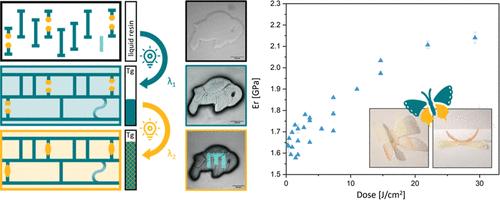
Photopolymerization-driven additive manufacturing (AM) is a well-established technique to generate polymeric 3D structures with both high resolution and formation in complex geometries. Recent approaches focus on AM techniques that enable multiproperty architectures using wavelength orthogonal photochemistry. Herein, a dual-cure, single-vat resin was developed, based on the radical photopolymerization of a thiol-methacrylate monomer system containing covalently bound chalcone moieties as dimerizable cross-linkers. Thermo-mechanical properties were spatially and systematically controlled via the wavelength-selective [2 + 2] cycloaddition reaction of the chalcone groups. Reaction kinetics were studied with infrared and ultraviolet–visible spectroscopy to ensure sequence-dependent λ-orthogonality during the two-stage illumination process. 3D-structures were fabricated by dynamic light processing (DLP), imprinting, and two-photon lithography (TPL). In particular, the ability to excite both the radical photoinitiator and the chalcone groups separately with TPL in high spatial resolution enabled the production of multifunctional microstructures and represents a versatile concept for the fabrication of soft active devices along various length scales.
期刊介绍:
The journal Chemistry of Materials focuses on publishing original research at the intersection of materials science and chemistry. The studies published in the journal involve chemistry as a prominent component and explore topics such as the design, synthesis, characterization, processing, understanding, and application of functional or potentially functional materials. The journal covers various areas of interest, including inorganic and organic solid-state chemistry, nanomaterials, biomaterials, thin films and polymers, and composite/hybrid materials. The journal particularly seeks papers that highlight the creation or development of innovative materials with novel optical, electrical, magnetic, catalytic, or mechanical properties. It is essential that manuscripts on these topics have a primary focus on the chemistry of materials and represent a significant advancement compared to prior research. Before external reviews are sought, submitted manuscripts undergo a review process by a minimum of two editors to ensure their appropriateness for the journal and the presence of sufficient evidence of a significant advance that will be of broad interest to the materials chemistry community.



 京公网安备 11010802042870号
京ICP备2023020795号-1
京公网安备 11010802042870号
京ICP备2023020795号-1

 分享
分享
 求助内容:
求助内容: 应助结果提醒方式:
 扫码关注我们
